
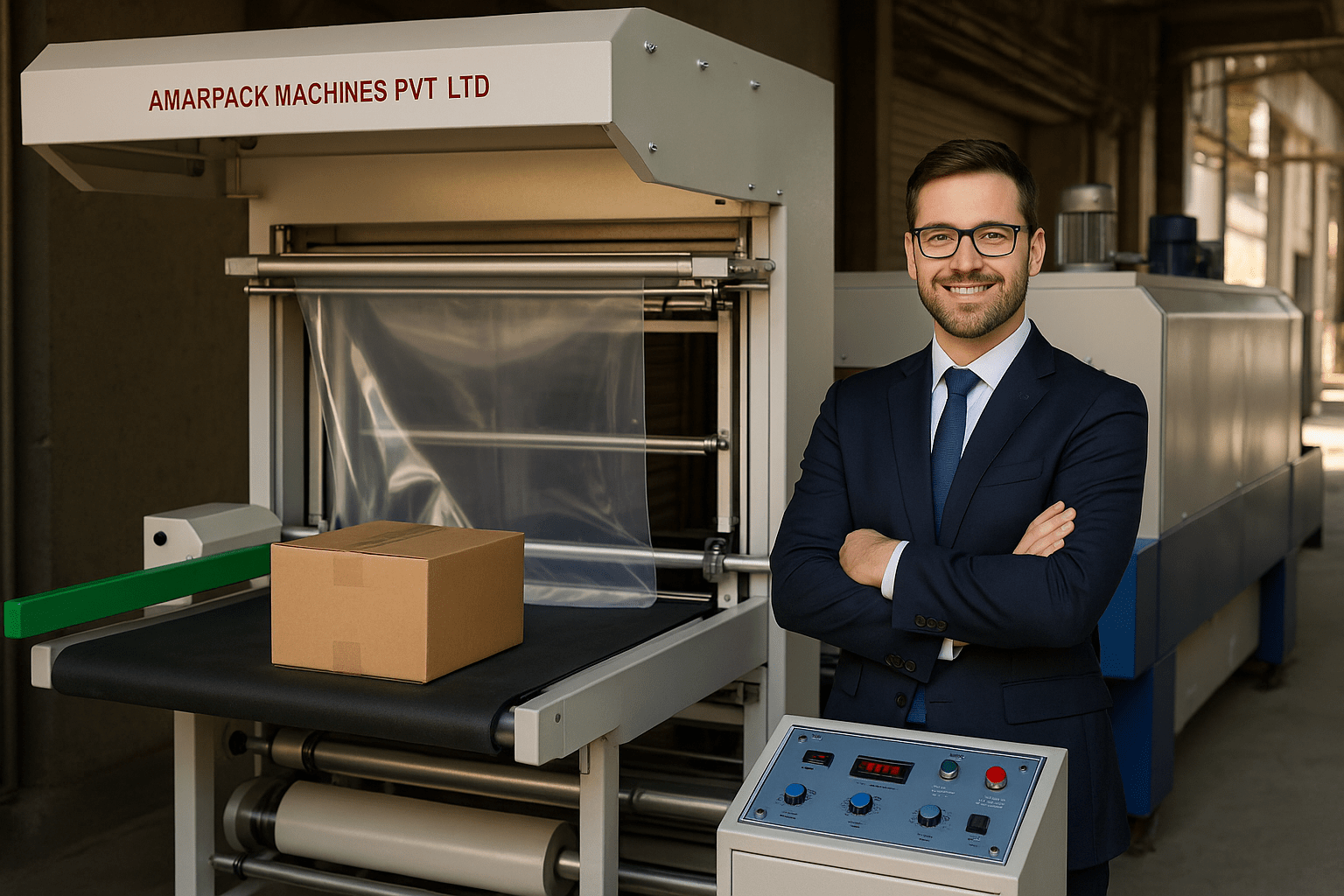
Guide to Choosing the Right Shrink Wrapping Machine for Your Business Selecting Shrink Wrapping Machine for Your Business is a mission-critical decision for industrial manufacturers and production facilities across India. The equipment you choose directly influences packaging speeds, costs, product protection, and the ability to meet rigorous industry standards for hygiene and compliance. AmarPack Machines, with over 27 years of engineering experience, provides a certified, reliable, and customizable range of shrink wrapping solutions for FMCG, pharmaceuticals, food and beverage, logistics, chemicals, and more. This technical buyer’s guide is designed for production managers, packaging engineers, logistics coordinators, and procurement teams responsible for specifying or upgrading shrink wrapping lines. With an emphasis on AmarPack’s depth in Shrink Wrapping Machine design, shrink tunnel technology, web and L-sealers, and packaging line automation, this guide equips you to make informed decisions for both domestic and international operations. Whether your packaging needs involve high-speed automated lines, stable multipack bundling, or secure secondary packaging with low downtime, understanding the core machinery types, film choices, and operational requirements will yield long-term value. AmarPack’s solutions are engineered for reliability and efficiency, fully compliant with ISO 9001:2015 and CE standards, supporting customers across India and overseas. Learn about AmarPack’s engineering experience and certifications to benchmark their commitment to quality manufacturing and industry compliance. Understanding Shrink Wrapping Machines and Their Functions Shrink wrapping integrates two main processes: sealing a product inside a shrink film, and then applying heat so the film contracts tightly around the item. This approach ensures protection from dust and physical handling, provides tamper resistance, and is widely used for both primary and secondary packaging. How sealing and heat shrinking operate together: The product is placed inside a plastic film, often as a centerfold or tube. A seal bar (in L, side, or straight configuration) trims and seals the film, enclosing the product. The sealed pack enters a heated tunnel where precise temperature and airflow cause the film to shrink uniformly around the product, resulting in a tight, visually appealing wrap. Key points distinguishing shrink wrapping from stretch wrapping: Shrink wrapping involves heat to contract film, making it suitable for retail packs, grouped items, and industrial bundles. Stretch wrapping relies on film tension (without heat) and typically stabilizes large, palletized shipments. Shrink wrapping offers a reliable, tamper-resistant finish and supports scalability – from small, manual lines to high-output automated systems. Types of Shrink Wrapping Machines Available Industrial shrink wrapping machines come in multiple configurations suited to different production scales and packaging formats. Choosing the correct model depends on your automation needs, throughput targets, and range of packaged products. Manual and Chamber Shrink Wrapping Machines: Operation and Typical Applications Operated by a single user for each cycle. Suitable for businesses with low daily output, frequent product changes, or variable pack sizes. The sealing and shrinking steps may happen together within a single heated chamber. Used by small factories, start-ups, or those offering diverse packaging solutions. L-Bar Sealers Combined with Shrink Tunnels for Flexible Packaging Lines An L-bar sealer forms two seals around the product in one movement, suitable for consistent pack dimensions. The sealed package then travels through a dedicated shrink tunnel machine that applies controlled heat, tightening the film. Configurations range from manual and semi-automatic to fully automatic for different throughput requirements. Ideal for retail units, promotional packs, and industries needing both single-item packaging and multipack options. The Semi-Automatic Web Sealer Machine ideal for box bundling enables streamlined, secure, and cost-effective bundling of boxes, bottles, and trays in medium to high-volume lines. Continuous Side-Seal Machines: Best for Steady, High-Volume Runs Designed for continuous operation, handling variable-length products with consistent width. Utilizes a side-sealing bar and conveyor feed for uninterrupted flow. Suitable for facilities requiring high outputs – typically 40 to over 100 packs per minute. Popular for applications with uniform product flows and for integrating into automated lines. Sleeve or Bundle Wrapping Solutions for Multipacks and Grouped Products Applies an open-ended film sleeve that forms “bullseye” bundling – common for trays, bottle packs, and collated items. Seals are created along the sides or ends, with intentionally open holes suitable for secondary packaging. Delivers high throughput and is cost-effective for larger bundles and distribution packs. Machine Type Automation Level Typical Speed (packs/min) Best Use Cases Manual/Chamber Manual 2–8 Small businesses, diversified products L-bar Sealer + Tunnel Semi/Automatic 5–40 Medium-scale lines, multipacks, retail Continuous Side-Seal Automatic 40–150+ High-speed, variable lengths Sleeve/Bundle Wrapper Automatic Up to 150+ Bundles, trays, distribution packs Explore AmarPack’s range of shrink wrapping machines to see detailed configurations for each machine type. For box and carton applications, the Semi-Automatic Web Sealer Machine ideal for box bundling stands out for its professional results and operational cost-efficiency. For products requiring stability and precise alignment, the Slate Chain Shrink Tunnel Machine for stable packaging offers engineered performance on high-speed lines with minimal vibration. How to Choose the Best Shrink Wrapping Machine for Your Business Making the best investment in shrink wrapping machinery requires a thorough assessment of your packaging line, ongoing needs, and potential future expansion. Use this framework to streamline your decision. 1. Evaluating Product Dimensions, Shape, and Sensitivity Identify all item sizes (min/max), including irregular or fragile products. Factor in tolerance for heat, susceptibility to pressure, and edge sharpness. 2. Calculating Required Throughput for Peak and Sustained Production Set clear targets: maximum packs per hour/day, including changeover and downtime. Distinguish between catalog machine speeds and real-world, consistently achievable rates. 3. Aligning Machine Automation Levels with Workflow and Staffing Semi-automatic machines balance flexibility and manpower; operators load and position products but enjoy automation for sealing and shrinking. Fully automatic models automate feeding, positioning, sealing, and sometimes even collating or grouping, reducing staffing costs and increasing line speed. 4. Selecting Shrink Film Types Compatible with Machine Options Match film composition (LDPE, polyolefin, PVC), width, and thickness with both your products and the machine’s sealing technology. Confirm the film is suitable for the sealing bar style and tunnel temperature control available on your line. 5. Inspecting Sealing Capacity, Tunnel Dimensions,
Automatic Shrink Wrapping Machin – Expert Guide for Selection, Compatibility, and Line Integration
Automatic Shrink Wrapping Machine – Expert Guide for Selection, Compatibility, and Line Integration Date: 09 Oct, 2026 | Written by : Amarnath Sharma An automatic shrink wrapping machine automates product feeding, film wrapping, sealing, cutting, and shrinking. It is widely used for cartons, bottles, food products, cosmetics, pharmaceutical products, and industrial packaging. Choosing the right machine depends on more than production speed. Product size, film type, sealing method, shrink tunnel capacity, and production-line integration all affect the final packaging quality and machine performance. An automatic shrink wrapping machine achieves maximum line efficiency (25 to 60+ packs per minute) only when three interdependent variables align: “dwell time, blade seal temperature, and tunnel airflow velocity.” Deviations in these settings cause 85% of packaging line failures—such as burn-through, “dog ears,” or film slippage. This technical guide outlines operational benchmarks, diagnostic tables for common packaging defects, and film-yield formulas to help plant managers optimize uptime and minimize consumable waste. How to Choose an Automatic Shrink Wrapping Machine Dimensions & Mass: Length, width, height, and unit weight. Line Output: Target speed in packs per minute (PPM). Film Spec: POF (retail) vs. LDPE (heavy-duty transit). SKU Diversity: Number of box sizes and required changeover speed. Site Limits: Conveyor speeds, layout footprint, and electrical load. Intermittent vs. Continuous Motion Shrink Wrapping Machines Parameter Intermittent Motion Continuous Motion Typical application Lower/medium-speed packaging High-speed production Product movement Periodic indexing Continuous movement Sealing L-bar / intermittent sealing Continuous side seal + cross seal Typical speed Approx. 20–45 PPM Approx. 50–120+ PPM Machine complexity Moderate Higher Changeover Generally simpler More sophisticated Best suited for Cartons, boxes, retail packs Bottles, multipacks, high-volume production Actual speed depends on product dimensions, film, package configuration, machine design, and upstream line speed. Technical Parameter Matrix: Film Chemistry vs. Machine Calibration Shrink film performance changes drastically depending on polymer density. Setting incorrect tunnel temperatures or conveyor speeds results in structural weak points or incomplete shrinkage. Film Type Gauge Range Typical Seal Bar Temp (°C) Tunnel Air Temp (°C) Optimal Conveyor Speed (m/min) Primary Applications POF (Polyolefin) 12 – 25 µm 140°C – 165°C 150°C – 180°C 12 – 20 Cosmetics, Retail Multi-Packs, Food Boxes LDPE (Polyethylene) 35 – 100+ µm 180°C – 220°C 180°C – 230°C 6 – 12 Beverage Cans/Bottles, Heavy Cartons, Trays PVC (Cross-linked) 15 – 30 µm 130°C – 150°C 130°C – 160°C 10 – 16 Hardware, Stationery, CD/DVD Bundles To calculate the ideal center-folded shrink film size for your product, use these standard sizing formulas: Film Width: Product Width + Product Height + Clearance (25 mm to 40 mm) Cut Length: Product Length + Product Height + 30 mm The clearance ensures smooth feeding around the product without tearing, while the extra 30 mm on the cut length protects the seal bar from clipping the edges. Trimming just 15–20 mm of excess film width saves 1 to 2 grams of plastic per package. On an automatic line running 45 packs per minute for two shifts, that small adjustment eliminates over 15 tons of film waste annually—saving tens of thousands of dollars in consumable costs per machine. How Do You Choose Between a Manual Shrink Wrapping Machine and an Automatic Shrink Wrapping Machine? When upgrading from manual hand-held wrapping devices, plant managers often debate between an entry-level manual shrink wrapping machine and a fully automated line. The choice depends entirely on your daily production volume, budget, and labor constraints. A manual setup, such as a manual sleeve wrapper or L-sealer, is highly affordable and space-saving. It is strictly limited to low-volume operations where operators manually pull down a sealing bar. If your production requires a flexible, entry-level industrial setup, starting with portable shrink wrapping machines allows your operators to feed products manually while the machine handles high-speed shrinking. For high-volume, growing production lines, an automatic shrink wrapping machine is essential. A fully automatic L-sealer or automatic sleeve wrapper runs continuously without requiring constant operator intervention. This setup eliminates manual labor bottlenecks, drastically increases packaging speed, and reduces plastic film wastage. Integrating Automatic Shrink Wrappers into Existing Packaging Lines A high-performance automatic shrink wrapping machine must work seamlessly with upstream and downstream equipment. Integrating infeed pacing sensors, synchronized conveyors, accurate product spacing, and controlled discharge prevents product collisions, film misalignment, and sealing defects. For high-speed production lines, servo-driven systems ensure precise product positioning and repeatable motion, while integrated PLC and HMI controls simplify recipe management, real-time diagnostics, and SKU changeovers. Key Steps for Conveyor Synchronization When transitioning from manual or semi-automatic stations to an automated line, follow these three conveyor synchronization steps: Infeed Pacing: Install optical indexing sensors to space products 50–100 mm apart before the infeed belt reaches the sealer photo-eye. Discharge Alignment: Avoid drop transfers into the shrink tunnel. Use continuous live-roller transfers to prevent shifting or distortion of the un-shrunk, loose pouch. Outfeed Cooling: Integrate passive ambient cooling fans over the outfeed conveyor to set the film polymer before manual handling or automated carton packing. Why Choose a Local Manufacturer for Your Shrink Wrapping Solutions in India? While importing cheap, generic packaging machinery might seem attractive initially, it frequently leads to severe operational headaches. A single broken conveyor belt or a faulty heating element can shut down your entire dispatch line for days. Partnering with an established, local Automatic Shrink Wrapping Machine manufacturer in India offers several critical advantages: Custom Engineering: Industrial packaging is rarely one-size-fits-all. A local manufacturer can customize conveyor heights, tunnel dimensions, and sealing bar lengths to integrate seamlessly into your existing factory floor. On-Site Technical Support: If a technical issue arises, having access to rapid, on-site service engineers in major manufacturing hubs like Mumbai ensures your downtime is measured in hours, not weeks. Ready Spare Parts: Sourcing replacement heating elements, Teflon-coated sealing blades, and conveyor belts locally eliminates long customs delays and high air-freight costs. Compliance and Standardization: Local manufacturers design machines to handle Indian power grid fluctuations and comply with domestic safety regulations, guaranteeing a safer work environment for your operators. Frequently Asked Questions How does an automatic shrink wrapping machine work? The
Web Sealer Machine: Parts, Working & How to Choose the Right Machine
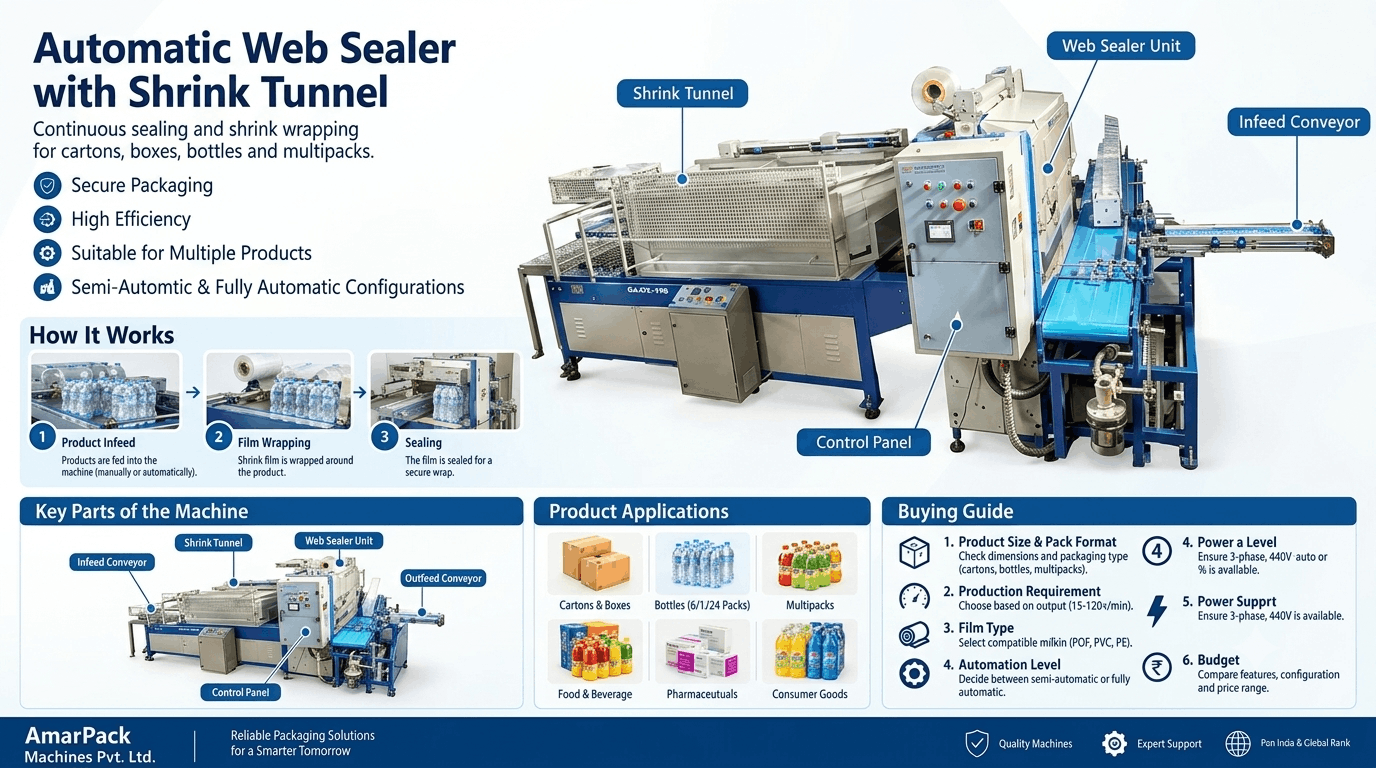
Web Sealer Machine: Parts, Working & How to Choose the Right Machine A web sealer machine is an industrial packaging machine used to seal shrink film around products or grouped products as part of a shrink packaging process. It is commonly used for cartons, boxes, bottles, multipacks, trays and other suitable products where consistent sealing and continuous product movement are required.The right web sealer depends on factors such as product dimensions, final pack configuration, film type and thickness, required production output, automation level and production-line requirements.Understanding how a web sealer works, its main components and the factors involved in machine selection can help manufacturers choose a suitable packaging configuration What Is a Web Sealer Machine? A web sealer machine feeds shrink film around a product or product group and creates a sealed film package. When connected to a shrink tunnel, the sealed pack then passes through controlled heat and airflow to shrink the film around the product. Depending on the machine configuration and application, web sealing systems can be used for: Cartons and boxes Bottles and bottle multipacks FMCG products Trays and grouped products Industrial products Other products suitable for shrink-film packaging The exact machine configuration depends on the product size, pack arrangement, film specification, required output and production process. Main Parts of a Web Sealer Machine Machine Part Function Film Roll Holder Holds and feeds the shrink film into the machine. Film Guide / Rollers Guides the film smoothly through the sealing section. Infeed Conveyor Carries products into the sealing area and maintains product movement. Sealing Bar / Sealing Assembly Applies controlled heat to create the required film seal. Teflon Tape / Cover Helps prevent the heated sealing surface from sticking to the film. Pneumatic System Operates pneumatic machine movements where applicable using components such as cylinders, tubing, fittings and solenoid valves. Heater System Provides controlled heat to the sealing assembly according to the machine configuration and film requirements. Control Panel Controls machine operation and adjustable parameters such as temperature and operating speed. Outfeed Conveyor Transfers the sealed product toward the shrink tunnel or discharge section. When a web sealer is supplied as an integrated web sealer with shrink tunnel, the shrink tunnel forms the next stage of the packaging system. Shrink Tunnel The shrink tunnel applies controlled heat and airflow to shrink the sealed film around the product. The tunnel is a separate stage from the sealing process, although both machines can be connected into one continuous packaging system. Semi-Automatic vs Automatic Web Sealer The appropriate automation level depends on product flow, operator involvement, required output and production-line integration. Factor Semi-Automatic Automatic Product Feeding Operator-assisted Automatic or integrated Operator Involvement Higher Lower Product Variation Suitable for varied products and batches Suitable for defined and continuous product flows Line Integration Can be used as a standalone system Can be integrated with production lines Production Process Batch or moderate production Continuous packaging applications Actual machine selection should be based onproduct characteristics, required output, pack configuration andline requirements, rather than production volume alone. How to Choose the Right Web Sealer Machine Before purchasing a web sealer machine, evaluate the following factors. 1. Product and Pack Dimensions Measure the final pack length, width and height,including the product arrangement, tray or grouping configuration. For multipacks, the dimensions of the final grouped pack are particularlyimportant because they influence the required sealing and film-handlingconfiguration. 2. Pack Configuration Determine how the products will be packaged. Examples include: Individual products Cartons Trays 6-packs 12-packs 24-packs Other grouped products The pack arrangement should be clearly defined before selecting themachine. 3. Film Type Confirm the film recommended for the selected machine and application. Depending on the machine configuration and packaging requirement,commonly used shrink films may include: POF PVC PE / LDPE Film compatibility should always be checked with the machine manufacturer. 4. Film Thickness Film thickness can affectsealing performance, shrink behavior and overall packagingresults. Before selecting the machine, confirm the required film thickness rangeand ensure that the sealing system is suitable for the selected film. 5. Required Production Output Define the required production rate in: Packs per minute Packs per hour The required output should be evaluated together withproduct dimensions, pack arrangement, product spacing and machineconfiguration. 6. Sealing Capacity The required sealing width and product clearance should be checkedagainst the machine’s sealing assembly and film width. The final pack dimensions and film arrangement should be evaluated todetermine whether the selected machine can accommodate the application. 7. Automation Level Determine whether your production requires: Semi-automatic operation Automatic web sealing Web sealer with shrink tunnel Integration with an existing production line Automation should be selected according to the required product flow andoperator involvement. 8. Conveyor Requirements For production-line applications, consider: Conveyor width Conveyor height Product orientation Product spacing Infeed direction Outfeed direction Connection with existing equipment These factors are particularly important when integrating the web sealerwith upstream or downstream machinery. 9. Available Installation Space Check the available space before finalizing the machine. Consider: Machine footprint Infeed and outfeed space Operator access Maintenance clearance Conveyor direction Electrical connection requirements A proper site assessment can help avoid installation problems afterdelivery. 10. After-Sales Support After-sales support is an important consideration for industrialpackaging equipment. Check the availability of: Spare parts Installation assistance Operator training Technical support Maintenance assistance A machine should be evaluated not only on its initial configuration butalso on the support available throughout its operating life. Web Sealer with Shrink Tunnel A web sealer with shrink tunnel combines the sealing and shrinking stages into a connected packaging system.After the film is sealed, the product moves into the shrink tunnel, where controlled heat and airflow shrink the film around the product.This type of configuration can be suitable for continuous packaging applications involving: Cartons Boxes Bottles Bottle multipacks Trays Grouped products The required configuration depends on the product dimensions, pack arrangement, film specification, production output and available installation space. Web Sealer Machine Manufacturer in India AmarPack Machines Pvt. Ltd. manufactures web sealing and shrink packaging systems in India. The suitable machine configuration
Web Sealer, L-Sealer or Sleeve Shrink Machine? How to Choose the Right Shrink Wrapping Machine
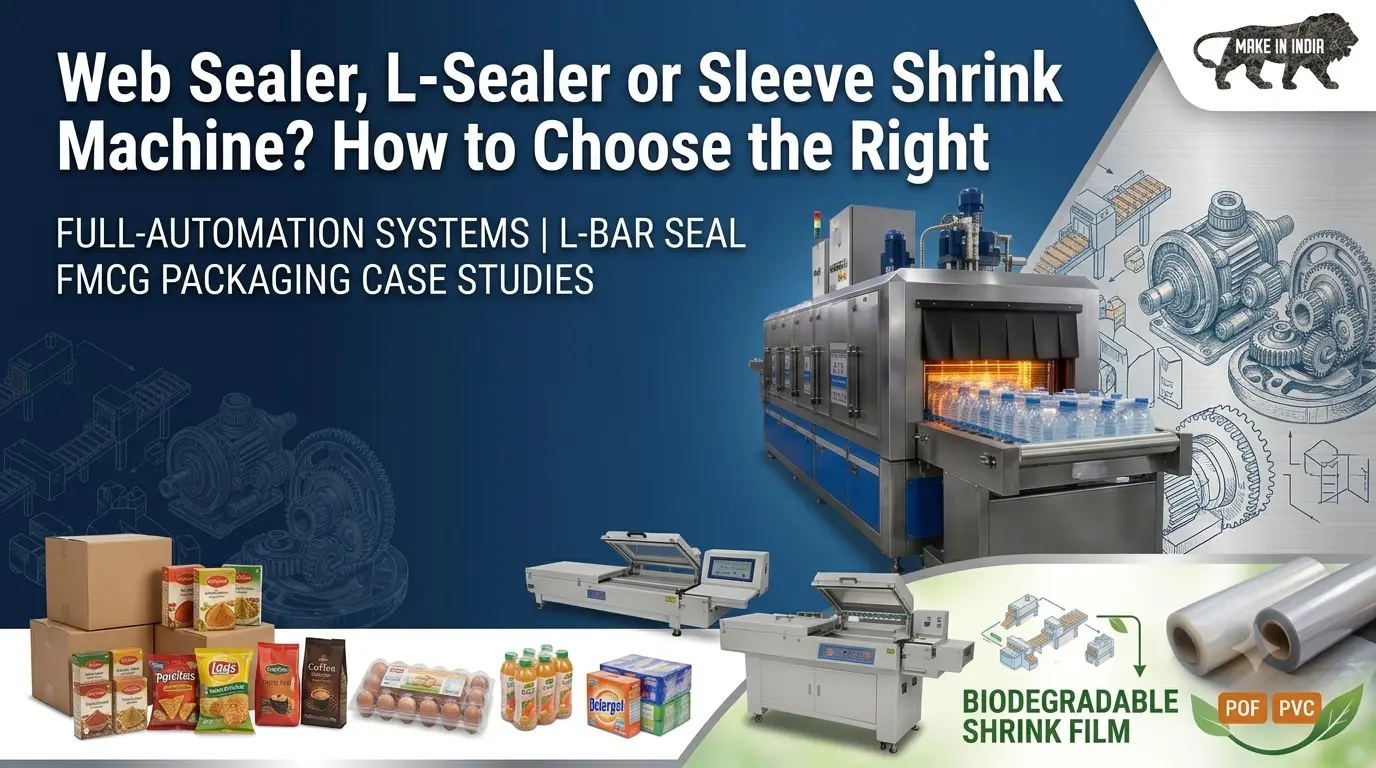
Web Sealer, L-Sealer or Sleeve Shrink Machine? How to Choose the Right Shrink Wrapping Machine Buy the wrong shrink wrapping machine, and you’ll feel it every shift: wrinkled packs, wasted film, a line that can’t keep up, or an oversized machine doing a small job. The catch is that “shrink wrapping machine” covers several very different machines. A web sealer bundling bottles, an L-sealer wrapping a gift box, and a sleeve machine fitting a tamper band on a pharma bottle all use heat-shrink film. But they suit different products, speeds, and budgets. This guide explains how shrink wrapping works, compares the main machine families, and shows you how to match a machine to your product. These machines protect products, show tampering, and give a clean retail finish, so they’re standard across food and beverage, pharma, cosmetics, FMCG, stationery, publishing, e-commerce, and logistics. How a Shrink Wrapping Machine Works If you are looking for a quick executive summary to guide your machinery budget and planning, here is the selection matrix used by top-tier Indian manufacturing plants: Every machine does two jobs. Wrap and seal. Shrink film is made under tension, so it “remembers” a smaller size. The machine draws it around the product, then heated sealing bars seal and cut it, leaving a loose bag or sleeve. Vent holes let trapped air escape. Apply heat. The pack rides a conveyor through a shrink tunnel, where hot air (or steam) heats the film until it contracts tightly around the product. A short cooling zone then sets the film into a smooth, firm finish. For very low volumes, a hand-held heat gun can replace the tunnel. Tunnel temperature, conveyor speed, and airflow decide how clean the finish looks. They have to suit your film and product. Web Sealer vs L-Sealer vs Sleeve Shrink Machine Web Sealer with Shrink Tunnel (called a side sealer in some markets) Products move along aonveyor while film is wrapped around them, sealed, and cut in a continuous flow. Add a collator, and the machine groups bottles or cans into multipacks automatically. Best for: high-volume, consistent products such as bottled water, juice, oil, cartons, and boxes Strengths: highest throughput, low labor per pack, easy to link into a full line Trade-offs: needs more floor space and investment, and is less flexible with frequent size changes Amarpack range: semi-automatic web sealers for bottles and boxes, conveyorised automatic machines, and single-line and four-line automatic systems with collators L-Sealer with Shrink Tunnel An L-sealer seals the front and one side of each pack in a single motion, using centerfolded film. It handles a wide range of sizes with almost no changeover. Best for: single items and mixed product lines, such as books, files, stationery, gift boxes, date boxes, and cosmetic kits Strengths: flexible, affordable, easy to operate, and it scales from manual to fully automatic. Trade-offs: it wraps one pack at a time, so speed has a ceiling Amarpack range: manual, pneumatic, online (conveyor-fed), and fully automatic L-sealers Sleeve Shrink Machine This one does a different job. Instead of enclosing the pack, it applies a shrink sleeve, neck band, or tamper-evident band to a bottle or jar, and the tunnel shrinks it to fit. Best for: pharma, cosmetic, pickle, juice, and beverage bottles that need tamper evidence or full-body branding Amarpack range: manual, rotary, and automatic sleeve applicators Choosing the Tunnel Hot-air tunnels suit general wrapping. Look for adjustable temperature, variable belt speed, and even airflow. Steam heat tunnels give gentle, even heat for sleeves and labels on curved containers. Heavy-duty tunnels handle thick PE film and large bundles. Quick Match: What Are You Packing? Your product Typical setup Bottled water, juice, or oil multipacks at high volume Automatic web sealer with collator + tunnel Cartons, detergent boxes, mixer boxes, pouch bundles Semi-automatic or conveyorised web sealer + tunnel (heavy-duty for PE film) Books, files, stationery, gift and date boxes L-sealer + tunnel, manual through fully automatic Tamper bands or full sleeves on pharma, cosmetic, or juice bottles Sleeve shrink machine + steam tunnel Pallets and large cartons Stretch wrapping or shrink hood systems Why Shrink Wrapping Pays Off Protection: film blocks dust and moisture and holds products together in transit Tamper evidence and shelf appeal: broken film shows an opened pack, and clear film shows off branding. Lower packaging cost: far less material, weight, and bulk than corrugated boxes, which cuts storage and freight costs Flexibility: one machine can handle many pack sizes How to Choose: 6-Point Buying Guide Product size, shape, and weight. Measure your largest and smallest packs, including height. Check them against the sealing area and tunnel opening. Round bottles, flat boxes, and irregular items favor different designs. Production volume. Estimate your packs per minute now and in two to three years. As a rough guide: Low volume: manual or semi-automatic L-sealer Medium volume: automatic L-sealer or semi-automatic web sealer High volume: automatic web sealer with collator Real speeds depend on pack size, film, and setup, so ask for demonstrated output on your product. Automation level. Weigh labor cost and error rates against purchase price. Automation pays back fastest on steady, high-volume runs. Film compatibility. Match the machine to your film: Film Key traits Best for POF (polyolefin) Clear, glossy, strong seals, food-safe Food, cosmetics, general retail PVC Low cost, shrinks at low temperature, can release fumes when sealed, not advised for food contact Budget and non-food packs PE / LDPE Heavy-duty, puncture-resistant, needs higher tunnel heat Heavy bundles, pouch bundling, pallet hoods 5. Floor space and line fit. Allow for infeed, outfeed, tunnel length, ventilation, and power. Check that conveyors, collators, and downstream carton sealing or strapping connect cleanly. 6. Total cost of ownership. Look past the price to film consumption, energy use, spare parts, service response, and training. A machine sized for your growth beats a cheaper one you’ll outgrow in a year. Frequently Asked Questions 1. What's the difference between a web sealer and an L-sealer? A web sealer wraps products in a continuous
How India’s Top Manufacturers Standardize Packaging: The Complete Guide to Custom Shrink Wrapping Solutions
How India’s Top Manufacturers Standardize Packaging The Complete Guide to Custom Shrink Wrapping Solutions Date: 01 Oct, 2026 | Written by : Amarnath Sharma Most production managers in India believe a basic hand – Shrink wrapping station is “good enough” for their factory floor. They hold this belief until a major transport shipment arrives damaged at a client’s warehouse or a packaging line bottleneck halts their entire daily dispatch. In high-volume B2B manufacturing, packaging is not just a final step; it is a critical pillar of quality control, brand protection, and throughput speed. Standardizing your secondary packaging line is the fastest way to slash labor costs, eliminate transit damage, and present a highly professional product to your clients. To help operations managers and procurement heads navigate this transition, this guide breaks down how India’s leading manufacturers leverage custom shrink wrapping solutions to optimize their lines. The Bottom Line Up Front (BLUFF): Which Packaging Line Do You Need? If you are looking for a quick executive summary to guide your machinery budget and planning, here is the selection matrix used by top-tier Indian manufacturing plants: Line Type & Configuration Average Speed (BPM / Packs Min) Best Suited Applications Compatible Shrink Films Standard Setup Price Range (INR) Manual L-Sealer + Shrink Tunnel 5 – 12 packs/min Low-volume cosmetics, textbooks, and small retail box packaging. POF (Polyolefin), PVC ₹96,500 – ₹2.86 Lakhs Semi-Automatic Web Sealer + Shrink Tunnel 10 – 20 packs/min Medium-volume bulk beverage trays, cartons, and bundled boxes. LDPE (Low-Density Polyethylene) ₹2.5 Lakhs – ₹4.5 Lakhs Fully Automatic L-Sealer + High-Speed Shrink Tunnel 25 – 45 packs/min Continuous pharmaceutical, FMCG, and high-speed food packaging lines. POF, LLDPE ₹6 Lakhs – ₹12 Lakhs Heavy-Duty Sleeve Wrapping / Collating Line 30 – 60+ packs/min Large-scale beverage bottles, massive carton boxes, and heavy industrial goods. Heavy-Duty LDPE ₹10 Lakhs – ₹25+ Lakhs What is a Shrink Wrapping Machine and How Does It Work? At its core, a professional industrial shrink wrapping machine consists of two primary components: a sealing unit and a heating unit. The sealing unit (such as an L-sealer or web sealer) cuts and seals the shrink film around the product to create a loose bag. Next, the product travels on a conveyor belt into a specialized heating unit called a shrink tunnel machine. Inside the tunnel, controlled recirculating hot air rapidly heats the film. This heat causes the film to shrink tightly around the contours of the product, forming a rigid, tamper-evident, and highly protective layer. By automating this sequence, factories can completely replace inconsistent hand-wrapping with a standardized process. This switch ensures that every single box, bottle, or bundle that leaves your facility is sealed with identical tension, neatness, and structural integrity. Shrink Chamber vs. Shrink Tunnel: Which Setup Fits Your Factory Output? When upgrading from manual hand-guns, plant managers often debate between buying a compact shrink chamber or investing in a continuous conveyorized shrink tunnel. The choice depends entirely on your daily production volume and space constraints. Shrink chambers combine sealing and shrinking into a single, compact workstation. The operator pulls down a hood to seal and shrink the film simultaneously. While highly affordable and space-saving, chambers are strictly limited to low-volume operations (usually under 5–8 packs per minute). For continuous, growing production lines, a conveyorized tunnel is essential. Moving your products through a dedicated tunnel ensures uniform heat distribution and high-speed processing. If you require a flexible, entry-level industrial setup, starting with shrink wrapping machines 12×10 inch or standard continuous tunnels allows your operators to feed products manually while the machine handles the shrinking at high speeds. How Do You Choose Between a Manual Shrink Wrapping Machine and an Automatic Shrink Wrapping Machine? When upgrading from manual hand-held wrapping devices, plant managers often debate between an entry-level manual shrink wrapping machine and a fully automated line. The choice depends entirely on your daily production volume, budget, and labor constraints. A manual setup, such as a manual sleeve wrapper or L-sealer, is highly affordable and space-saving. It is strictly limited to low-volume operations where operators manually pull down a sealing bar. If your production requires a flexible, entry-level industrial setup, starting with portable shrink wrapping machines allows your operators to feed products manually while the machine handles high-speed shrinking. For high-volume, growing production lines, an automatic shrink wrapping machine is essential. A fully automatic L-sealer or automatic sleeve wrapper runs continuously without requiring constant operator intervention. This setup eliminates manual labor bottlenecks, drastically increases packaging speed, and reduces plastic film wastage. to know more about automatic shrink wrapping machine – refer expert guide Box Shrink Wrapping Machine or Bottle Shrink Wrapping Machine? Different products demand distinct packaging geometries. For example, packaging flat cartons is completely different from stabilizing tall, heavy liquid containers. A dedicated box shrink wrapping machine is configured to handle rectangular shapes smoothly. It uses precise side-guides and top-compressors to prevent boxes from shifting or overlapping during the sealing process. This is crucial for maintaining the aesthetics of retail packaging like cosmetics, textbooks, and electronics. Conversely, a bottle shrink wrapping machine faces unique structural challenges. Tall bottles are prone to tipping over on standard conveyors, and their curved profiles require precise heat application to avoid wrinkles. Top-tier lines utilize specialized slate-chain conveyors to keep bottles perfectly upright during high-speed transit. For high-impact aesthetic labels on round containers, a specialized steam heat shrink tunnel machine is preferred. Unlike hot-air tunnels, a steam tunnel provides perfectly uniform 360-degree heat transfer. This precise application ensures that sleeve labels conform flawlessly to complex bottle necks without bubbling, burning, or distorting your branding. Shrink Film That Companies Use as Par Their Need: LDPE, LLDPE, or POF Choosing the wrong film can lead to weak packaging, split seals, or excessive material wastage. To standardize your packaging, you must match your film selection to your product type. Indian manufacturers generally choose between three major shrink film categories: LDPE (Low-Density Polyethylene): This thick, heavy-duty material is the gold standard for transit packaging. If you are shipping bulk cases of water bottles, heavy carton boxes,
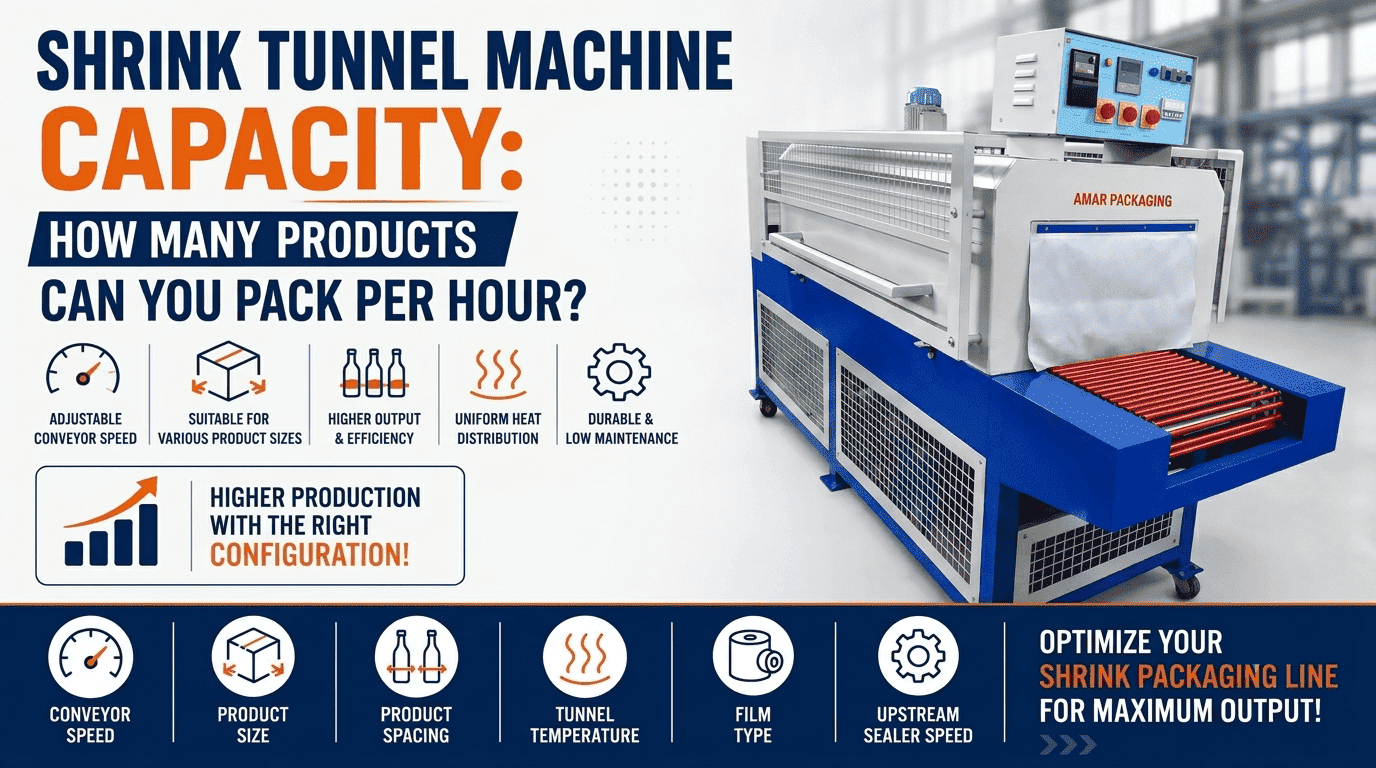
Shrink Tunnel Machine Capacity: How Many Products Can You Pack Per Hour
Shrink Tunnel Machine Capacity: How Many Products Can You Pack Per Hour? Shrink Tunnel Machine Introduction For manufacturers, FMCG companies, food processors, pharmaceutical businesses, and other industries, a shrink tunnel machine plays an important role in automated shrink packaging. It uses controlled heat to shrink plastic film tightly around a product or product bundle, creating a secure, professional and consistent package. One of the most important questions when selecting a shrink tunnel machine is production capacity: How many products or packs can a shrink tunnel machine process per hour? There is no single answer because actual production depends on several factors, including product dimensions, product spacing, conveyor speed, tunnel chamber size, shrink film, heating conditions, upstream sealing equipment and the overall packaging-line configuration. This guide explains how a shrink tunnel machine works, how its capacity is calculated, what affects production per hour, and how to select the right machine for your packaging requirements. What Is a Shrink Tunnel Machine? A shrink tunnel machine is a heat-shrinking packaging machine that uses controlled hot air to shrink plastic film around a product or product bundle. The product is first wrapped or sealed with suitable shrink film. It then travels through the heated tunnel on a conveyor. As the film passes through the controlled heating zone, it contracts around the product and forms a tight package. A shrink tunnel machine can be used as part of a packaging system with equipment such as: L-sealer Web sealer Sleeve wrapping machine Automatic shrink wrapping machine Product feeding conveyors Cooling conveyors Other automated packaging equipment Common Applications of Shrink Tunnel Machines Shrink tunnel machines are used across a wide range of industries, including: Food and beverage packaging Water bottle multipacks FMCG products Pharmaceutical cartons Cosmetic products Stationery Electronic products Household products Industrial components Cartons and boxes Multipack products The correct machine configuration depends on the product size, packaging format, required output and type of shrink film being used. How Does a Shrink Tunnel Machine Work? The working process of a shrink tunnel machine can be divided into several stages: Product Wrapping The product or product bundle is covered with suitable shrink film. Film Sealing An L-sealer, web sealer, sleeve wrapper or other sealing system closes the film around the product. Product Infeed The wrapped product enters the shrink tunnel through the conveyor system. Controlled Heating Hot air circulates inside the tunnel and transfers heat to the shrink film. Film Shrinking The film contracts and conforms closely to the shape of the product or bundle. Finished Pack Discharge The shrink-wrapped product exits the tunnel and can move to cooling, inspection, secondary packaging or palletizing.This means the shrink tunnel machine is normally one part of the complete packaging line. Its production capacity should therefore be considered together with the equipment feeding it. How Many Products Can a Shrink Tunnel Machine Pack Per Hour? The production capacity of a shrink tunnel machine depends on the complete packaging application. Important variables include: Product dimensions Product arrangement Product spacing Conveyor speed Tunnel length Tunnel width and height Film type Film thickness Required shrink quality Heating conditions Upstream sealer speed Operator handling Changeover time A simple theoretical calculation is: Packs Per Hour = Packs Per Minute × 60 For example, if a packaging line processes 20 packs per minute: 20 × 60 = 1,200 packs per hour However, theoretical capacity should not automatically be treated as practical production capacity. Loading, product spacing, film changes, machine adjustments, changeovers and upstream equipment can reduce actual output. For this reason, the best way to determine the capacity of a shrink tunnel machine is to evaluate the actual product and complete packaging configuration. Shrink Tunnel Machine Production Capacity Different packaging applications require different production levels. Rather than assigning one universal capacity to every shrink tunnel machine, manufacturers should evaluate production according to their product and packaging configuration. Production Requirement Typical Consideration Small-scale production Manual or semi-automatic feeding and flexible operation Medium-scale production Conveyorised semi-automatic or automatic configuration High-volume production Automatic feeding, continuous sealing and higher conveyor throughput Industrial production Integrated packaging line designed around the required output The actual number of packs per hour should be confirmed based on product dimensions, pack configuration, film characteristics, tunnel settings and upstream machine capacity.This approach is more reliable than selecting a machine only from a maximum conveyor-speed specification. Products Per Hour vs Packs Per Hour A more practical capacity estimate can be made by considering conveyor speed and product pitch. Product Pitch = Product Length + Gap Between Products For example, if: Conveyor speed = 50 ft/min Product length = 10 inches Product gap = 2 inches Then: Product pitch = 10 + 2 = 12 inches Convert the conveyor speed to inches per minute: 50 × 12 = 600 inches/minute Then: 600 ÷ 12 = 50 packs/minute The theoretical hourly output becomes: 50 × 60 = 3,000 packs/hour If an operational efficiency factor of 85% is applied: 3,000 × 0.85 = 2,550 practical packs/hour This example demonstrates why actual production depends on more than conveyor speed. The same shrink tunnel machine can produce different outputs depending on product size, spacing, operating conditions and line efficiency. Products Per Hour vs Packs Per Hour When discussing shrink tunnel machine capacity, it is important to distinguish between products and packs. A pack may contain multiple individual products. For example, if six water bottles are shrink-wrapped together: 1 pack = 6 bottles If the packaging line produces: 1,000 packs/hour then the individual product output is: 1,000 × 6 = 6,000 bottles/hour Therefore, manufacturers should specify whether their production requirement is measured in: Products per hour Packs per hour Bottles per hour Bundles per hour Cartons per hour Cases per hour This avoids confusion when comparing different packaging machines or requesting a quotation. What Determines Shrink Tunnel Machine Capacity? Several factors influence the actual production capacity of a shrink tunnel machine. Product Dimensions Product size directly affects tunnel requirements and production planning. Large cartons and multipacks may require: Wider conveyors Greater chamber
How Temperature Control Impacts Shrink Tunnel Machine Performance
How Temperature Control Impacts Shrink Tunnel Machine Performance Shrink Tunnel Machine Introduction In manufacturing environments, temperature settings often vary depending on product shape, film thickness, and production speed. For example, POF film used for food trays generally requires lower temperature settings compared to PE film used for heavy industrial packaging. An industrial shrink tunnel machine uses controlled heat, airflow, and conveyor speed to achieve uniform shrink wrapping results. When temperature, conveyor speed, and airflow are properly balanced, the film shrinks uniformly to create a secure, professional-looking package. Incorrect settings can lead to wrinkles, loose wrapping, burnt film, excessive energy consumption, and unnecessary production downtime. In this guide, Amarpack Machines Private Limited explains how temperature control influences shrink tunnel performance, common packaging defects, and practical methods to optimize your packaging process. Why Temperature Control Matters in a Shrink Tunnel Machine Temperature is the heart of every shrink wrapping operation. Shrink films are engineered to contract only within a specific heat range. When the correct temperature is maintained, the film tightly conforms to the product while preserving its appearance and strength. Proper temperature control provides several advantages: Uniform and attractive packaging Strong film shrinkage Reduced material wastage Improved production speed Better product protection during storage and transportation Lower energy consumption AmarPack Machine Typical Application Example Temperature Range APST-100 Small packaging 130–170°C APST-200 Medium production 140–180°C APST-300 High production 150–220°C 1.How a Shrink Tunnel Machine Uses Heat A shrink tunnel consists of several integrated components that work together: Electric heating elements generate controlled heat. High-speed blowers circulate hot air throughout the chamber. A conveyor transports products at a controlled speed. Digital temperature controllers regulate the desired heat level. Airflow ducts distribute heat evenly around the product. As products pass through the tunnel, the shrink film softens and contracts evenly around the product, creating a clean and durable package. 2. Recommended Temperature for Different Shrink Films Different shrink films require different operating temperatures. Product Application Film Type Temperature Range Conveyor Setting Food trays POF 140–160°C Medium speed Water bottles PVC/POF 110–150°C High speed Pharmaceutical cartons POF 140–160°C Medium speed Industrial parts PE 170–220°C Slow speed The ideal temperature also depends on film thickness, product size, conveyor speed, and ambient working conditions. 3. Common Problems Caused by Incorrect Temperature Temperature Too Low When the tunnel temperature is below the recommended range: Loose packaging Wrinkled film Open corners Incomplete shrinkage Weak package appearance Temperature Too High Excessive heat can create: Burnt or melted film Product damage Film discolorationHoles in the packaging Excessive energy usage Maintaining the correct balance is essential for producing high-quality packages consistently. 4. Conveyor Speed and Temperature Work Together Conveyor speed determines how long the product remains inside the heating chamber. Fast Conveyor + Low Temperature Loose shrink Wrinkles Poor film adhesion Slow Conveyor + High Temperature Burnt film Product overheating Excessive shrinkage Balanced Settings The best packaging results are achieved by balancing conveyor speed with tunnel temperature according to the product and shrink film being used. 5. Factors That Affect Shrink Tunnel Performance Several variables influence shrink quality: Type of shrink film Film thickness Product dimensions Product material Conveyor speed Air circulation Heating element efficiency Ambient temperature Tunnel length Machine maintenance Operators should evaluate these factors together rather than adjusting temperature alone 6. How Digital Temperature Controllers Improve Performance Modern shrink tunnel machines use digital PID temperature controllers that continuously monitor and regulate heat levels. Benefits include: Accurate temperature control Faster machine warm-up Stable heat throughout production Reduced operator intervention Improved packaging consistency Lower electricity consumption Digital controls also reduce the risk of packaging defects caused by temperature fluctuations. 7. Industries That Benefit from Proper Temperature Control Food & Beverage Ensures hygienic, attractive packaging while preserving product quality. Pharmaceuticals Protects medicines and medical devices with secure, tamper-evident packaging. Cosmetics Produces wrinkle-free packaging that enhances shelf appeal. FMCG Supports high-speed production with consistent packaging quality. Electronics Protects delicate products without exposing them to excessive heat. Industrial Components Provides secure packaging for transportation and storage. 8. Tips to Improve Shrink Tunnel Efficiency Follow these best practices for better performance: Use the correct shrink film for your application. Preheat the tunnel before production. Match conveyor speed with film specifications. Clean heating chambers and blowers regularly. Inspect heating elements periodically. Replace worn conveyor belts when required. Avoid unnecessary overheating. Calibrate temperature controllers at scheduled intervals. Preventive maintenance not only improves packaging quality but also extends machine life. Get a Quote within a Hours 👉 Why Choose Amarpack Shrink Tunnel Machines? AmarPack Machines Pvt Ltd has been a trusted leader in manufacturing industrial packaging machinery since 1998. Engineered for high thermal efficiency and continuous operation, our shrink tunnels: Our machines offer: Digital temperature control Uniform hot air circulation Energy-efficient heating systems Adjustable conveyor speed Heavy-duty construction Low maintenance design Compatibility with POF, PVC, and PE films Custom machine configurations for different industries Key Advantages 27+ Years of Expertise: Proven track record in building durable, high-performance packaging systems. Customized Engineering: Tailored chamber sizes, airflow controls, and conveyor options (mesh, roller, or slat chain). Reliable & Energy Efficient: Built with heavy-duty insulation to minimize heat loss and operational downtime. Turnkey Support & Spare Parts: Fast access to genuine OEM replacement parts, complete installation, and technical assistance. Made in India: Built to international standards with dependable local aftermarket support. Frequently Asked Questions Q1. What is the ideal temperature for a shrink tunnel machine? The ideal temperature depends on the shrink film being used. Most POF films perform between 130°C and 170°C, while PE films generally require higher temperatures. Q2.Why does shrink film wrinkle? Wrinkling is usually caused by insufficient heat, improper airflow, incorrect conveyor speed, or unsuitable film selection. Q3. Can excessive heat damage products? Yes. Excessive temperature can burn shrink film, deform heat-sensitive products, and increase packaging defects. Q4.Does shrink tunnel temperature affect electricity consumption? Yes. Excessively high temperature increases power consumption without improving packaging quality. Q5. What happens if conveyor speed is too high? The film receives insufficient heat exposure, causing loose or incomplete shrinking. Know More
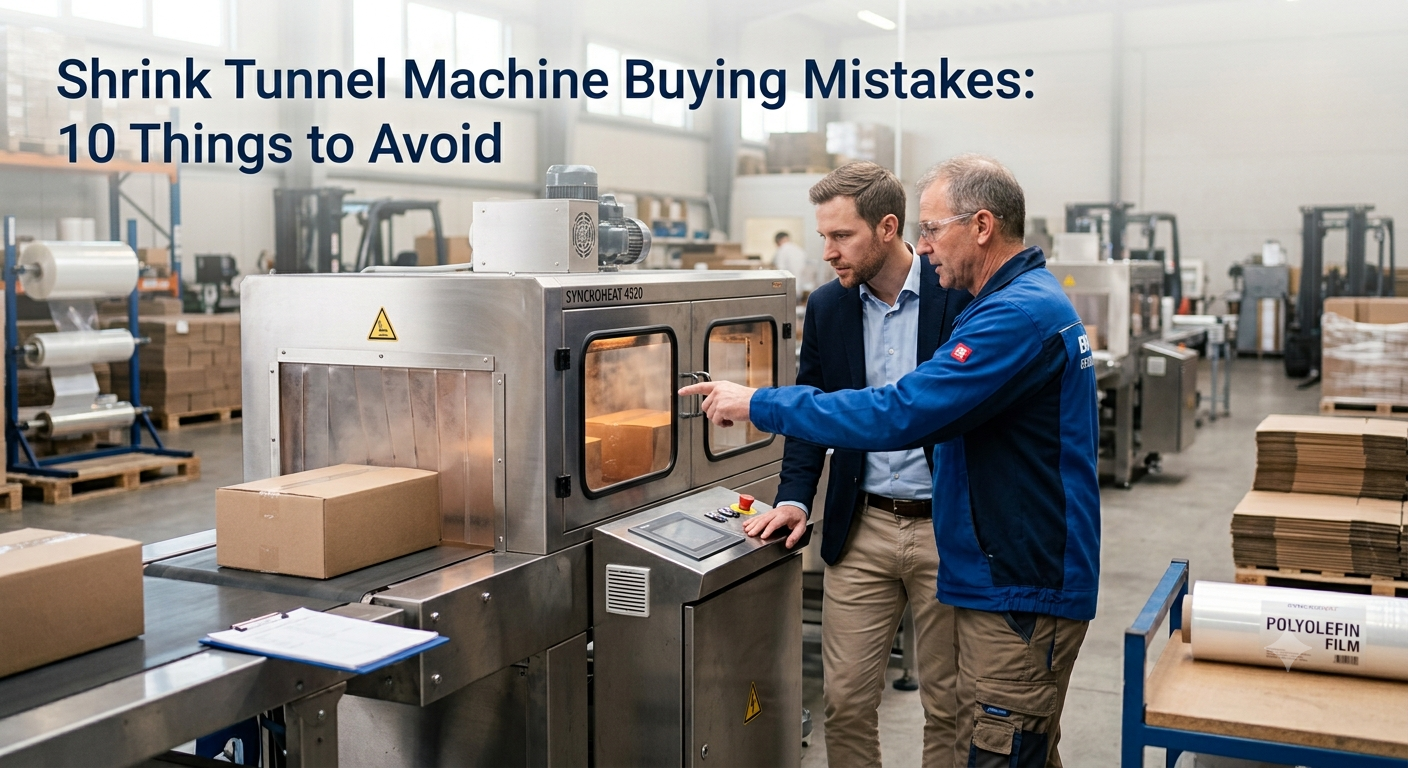
Shrink Tunnel Machine Buying Mistakes: 10 Things to Avoid
Shrink Tunnel Machine Buying Mistakes: 10 Things to Avoid Introduction Investing in a shrink tunnel machine is a critical decision for packaging and manufacturing operations. A reliable shrink tunnel ensures clean product presentation, tight protective sealing, reduced film wastage, and efficient production throughput. However, selecting the wrong equipment without evaluating important operational and technical factors can result in high energy consumption, frequent maintenance downtime, poor packaging quality, and increased production costs. Whether you are packaging water bottles, beverage multipacks, cartons, FMCG products, pharmaceutical boxes, or industrial goods, choosing the correct shrink tunnel system plays an important role in achieving consistent packaging performance. This shrink tunnel machine buying guide explains the most common mistakes manufacturers make before purchasing and provides practical solutions to help you select the right industrial shrink tunnel machine for your production requirements. Types of Shrink Wrapping Machines in India Shrink Tunnel Machine The simplest configuration — a conveyor-fed heat chamber. Product enters already enclosed in a film bag or sleeve. The tunnel heats surrounding air to 140–180 °C, causing the film to contract uniformly. Output rates range from 10 to 60 packs per minute depending on tunnel length and belt speed. This is the entry point for operations adding shrink finishing to an existing line. Web Sealer with Shrink Tunnel A web sealer unrolls film from a centre-fold roll, wraps the product in a tube, and makes a trailing seal at each end. The sealed pack then enters the shrink tunnel. Web sealers are the preferred solution for beverage bundling (water bottles, soft drinks, beer cans) and for overwrapping corrugated trays. Semi-automatic models handle 15–25 packs per minute; fully automatic servo-driven models reach 40–70 packs per minute. L-Sealer with Shrink Tunnel An L-sealer uses two sealing bars — one horizontal, one vertical — to make three sides of the wrap in one stroke. Throughput ranges from 12 to 30 cycles per minute for semi-automatic models, up to 60+ for automatic inline L-sealers. L-sealers are the correct choice when products must be individually wrapped rather than bundled. What is a Shrink Tunnel Machine? A shrink tunnel machine is an automated packaging system that uses controlled heat circulation to shrink plastic films such as POF (Polyolefin), PVC, and PE (Polyethylene) around products. The machine passes wrapped products through a heated chamber where hot air circulation causes the film to contract evenly, creating a tight, secure, and professional package. Shrink tunnel machines are widely used in: Food and beverage industries Water bottle packaging FMCG products Pharmaceutical packaging Cosmetic products Carton and box packaging Industrial product bundling A properly selected shrink tunnel machine improves packaging appearance, protects products during transportation, and increases overall production efficiency. Investing in a shrink tunnel machine is a critical decision for packaging and manufacturing operations. A reliable shrink tunnel ensures clean product presentation, tight protective sealing, and efficient throughput. However, selecting equipment without evaluating key operational and technical factors can lead to high energy costs, frequent maintenance downtime and defective packaging Here are the 10 most critical shrink tunnel machine buying mistakes manufacturers must avoid ranked from foundational operational traps to long-term financial pitfalls along with actionable steps to make the right choice for your facility. 1. Sizing the Chamber Too Close to Product Dimensions The Mistake: Choosing a shrink tunnel based solely on average product sizes without accounting for maximum package dimensions, height variations, or future SKU additions. The Impact: Products that fit too tightly snag on internal silicone curtains or scrape against heating elements, causing film burn-through, product jams, and potential fire hazards. How to Avoid: Measure the length, width, and height of your largest product variant. Select a tunnel chamber that leaves at least 2 to 3 inches (5–7.5 cm) of clearance around the top and sides of the package to allow optimal hot air circulation. 2. Choosing the Wrong Conveyor Belt Mechanism The Mistake: Buying a standard conveyor without evaluating your product’s weight, base geometry, and stability. The Impact: Lightweight packages tip over between wide rollers, while heavy or flat-bottomed items fail to shrink cleanly on improper surfaces. 3. Conveyor Belt Selection Guide The Mistake: Buying a standard conveyor without evaluating your product’s weight, base geometry, and stability. The Impact: Lightweight packages tip over between wide rollers, while heavy or flat-bottomed items fail to shrink cleanly on improper surfaces. Conveyor Type Best Suited For Key Operational Advantage Live Rollers Rigid, flat-bottomed packages (boxes, cartons, trays) Rotates products to ensure even bottom shrinkage Dead Rollers Products requiring precise bottom film shrinkage Keeps packages stationary relative to rollers for targeted heat exposure Mesh Belts (Teflon / Stainless) Small, lightweight, or flexible items Prevents small or unstable products from tilting or falling through gaps Slat Chain Conveyors Heavy-duty industrial items, crates, or multipacks Provides maximum load-bearing strength and smooth transport 4. Mismatching Film Material and Tunnel Capabilities The Mistake: Failing to align the tunnel’s heat output and airflow capacity with the specific film material being used (Polyolefin [POF], Polyethylene [PE], or Polyvinyl Chloride [PVC]). The Impact: Heavy-duty PE film used for bundling requires high heat and longer chamber residence times, whereas thin POF film warps or burns under excessive thermal velocity. How to Avoid: Verify that heater wattage, fan speeds, and conveyor speed ranges match the thermal profile, thickness (gauge), and shrink characteristics of your chosen packaging film. 5. Overlooking Line Speed and Chamber Residence Time The Mistake: Purchasing a tunnel that cannot keep pace with upstream automated L-sealers, sleeve wrappers, or feed conveyors. The Impact: This creates a bottleneck where products wait, or forces operators to run the conveyor too quickly, resulting in loose, under-shrunk packaging. How to Avoid: Calculate your required throughput in Packages Per Minute (PPM). Ensure the tunnel chamber length provides sufficient “residence time” (exposure time) at your maximum conveyor speed. 6. Ignoring Insulation Quality and Energy Efficiency The Mistake: Choosing low-cost equipment built with thin single-wall paneling or minimal thermal insulation. The Impact: Excessive heat leakage drives up monthly power bills, radiates unwanted heat into the workplace, and places
Shrink Wrapping Machine in India : Types,Price & How to Choose
Shrink Wrapping Machine in India : Types,Price & How to Choose What Is a Shrink Wrapping Machine? Types of Shrink Wrapping Machine in India How a Shrink Wrapping Machine Works Shrink Film: POF vs PVC vs PE Shrink Wrapping Machine Price in India How to Choose the Right Shrink Wrapping Machine Industries & Applications Buying Across India from Indian Manufacturer FAQ What Is a Shrink Wrapping Machine? A shrink wrapping machine applies heat-shrinkable plastic film around a product or group of products and then passes the wrapped item through a heat tunnel where the film contracts tightly against the surface. The result is a tamper-evident, dust-resistant, and visually clean package that protects contents during transit and enhances shelf appeal. Shrink wrapping is used across food and beverage, pharmaceuticals, FMCG, printing and publishing, and industrial goods — any product that benefits from a tight, transparent outer layer. The machine does two distinct jobs: sealing the film around the product and applying controlled heat to shrink it. When people in India search for a “shrink wrapping machine,” they are typically looking for one of three configurations: a standalone heat tunnel (for products already bagged or loosely film-wrapped), a web sealer paired with a tunnel (for cartons, trays, and FMCG multipacks), or an L-sealer paired with a tunnel (for individual product wrapping on mid-to-high-volume lines). Each is covered in detail below. Types of Shrink Wrapping Machines in India Shrink Tunnel Machine The simplest configuration — a conveyor-fed heat chamber. Product enters already enclosed in a film bag or sleeve. The tunnel heats surrounding air to 140–180 °C, causing the film to contract uniformly. Output rates range from 10 to 60 packs per minute depending on tunnel length and belt speed. This is the entry point for operations adding shrink finishing to an existing line. Web Sealer with Shrink Tunnel A web sealer unrolls film from a centre-fold roll, wraps the product in a tube, and makes a trailing seal at each end. The sealed pack then enters the shrink tunnel. Web sealers are the preferred solution for beverage bundling (water bottles, soft drinks, beer cans) and for overwrapping corrugated trays. Semi-automatic models handle 15–25 packs per minute; fully automatic servo-driven models reach 40–70 packs per minute. L-Sealer with Shrink Tunnel An L-sealer uses two sealing bars — one horizontal, one vertical — to make three sides of the wrap in one stroke. Throughput ranges from 12 to 30 cycles per minute for semi-automatic models, up to 60+ for automatic inline L-sealers. L-sealers are the correct choice when products must be individually wrapped rather than bundled. How a Shrink Wrapping Machine Works: Step-by-Step Understanding the process sequence helps you evaluate machine specifications correctly: Film feed.Film unwinds from a roll and is guided around the product by a film frame or forming collar. Heated sealing bars cut and seal the film around the product, creating a loose wrap. Tunnel entry.The loosely wrapped product travels on a mesh conveyor belt through the heated tunnel. Hot air (140–200 °C depending on film type) circulates around the product; the film shrinks uniformly inward. Cooling exit.The wrapped product exits onto a cooling conveyor where the film sets in its final taut position. Operator note: The two variables that most affect wrap quality are tunnel temperature and belt speed. A too-fast belt gives incomplete shrink; a too-slow belt burns the film. Always run a short trial to dial in both settings for your specific product and film combination. Shrink Film: POF vs PVC vs PE The machine and the film must be matched – the wrong film on the wrong machine produces poor seals or film tear. Three film types cover almost all applications in India: Film Type Shrink Rate Food Safe Typical Use Cost POF (Polyolefin) 40–60% ✔ Yes (FSSAI-aligned) Food, pharma, FMCG, cosmetics Medium PVC (Polyvinyl Chloride) 40–50% ✘ Non-food Stationery, industrial, non-food retail Low PE (Polyethylene) 15–25% ✔ Yes Bundling heavy multi-packs, beverages Low POF film is the default choice for Indian food and pharma buyers. It is odourless, produces no chlorine fumes during sealing (unlike PVC), delivers a high-clarity finish, and is accepted under FSSAI food-packaging guidelines. Thickness range is typically 12–25 microns. PVC film has a lower material cost and is widely used for non-food applications — stationery packs, software boxes, and industrial parts. It requires adequate ventilation at the sealing station. PE film shrinks less dramatically but is tough and puncture-resistant. It is the standard film for beverage bundling — six-pack water bottles, 12-pack cans — where the goal is unitising rather than tight contouring. Shrink Wrapping Machine Price in India The price of a shrink wrapping machine in India depends on the machine type, automation level, sealing dimensions, shrink tunnel size, conveyor configuration, production capacity and customization requirements. AmarPack offers different configurations for individual products, cartons, bottles, multipacks and industrial packaging applications. Machine Type Price Range Power Supply Speed / Output Technical Specifications Film Compatibility Best For Web Sealer + Shrink Tunnel ₹5.5 Lakh – ₹18 Lakh Approx. 3-Phase 440V, 12–24 KW 15–120+ PPM Chamber Length up to 3000 mm, Width up to 800 mm POF / PE / LDPE Bottle multipacks, beverage bundling, FMCG packaging lines L-Sealer + Shrink Tunnel ₹4.5 Lakh – ₹9.5 Lakh Approx. 3-Phase 440V, 9–16 KW 12–70+ PPM L-Bar sealing system, handles products up to 500 × 400 mm POF / PVC / PE Books, boxes, cartons, single-SKU FMCG products How to Choose the Right Shrink Wrapping Machine The correct machine matches your product dimensions, required throughput, and budget — in that order. Step 1: Define what you are packing Individual products (books, boxes, pharma cartons, cosmetics) → L-sealer with shrink tunnel. Bundled groups (6-pack bottles, trays, carton overwraps) → Web sealer with shrink tunnel. Pre-sleeved or pre-bagged products (bottles with neck sleeves) → Standalone shrink tunnel only. Step 2: Establish your required throughput Count your current output rate and set a target for 12–18 months out. Add 20% headroom to the machine’s rated speed. Below 15 packs per minute, a semi-automatic machine is almost always
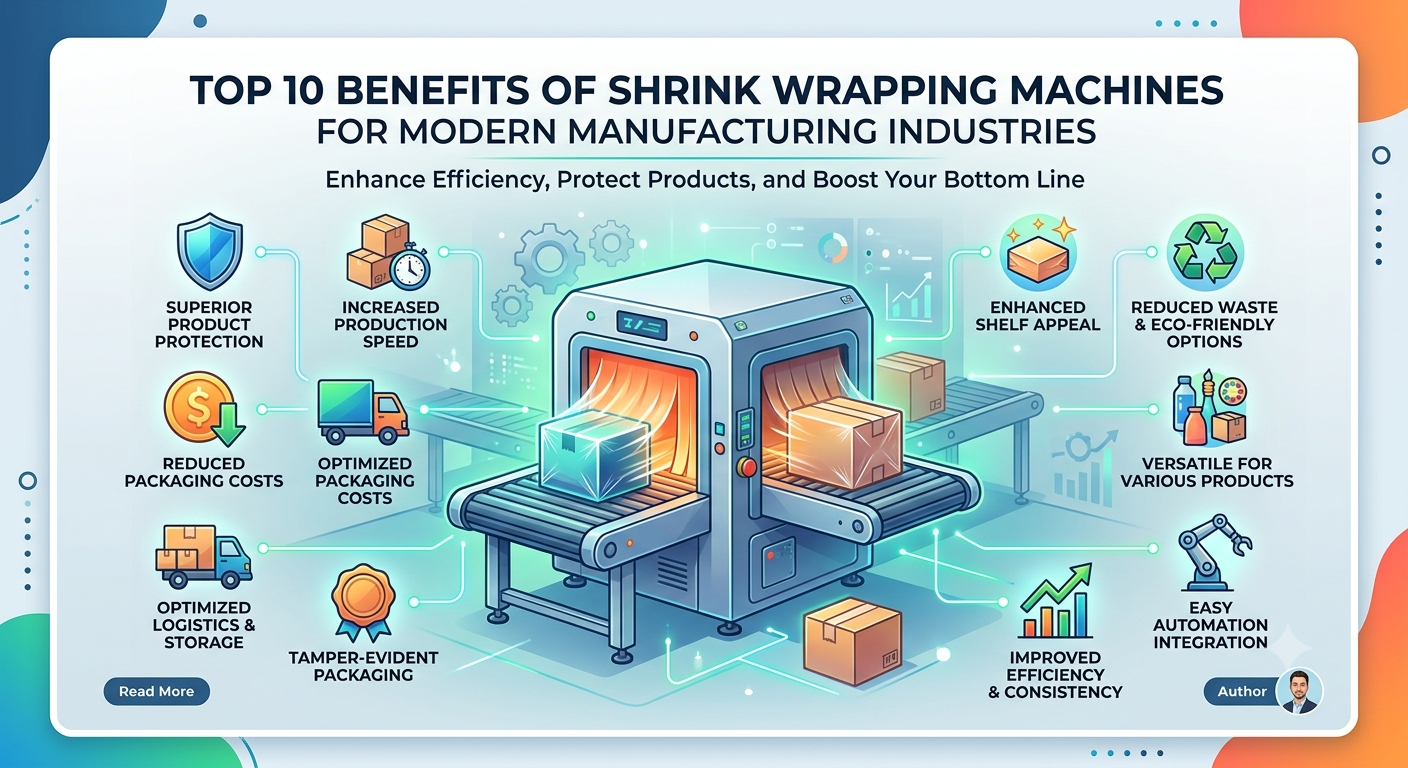
Top 10 Benefits of Shrink Wrapping Machines for Modern Manufacturing Industries
Top 10 Benefits of Shrink Wrapping Machines for Modern Manufacturing Industries Top 10 Benefits of Shrink Wrapping Machines for Modern Manufacturing Industries Top 10 Benefits of Shrink Wrapping Machines for Modern Manufacturing Industries Why Modern Manufacturing Industries Choose Shrink Wrapping Machines A Shrink Wrapping Machine is an efficient packaging solution designed to protect products, reduce packaging costs, and improve production efficiency. By using heat-shrinkable films such as POF, PE, or PVC, it creates a tight, secure, and tamper-evident package that protects products from dust, moisture, and damage. Modern shrink wrapping machines help manufacturers increase packaging speed, reduce labor costs, and achieve consistent packaging quality. These machines are widely used across industries including food & beverages, pharmaceuticals, FMCG, cosmetics, electronics and industrial products, making them an ideal choice for businesses looking for reliable and cost-effective packaging solutions. In this comprehensive guide, we’ll explore the top 10 benefits of shrink wrapping machines, how they improve manufacturing operations, and why they have become an essential investment for businesses seeking higher productivity and better packaging quality. Table of Contents What is a Shrink Wrapping Machine? How Does a Shrink Wrapping Machine Work? Top 10 Benefits of Shrink Wrapping Machines Industries Using Shrink Wrapping Machines Types of Shrink Wrapping Machines Why Choose AmarPack Machines Pvt Ltd? Frequently Asked Questions What is a Shrink Wrapping Machine? A shrink wrapping machine is an industrial packaging system designed to wrap products in a heat-sensitive plastic film. Once the product is enclosed in the film, it passes through a heated shrink tunnel where controlled heat causes the film to shrink tightly around the product. The result is: Secure packaging Excellent product visibility Tamper evidence Moisture protection Professional appearance Shrink wrapping machines are available in manual, semi-automatic, and fully automatic configurations to suit different production capacities. How Does a Shrink Wrapping Machine Work? A shrink wrapping machine operates through a streamlined four-stage process to create a tight, protective package. It begins with product placement, where the item is enclosed inside a shrink film pouch or loosely wrapped with shrink film. Next, in the sealing stage, an L-bar sealer or automatic sealer trims off excess film and securely seals the edges around the product. The item then moves into heat shrinking, passing through a specialized shrink tunnel where controlled hot air causes the film to shrink evenly and conform tightly to the product’s shape. Finally, the finished package exits the machine with a clean, durable, and professional-looking seal, fully prepared for storage, transit, or retail display Top 10 Benefits of Shrink Wrapping Machines 1. Superior Protection Against Dust, Moisture & Damage Shrink wrapping provides superior protection against dust, moisture, and physical damage by creating a tightly sealed barrier around products. This durable layer keeps out environmental contaminants like dirt, rain, oil, scratches, and corrosion, ensuring items stay completely clean and safe. It is particularly essential for sensitive goods such as electronics, automotive parts, pharmaceuticals, and food products. By preventing rust on metal components and reducing handling damage during export shipping, shrink wrapping extends product shelf life and guarantees that items arrive in pristine condition. 2. Tamper-Evident Packaging Improves Customer Trust Shrink wrapping provides tamper-evident packaging that significantly enhances product security and builds customer trust across modern supply chains. Because the tightly sealed film cannot be opened without leaving visible damage, any attempt at tampering or opening is immediately obvious. This makes it an essential packaging solution for industries like pharmaceuticals, cosmetics, food, consumer electronics, and FMCG. By safeguarding product integrity, shrink wrapping discourages counterfeiting, prevents theft, and gives consumers complete confidence that their purchases are untouched and safe. 3. Significant Reduction in Packaging Costs Shrink wrapping offers a significant reduction in overall packaging costs, making it a highly cost-effective alternative to bulky traditional materials like cardboard boxes or wooden crates. Because shrink film is extremely lightweight and compact, it minimizes material consumption, requires less warehouse storage space, and reduces packaging waste while speeding up production operations. Furthermore, by adding virtually no extra weight or bulk to shipments, companies can dramatically lower their freight and transportation expenses, saving substantial money over high-volume shipping cycles 4. Faster Packaging Increases Productivity Automatic shrink wrapping machines significantly boost productivity by bringing speed and consistency to modern manufacturing lines. Depending on the model and product size, these automated systems can wrap anywhere from 30 to over 100 items per minute. This high-speed capability reduces the need for manual labor, cuts operational costs, and ensures uniform package quality across every unit. By maximizing daily output and eliminating bottlenecks, shrink wrapping serves as an ideal solution for high-volume production environments. 5. Easy Bundling of Multiple Products Shrink wrapping is an exceptionally efficient method for bundling multiple items together into a single, cohesive unit without the need for extra packaging materials like cardboard dividers. From water bottle multipacks and cosmetic gift sets to pharmaceutical kits and promotional FMCG bundles, the tightly contoured film holds products securely in place to minimize movement during handling and transit. This not only creates stable pallet loads for simplified logistics and better inventory management, but it also delivers an attractive, professional retail presentation that draws consumers’ attention on store shelves 6. Professional Product Presentation That Enhances Brand Value In today’s competitive market, packaging creates the crucial first impression that communicates quality, professionalism, and brand reliability to customers. A shrink wrapping machine applies a high-gloss, crystal-clear, and wrinkle-free film around products like cosmetics, beverage bottles, books, food trays, and electronics, creating a premium finish that dramatically improves retail shelf appeal. Unlike bulky cardboard packaging, transparent shrink film displays the actual product, boosting consumer trust and providing a superior unboxing experience. Beyond basic protection, shrink wrapping also serves as a powerful marketing tool—especially when utilizing custom-printed films to feature logos, promotional offers, product details, and QR codes directly on the package. 7. Environmentally Friendly and Sustainable Packaging Sustainability is becoming a priority for manufacturers worldwide. Businesses are looking for packaging solutions that reduce waste, improve recyclability, and lower environmental impact. Modern shrink wrapping machines support