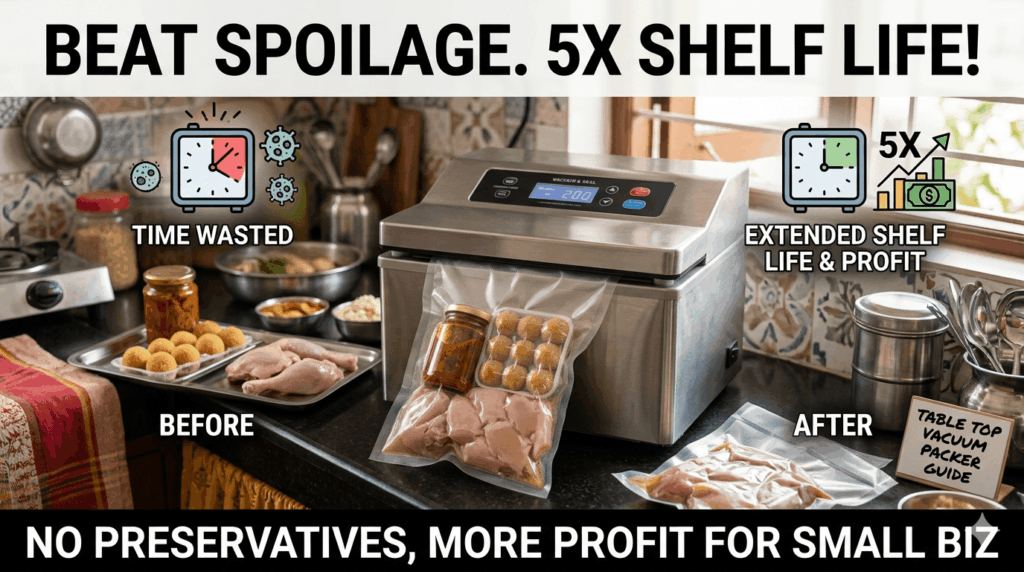
For most small food businesses, the difference between profit and loss comes down to one invisible enemy: time. A pickle jar that spoils in two months, a batch of laddoos that goes stale in a week, a tray of chicken that has to be sold the same day — every hour your product sits on a shelf, it loses value.
Now imagine stretching that shelf life by five times — without adding preservatives, without a commercial cold storage, and without a factory-scale setup. That is exactly what thousands of home kitchens, cloud brands, regional snack makers, and neighborhood meat shops are doing today with a single compact device: the table top vacuum packing machine.
In this guide, we break down how the technology works, which food categories see the biggest shelf-life gains, what the real ROI looks like for a small business, and how to pick the right machine so you don’t waste money on the wrong specs.
The Shelf Life Problem Every Small Food Business Knows Too Well
If you run a small food brand, you have probably lived through at least one of these:
- A distributor returns stock because the “best before” date is too close.
- A retailer refuses to stock you because your product “doesn’t travel well.”
- You lose 20–30% of a batch because it didn’t sell fast enough.
- You can’t expand to another city because your product won’t survive the journey.
Industry estimates suggest small and unorganized food producers lose 15–30% of output to spoilage, staleness, and moisture damage. For a business running on thin margins, that is the difference between scaling up and shutting down.
The traditional workarounds — heavy preservatives, refrigerated logistics, or overproducing only what sells locally — are either expensive, unhealthy, or limit your growth ceiling. Vacuum packing solves the problem at its root.
What Is a Table Top Vacuum Packing Machine?
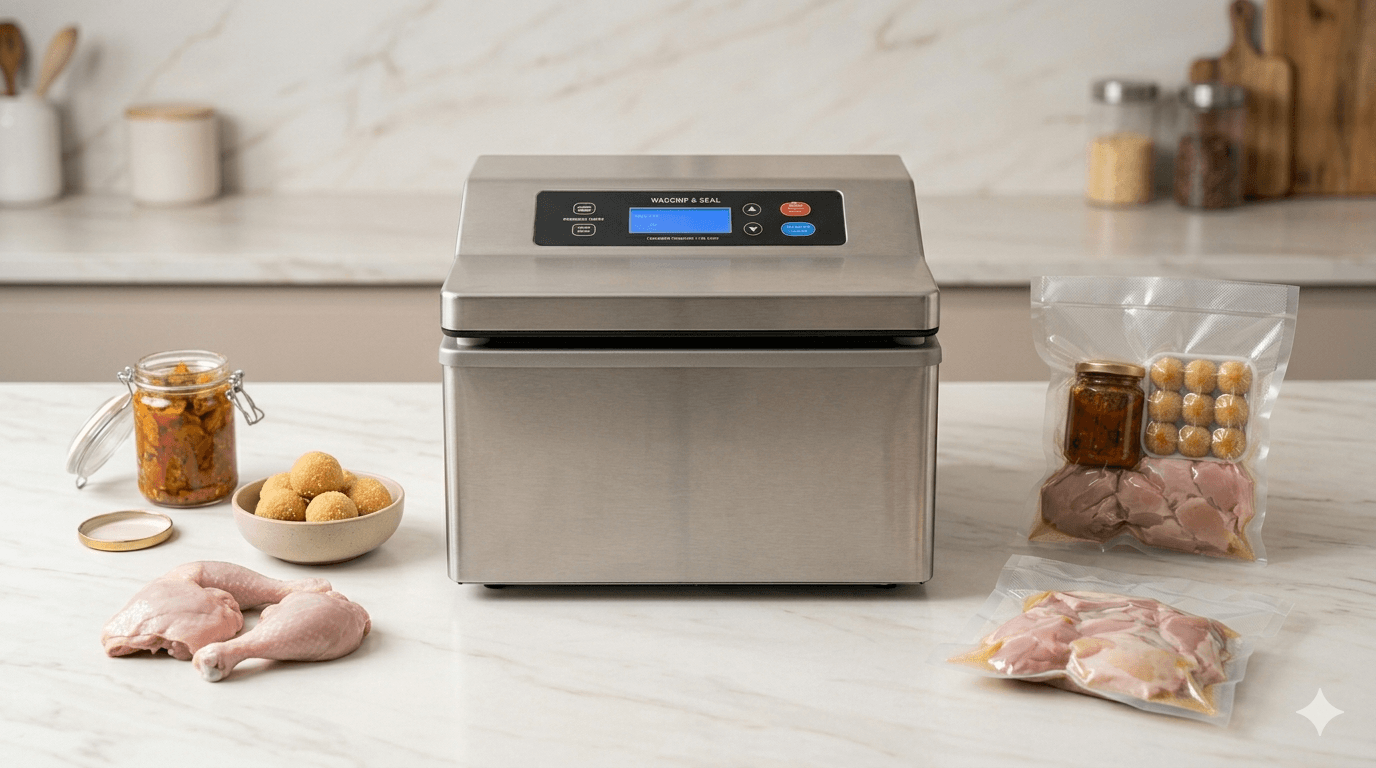
A table top vacuum packing machine is a compact, single-chamber sealer designed to remove air from a bag and seal it airtight, creating a vacuum-packed package, typically for preserving food, electronics, or medical items. These machines are ideal for limited workspaces like countertops, small shops, and restaurants, offering professional, high-performance sealing in a small footprint.
The result is an airtight, shelf-stable pack that slows down the biological and chemical processes that cause food to spoil.
- Placement: The product is placed inside a plastic vacuum bag, and the open end is placed over the seal bar within the chamber.
- Vacuum & Seal: The lid is closed, and the machine automatically evacuates the air from the chamber and the bag.
- Finalization: The machine heats the seal bar to seal the bag, then returns to normal pressure.
For most early-stage D2C and regional food brands, a table top chamber sealer hits the sweet spot of price, versatility, and output.
The Science: Why Vacuum Packing Extends Shelf Life by 5X
Food spoils because of four main things: oxygen, moisture, microbes, and light. Vacuum packing directly neutralizes the first three.
- Oxygen removal stops oxidation. Fats stop going rancid, colors stay vibrant, and flavors stay fresh.
- Aerobic bacteria and mold can’t grow in an oxygen-free environment. These are the microbes responsible for most visible spoilage.
- Moisture loss and moisture gain both stop. Crunchy snacks stay crunchy; fresh products don’t dry out.
- No freezer burn when vacuum-packed items are stored in a freezer.
This is why a vacuum-sealed pack of chicken can last 2–3 years in the freezer versus 6 months loose, and why spices keep their aroma for over a year versus three months in a standard pouch.
Real-World Examples: Which Foods Get a 5X Shelf Life Boost?
Here is how shelf life typically changes once a small food business switches to vacuum packing. These are directional benchmarks — actual results depend on storage conditions, recipe, and hygiene.
| Product |
Standard Shelf Life |
Vacuum-Packed Shelf Life |
Multiplier |
| Pickles (oil-based) |
2 months |
12 months |
6X |
| Spices & masala blends |
3 months |
15 months |
5X |
| Dry snacks (chivda, chakli) |
15 days |
75–90 days |
5–6X |
| Coffee beans / ground coffee |
1 month |
6 months |
6X |
| Dried fruits & nuts |
2 months |
12 months |
6X |
| Fresh meat (frozen) |
6 months |
2–3 years |
4–6X |
| Cheese |
2 weeks |
2 months |
4X |
| Bakery items (frozen) |
1 week |
6–8 weeks |
6–8X |
| Ready-to-eat curries (frozen) |
2–3 days |
3–6 months |
30X+ |
The 5X figure isn’t marketing hype — it’s the average across most small-business food categories.
7 Business Benefits Beyond Just Shelf Life
Shelf life is the headline. But for a small food business, the real win is everything that becomes possible because of longer shelf life.
1. Lower Food Waste, Higher Margins
If you currently waste 20% of every batch, eliminating half of that goes straight to your bottom line. For a brand doing ₹5 lakh a month, that’s ₹50,000+ saved every month.
2. Expand Your Distribution Radius
A product that lasts 15 days limits you to a 50 km delivery range. A product that lasts 90 days unlocks national distribution, Amazon, Flipkart, Zepto, and export markets.
3. A Premium, Branded Look
Vacuum-sealed packs look clean, professional, and tamper-proof. They instantly elevate your product above loose polybag competitors — critical when you’re selling online or in modern trade.
4. Buy Ingredients in Bulk
Longer shelf life means you can buy raw materials in bulk when prices are low and keep them preserved. Spice brands alone often save 10–15% on procurement this way.
5. Better Inventory Management
You can produce in batches instead of daily, smooth out your kitchen workflow, and free up labor for sales and marketing.
6. Unlock New Sales Channels
Exports, corporate gifting, hampers, subscription boxes, and modern retail all require products with at least 6+ months of shelf life. Vacuum packing is the cheapest way in.
7. Easier FSSAI and Export Compliance
Sealed, dated, tamper-evident packaging aligns with FSSAI labeling norms and international food safety standards, making compliance audits far smoother.
How to Choose the Right Table Top Vacuum Packing Machine
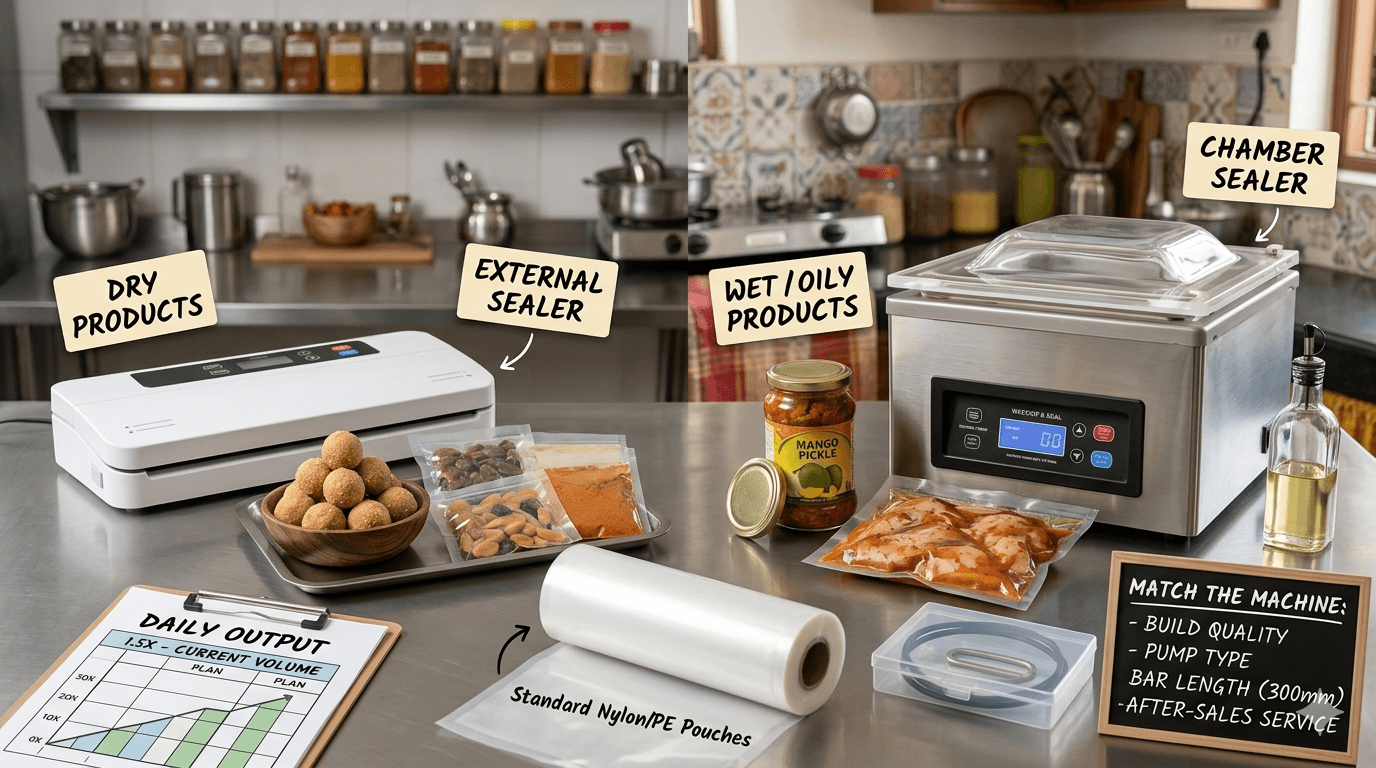
1. Product type Dry products → external sealer is fine. Wet, oily, or liquid products → you need a chamber sealer.
2. Daily output Estimate how many packs per day you need to seal. Look at the machine’s cycle time (usually 15–40 seconds per pack) and make sure it can comfortably handle 1.5X your current volume.
3. Sealing bar length Standard is 260 mm or 300 mm. Make sure it fits your largest pouch size.
4. Pump type Dry pump — cheaper, lower maintenance, fine for dry products. Oil pump — stronger suction, better for liquids, slightly more upkeep.
5. Build quality Stainless steel body holds up in a commercial kitchen; plastic bodies don’t.
6. After-sales service Ask where the service center is, whether spares (heating elements, pump oil, gaskets) are easily available, and what the warranty covers.
7. Pouch ecosystem Confirm the machine works with standard food-grade nylon/PE pouches available in your city. Proprietary pouches will lock you into a single supplier.
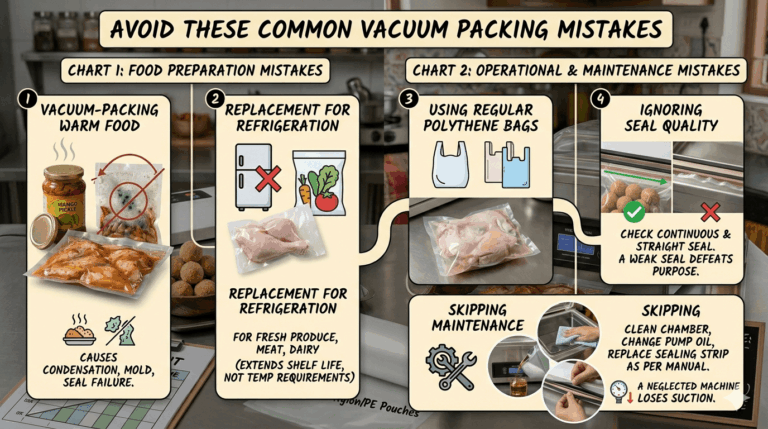
Common Mistakes to Avoid
Industries That Use Tabletop Vacuum Packing Machine
MEDICAL & PHARMA: Sealed pouches of sterilized instruments and a blister pack of small vials.
ELECTRONICS: Circuit boards and sensitive microchips.
PRECISION HARDWARE: Tiny gears and springs for manufacturing.
COLLECTIBLES: Rare coins and vintage trading cards in a protective sleeve.
SPECIALIZED MANUFACTURING: Samples of fine powders.
Frequently Asked Questions
Conclusion
The Smallest Investment With the Biggest Compounding Payoff
If you’re a small food business trying to grow, a table top vacuum packing machine isn’t a nice-to-have — it’s the single highest-leverage piece of equipment you can buy after your core cooking tools. It protects the margin you’ve already earned, unlocks markets you couldn’t previously reach, and gives your brand the professional polish that modern retail demands.
Five times the shelf life. A fraction of the waste. A much bigger map for your business.
Ready to take the next step? Start by identifying your top-selling SKU, calculate its current wastage, and match that number against the cost of a machine that fits your product type. Most small businesses find the investment pays for itself within 60 days — and then keeps paying, forever.
If you found this guide useful, share it with another food entrepreneur who is still wrapping their product in cling film and hoping for the best.