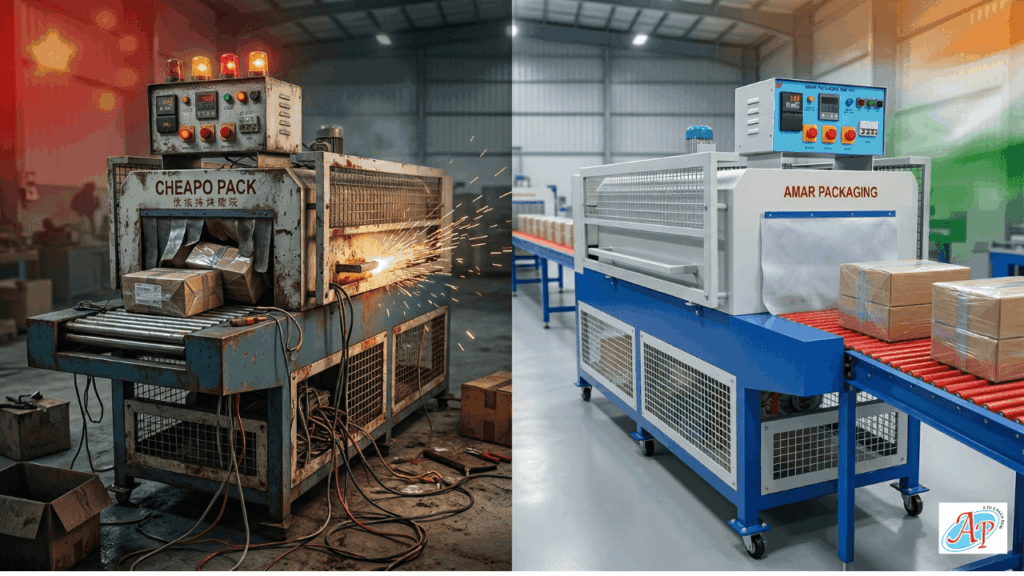
Every year, thousands of Indian manufacturers import packaging machines from China, attracted by prices that seem 40–60% lower than domestic alternatives. On paper, it looks like a smart business move. In reality, Chinese packaging machine problems in India have cost countless businesses far more than they ever saved.
If you run an MSME, a food processing unit, a pharma packaging line, or a contract packing facility — this article is written specifically for you. We have spent years in the Indian packaging machinery industry, working directly with manufacturers who have experienced these problems first-hand. What follows is an honest, detailed breakdown of the real challenges Indian buyers face after importing packaging machines from China.
This is not about bashing any country’s manufacturing. It is about helping you make a well-informed capital investment decision — because in packaging, the wrong machine does not just waste money. It stops your production line.
Why Chinese Packaging Machines Attract Indian Buyers
Before we discuss the problems, let us understand the appeal. China’s packaging machinery industry benefits from massive-scale supply chains, specialised industrial clusters, and lower raw material costs. A machine quoted at ₹40 lakh by an Indian or European manufacturer might be available from a Chinese factory for ₹15–18 lakh.
Chinese manufacturers also project strong technological parity. Servo-driven mechanisms, touchscreen HMIs, and branded PLCs appear on their specification sheets — giving the impression of European-grade technology at MSME-friendly pricing.
For Indian MSMEs operating on razor-thin margins, this price gap is genuinely hard to resist. But as hundreds of buyers have discovered, the base price is only the beginning of the story.
Problem 1: Electronic Burnout from Indian Power Supply
This is the single most immediate failure point, and it hits hard.
Chinese packaging machines are engineered for China’s highly stable, modernised electrical grids. Their PLCs, servo drives, and thermal overload protectors are designed to handle a narrow voltage fluctuation — often as tight as 2 volts.
Indian industrial power, especially outside metro cities, fluctuates across a 110-volt range. Voltage dips to 140V and surges to 250V are routine in Tier 2 and Tier 3 cities. When a Chinese machine encounters this, the delicate electronic controllers suffer thermal overload. The result is sudden and total — the PLC burns out, the servo drive fails, and the entire machine goes dead.
Replacing these components is not a quick fix. Because these are often proprietary parts, you cannot source local equivalents. You wait weeks for replacements from Shenzhen.
What this means for your business: One serious voltage event can knock your production line offline for 4–8 weeks. If you are in a region with unstable power, this risk is almost guaranteed.
Problem 2: Spare Parts Delays of 4 to 8 Weeks
When a critical component fails — a sealing jaw, a sensor, a gear, or a PLC module — Indian buyers discover the harsh reality of the spare parts supply chain.
Within China, a replacement part might arrive in 2 days. For an Indian buyer, the same part routinely takes 4 to 8 weeks. This is not just a logistics issue. Geopolitical tensions between India and China have created additional friction — heightened customs scrutiny, holding periods for Chinese machinery sub-assemblies, and restrictions on Chinese technical personnel travelling to Indian factories.
The result is that a minor mechanical fault — something that should cost you a day of downtime — becomes a month-long production crisis. Your raw materials expire, your labour sits idle, and your delivery commitments to clients collapse.
Problem 3: Proprietary Software Lockouts
Many Chinese OEMs install proprietary, password-locked PLCs and HMIs in their machines. When a fault triggers a hard stop, your local technician — no matter how skilled — cannot access the software to diagnose or recalibrate the machine.
You become entirely dependent on the Chinese manufacturer for remote unlocking or dispatching proprietary modules. If the manufacturer is unresponsive, or if your agent has disappeared post-sale, your machine sits frozen on the factory floor.
This is one of the most frustrating Chinese packaging machine problems in India because the hardware might be perfectly fine. The machine is locked by software — and you have no key.
Problem 4: Material Incompatibility with Indian Packaging Films
Chinese packaging machines are calibrated for the standardised, virgin plastic films used widely in China. Indian manufacturers, driven by cost pressures and sustainability mandates, extensively use recycled LDPE and BOPP films.
These Indian films have inconsistent thickness, unpredictable friction coefficients, and fluctuating melting points. A Chinese VFFS machine with standard impulse sealing bars — lacking dynamic auto-modulation — struggles badly with this variability.
When the film is slightly thicker, the heat is insufficient and you get weak, leaking seals. When it is thinner, the temperature burns through the film, melting plastic onto the sealing jaws and jamming the forming tube. The same problem occurs with Indian corrugated boards, which carry higher moisture content than rigid Chinese paperboard. Chinese carton erectors jam frequently on Indian materials.
The practical impact: Material rejection rates of 10–15% are common, directly eating into your margins on every production run.
Problem 5: Zero After-Sales Support in India
This is the problem that turns every other problem into a crisis.
An estimated 19% of Indian industrial firms still rely on reactive, run-to-fail maintenance. When your Chinese machine breaks down, you need expert support immediately. But most budget Chinese OEMs have no service infrastructure in India — no local engineers, no regional spare parts warehouses, no technical helpline.
If you imported directly through an online B2B platform, you likely have zero local support. Even if you purchased through an Indian agent, many agents operate as pure commission brokers who vanish after the sale is complete.
Industry data suggests that unplanned downtime in Indian manufacturing costs Laks per hour. Without local support, every breakdown becomes an extended, expensive crisis.
Problem 6: Hidden Import Costs That Kill the Price Advantage
The primary reason you considered a Chinese machine was the price. But the final landed cost in India is dramatically different from the FOB price you were quoted.
Here is how the costs stack up on a machine with a $20,000 (approximately ₹17 lakh) FOB price:
- Basic Customs Duty (BCD): 7.5% to 20%
- Social Welfare Surcharge (SWS): 10% on BCD
- Integrated GST (IGST): 18% on the cumulative total of CIF value + BCD + SWS
- Anti-Dumping Duties: For certain plastic processing and packaging machinery, the DGTR imposes ADDs ranging from 27% to 63%
- Port handling, CHA charges, demurrage: Variable but always significant
When all duties, taxes, and logistics costs are aggregated, the final landed cost of the Chinese machine frequently equals — or exceeds — the price of a better-quality Indian alternative. The 40% saving that drove your purchase decision has evaporated.
Problem 7: BIS Scheme X Compliance Threat
The Bureau of Indian Standards has introduced the Machinery and Electrical Equipment Safety Order — commonly called Scheme X. Full enforcement is scheduled for September 2026.
Under Scheme X, all industrial machinery including packaging, sealing, and labelling equipment must carry formal BIS certification. For Chinese manufacturers, this requires going through the Foreign Manufacturers Certification Scheme (FMCS) — a process involving factory audits in China by Indian officials, lab testing, and exhaustive documentation. The process takes a minimum of 6–7 months.
Budget Chinese machinery, often assembled from non-standardised components, is highly unlikely to pass Scheme X safety protocols. If the machines are not certified, they will be permanently blocked at Indian customs.
What this means for you: If you are planning a purchase for late 2025 or 2026 delivery, you must verify BIS certification before placing your order. Otherwise, your machine may never clear Indian customs.
Problem 8: Poor Documentation and Language Barriers
Chinese packaging machines frequently arrive with user manuals that have been machine-translated into barely comprehensible English. Critical documents — electrical schematics, pneumatic routing diagrams, troubleshooting guides — are often missing, outdated, or available only in Mandarin.
The problem extends to the machine itself. Touchscreen HMIs often display poorly localised menus, and hardcoded Mandarin error messages appear when faults occur. Your line operators cannot identify the root cause when an optical sensor fault or jaw jam triggers an automatic stop. This leads to extended troubleshooting, increased scrap, and severe operator frustration.
Problem 9: Environmental Degradation in Indian Factory Conditions
Indian factory environments — high ambient heat, extreme monsoon humidity, and heavy dust from spices, flour, and grains — are brutal on imported electronics.
Budget Chinese machines typically use low-cost photoelectric sensors and proximity switches with inadequate Ingress Protection ratings. Dust accumulation blinds optical sensors, preventing accurate film registration and causing misaligned cuts and massive material waste. Monsoon humidity exceeding 75% causes condensation inside poorly sealed electrical cabinets, leading to moisture-induced short circuits in PLCs and corrosion in pneumatic cylinders.
Industrial dehumidifiers and fluoropolymer sealing systems that would protect against these conditions are routinely omitted from budget Chinese machines to keep the export price low.
Problem 10: B2B Scams and Ghost Factories
The digital procurement ecosystem on platforms like Alibaba and Made-in-China is rife with sophisticated fraud.
Indian buyers frequently encounter “ghost factories” — trading companies with no actual manufacturing facility. They use professional-looking websites with plagiarised images of high-end machinery, collect substantial advance payments, and deliver substandard equipment or nothing at all.
Even when dealing with legitimate suppliers, cross-border dispute resolution is enormously difficult. Contracts signed with Chinese companies are notoriously hard to enforce across jurisdictions. For the average Indian MSME, pursuing international litigation is prohibitively expensive and time-consuming.
Chinese Packaging Machine vs Indian Packaging Machine — An Honest Comparison
| Factor | Chinese Import (Budget/Direct) | Indian Manufacturer |
|---|
| Upfront Price | 30–60% lower | Moderate |
| Total Cost Over 3 Years | Often higher (downtime + parts + duties) | Predictable and lower |
| Power Grid Resilience | Very low — designed for stable Chinese grids | High — engineered for Indian power fluctuations |
| Spare Parts Delivery | 4–8 weeks from China | 24–48 hours local dispatch |
| After-Sales Support | Uncertain, agent-dependent | Direct OEM support available |
| Material Compatibility | Calibrated for Chinese virgin films | Calibrated for Indian recycled films |
| BIS / FSSAI Compliance | High risk of failure | Fully compliant |
| Documentation | Often in Mandarin, poorly translated | Full English / Hindi documentation |
| Dispute Resolution | Cross-border, very difficult | Domestic legal recourse available |
The pattern is clear: the lower upfront cost of a Chinese machine is frequently offset — and exceeded — by higher operating costs, longer downtime, and regulatory risk.
How to Avoid These Problems
- If you are currently evaluating packaging machinery, here are practical steps to protect your investment.
- Calculate Total Cost of Ownership, not just the purchase price. Factor in import duties (30–60%), at least 10 days of unplanned downtime per year, spare parts shipping costs, and the cost of idle labour during breakdowns. Compare this total against a domestic machine quote.
- Demand open-architecture electronics. If you must import from China, your contract should specify globally standard, unlocked PLCs and HMIs — such as Siemens, Delta, or Allen Bradley. Refuse proprietary, locked systems. This single requirement can save you from the worst lockout scenarios.
- Insist on environmental hardening. Your purchase contract should mandate heavy-duty thermal overload protectors, IP65-rated dust-proof sensors, and moisture-resistant pneumatic systems. These are commonly omitted from budget Chinese machines to lower the price.
- Test with your actual materials before paying. Ship 50 kg of your exact Indian packaging film to the Chinese factory and insist on a Factory Acceptance Test (FAT) using your materials. Demand unedited video proof of continuous running. This simple step can reveal material incompatibility before the machine ships.
- Verify BIS certification. With Scheme X enforcement approaching in September 2026, confirm that the machine and manufacturer hold valid BIS certification under the FMCS. Without it, the machine will not clear Indian customs.
- Work with established Indian agents, not B2B platforms. If importing, always work through a legally bound Indian distributor or Value-Added Reseller who maintains local spare parts inventory and provides enforceable SLAs.
- Consider Indian manufacturers seriously. Domestic packaging machine builders engineer specifically for Indian power conditions, Indian materials, and Indian factory environments. Spare parts arrive in hours, not weeks. Service engineers can reach your factory within a day. And government schemes like CLCSS offer a 15% capital subsidy (up to ₹15 lakh) that can effectively close the price gap with Chinese imports.
Conclusion: Make the Right Machine Decision for Your Business
The appeal of low-cost Chinese packaging machines is easy to understand. For businesses operating on tight margins, a 40% upfront saving can seem like the right decision. However, as this analysis shows, the hidden risks — electronic failures, long spare part delays, software lockouts, and compatibility issues — often lead to significantly higher costs over time.
For manufacturers running operations involving equipment like a Shrink Tunnel Machine or a vacuum packaging machine, even a few days of unplanned downtime can disrupt production schedules and impact client commitments. What initially appears to be a cost-saving investment can quickly turn into a long-term operational risk.
At the same time, the Indian packaging machinery industry has evolved rapidly. Today, working with a reliable Indian packaging machine manufacturer means getting machines designed specifically for Indian power conditions, locally available spare parts, and faster service support — all of which directly reduce downtime and improve efficiency.
Before making a final decision, it is critical to evaluate the total cost of ownership, not just the purchase price. Consider downtime, maintenance delays, and long-term reliability.
Because in packaging, the real question is not how much you save upfront —
it is how much your business can afford to lose when the machine stops.
Frequently Asked Questions