Automatic Shrink Wrapping Machine -
Expert Guide for Selection, Compatibility, and Line Integration
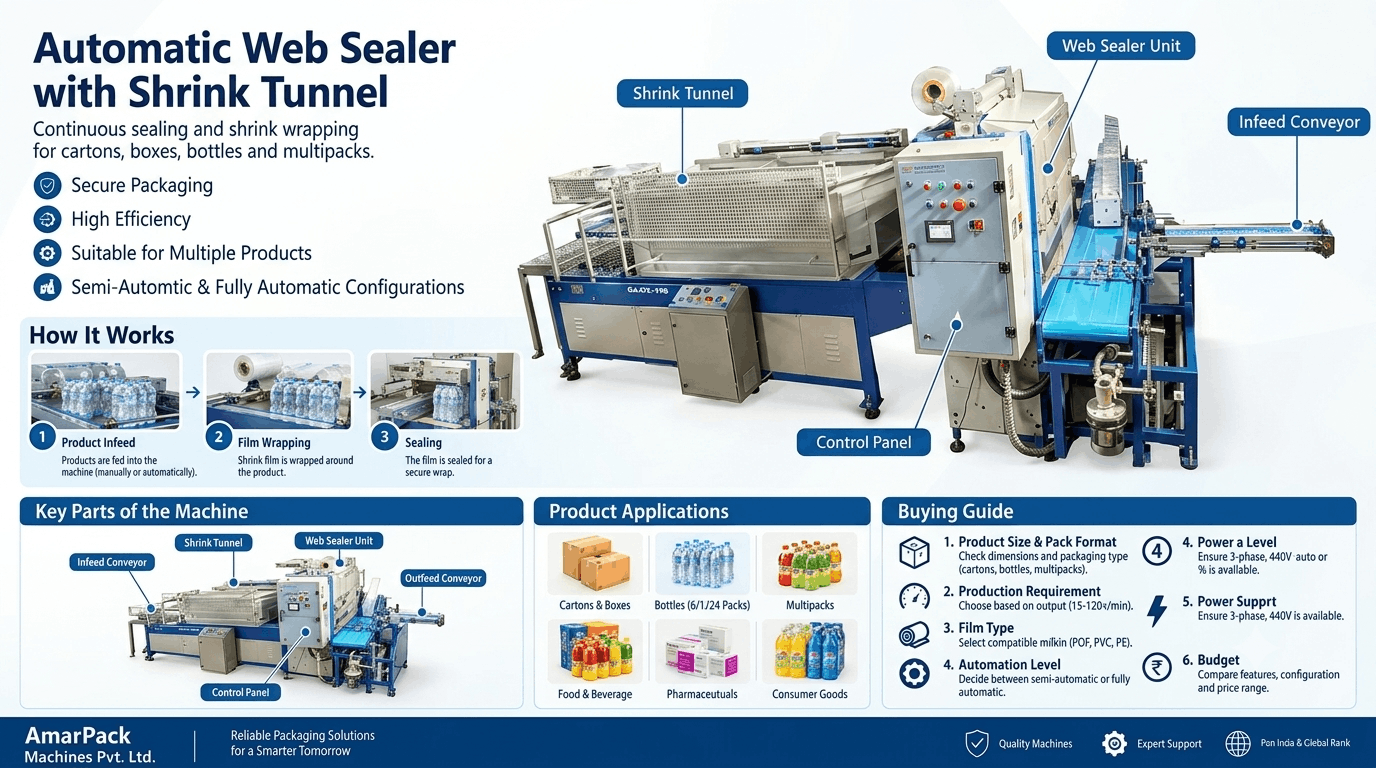
An automatic shrink wrapping machine automates product feeding, film wrapping, sealing, cutting, and shrinking. It is widely used for cartons, bottles, food products, cosmetics, pharmaceutical products, and industrial packaging. Choosing the right machine depends on more than production speed. Product size, film type, sealing method, shrink tunnel capacity, and production-line integration all affect the final packaging quality and machine performance.
An automatic shrink wrapping machine achieves maximum line efficiency (25 to 60+ packs per minute) only when three interdependent variables align: “dwell time, blade seal temperature, and tunnel airflow velocity.” Deviations in these settings cause 85% of packaging line failures—such as burn-through, “dog ears,” or film slippage. This technical guide outlines operational benchmarks, diagnostic tables for common packaging defects, and film-yield formulas to help plant managers optimize uptime and minimize consumable waste.
How to Choose an Automatic Shrink Wrapping Machine
Dimensions & Mass: Length, width, height, and unit weight.
Line Output: Target speed in packs per minute (PPM).
Film Spec: POF (retail) vs. LDPE (heavy-duty transit).
SKU Diversity: Number of box sizes and required changeover speed.
Site Limits: Conveyor speeds, layout footprint, and electrical load.
Intermittent vs. Continuous Motion Shrink Wrapping Machines
| Parameter | Intermittent Motion | Continuous Motion |
|---|---|---|
| Typical application | Lower/medium-speed packaging | High-speed production |
| Product movement | Periodic indexing | Continuous movement |
| Sealing | L-bar / intermittent sealing | Continuous side seal + cross seal |
| Typical speed | Approx. 20–45 PPM | Approx. 50–120+ PPM |
| Machine complexity | Moderate | Higher |
| Changeover | Generally simpler | More sophisticated |
| Best suited for | Cartons, boxes, retail packs | Bottles, multipacks, high-volume production |
Actual speed depends on product dimensions, film, package configuration, machine design, and upstream line speed.
Technical Parameter Matrix: Film Chemistry vs. Machine Calibration
Shrink film performance changes drastically depending on polymer density. Setting incorrect tunnel temperatures or conveyor speeds results in structural weak points or incomplete shrinkage.
| Film Type | Gauge Range | Typical Seal Bar Temp (°C) | Tunnel Air Temp (°C) | Optimal Conveyor Speed (m/min) | Primary Applications |
|---|---|---|---|---|---|
| POF (Polyolefin) | 12 – 25 µm | 140°C – 165°C | 150°C – 180°C | 12 – 20 | Cosmetics, Retail Multi-Packs, Food Boxes |
| LDPE (Polyethylene) | 35 – 100+ µm | 180°C – 220°C | 180°C – 230°C | 6 – 12 | Beverage Cans/Bottles, Heavy Cartons, Trays |
| PVC (Cross-linked) | 15 – 30 µm | 130°C – 150°C | 130°C – 160°C | 10 – 16 | Hardware, Stationery, CD/DVD Bundles |
To calculate the ideal center-folded shrink film size for your product, use these standard sizing formulas:
Film Width: Product Width + Product Height + Clearance (25 mm to 40 mm)
Cut Length: Product Length + Product Height + 30 mm
The clearance ensures smooth feeding around the product without tearing, while the extra 30 mm on the cut length protects the seal bar from clipping the edges. Trimming just 15–20 mm of excess film width saves 1 to 2 grams of plastic per package. On an automatic line running 45 packs per minute for two shifts, that small adjustment eliminates over 15 tons of film waste annually—saving tens of thousands of dollars in consumable costs per machine.
How Do You Choose Between a Manual Shrink Wrapping Machine and an Automatic Shrink Wrapping Machine?
When upgrading from manual hand-held wrapping devices, plant managers often debate between an entry-level manual shrink wrapping machine and a fully automated line. The choice depends entirely on your daily production volume, budget, and labor constraints.
A manual setup, such as a manual sleeve wrapper or L-sealer, is highly affordable and space-saving. It is strictly limited to low-volume operations where operators manually pull down a sealing bar. If your production requires a flexible, entry-level industrial setup, starting with portable shrink wrapping machines allows your operators to feed products manually while the machine handles high-speed shrinking.
For high-volume, growing production lines, an automatic shrink wrapping machine is essential. A fully automatic L-sealer or automatic sleeve wrapper runs continuously without requiring constant operator intervention. This setup eliminates manual labor bottlenecks, drastically increases packaging speed, and reduces plastic film wastage.
Integrating Automatic Shrink Wrappers into Existing Packaging Lines
A high-performance automatic shrink wrapping machine must work seamlessly with upstream and downstream equipment. Integrating infeed pacing sensors, synchronized conveyors, accurate product spacing, and controlled discharge prevents product collisions, film misalignment, and sealing defects.
For high-speed production lines, servo-driven systems ensure precise product positioning and repeatable motion, while integrated PLC and HMI controls simplify recipe management, real-time diagnostics, and SKU changeovers.
Key Steps for Conveyor Synchronization
When transitioning from manual or semi-automatic stations to an automated line, follow these three conveyor synchronization steps:
- Infeed Pacing: Install optical indexing sensors to space products 50–100 mm apart before the infeed belt reaches the sealer photo-eye.
- Discharge Alignment: Avoid drop transfers into the shrink tunnel. Use continuous live-roller transfers to prevent shifting or distortion of the un-shrunk, loose pouch.
- Outfeed Cooling: Integrate passive ambient cooling fans over the outfeed conveyor to set the film polymer before manual handling or automated carton packing.
Why Choose a Local Manufacturer for Your Shrink Wrapping Solutions in India?
While importing cheap, generic packaging machinery might seem attractive initially, it frequently leads to severe operational headaches. A single broken conveyor belt or a faulty heating element can shut down your entire dispatch line for days.
Partnering with an established, local Automatic Shrink Wrapping Machine manufacturer in India offers several critical advantages:
- Custom Engineering: Industrial packaging is rarely one-size-fits-all. A local manufacturer can customize conveyor heights, tunnel dimensions, and sealing bar lengths to integrate seamlessly into your existing factory floor.
- On-Site Technical Support: If a technical issue arises, having access to rapid, on-site service engineers in major manufacturing hubs like Mumbai ensures your downtime is measured in hours, not weeks.
- Ready Spare Parts: Sourcing replacement heating elements, Teflon-coated sealing blades, and conveyor belts locally eliminates long customs delays and high air-freight costs.
- Compliance and Standardization: Local manufacturers design machines to handle Indian power grid fluctuations and comply with domestic safety regulations, guaranteeing a safer work environment for your operators.