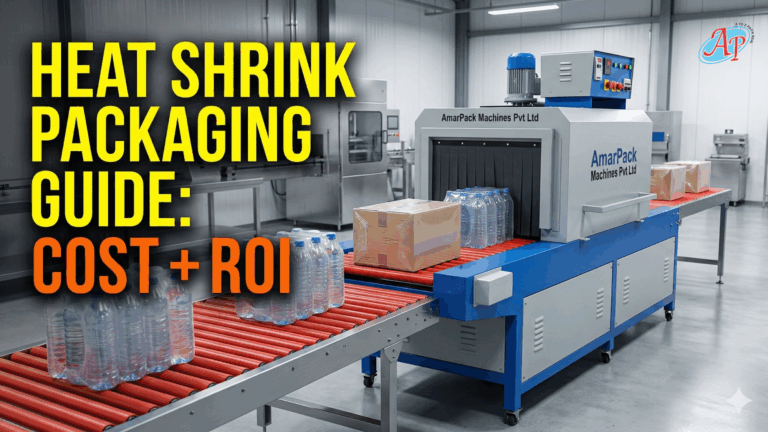
Heat Shrink Packaging Technology: Benefits, Cost Breakdown & ROI Guide 2025
When Kiran Patil, Operations Head at a mid-sized beverage company in Nagpur, walked into her new role, she immediately noticed a bottleneck:
➡️ Hand-wrapped boxes, slow throughput, high product damage, and constantly rising labor expenses.
Her first major upgrade?
A heat shrink packaging system.
Within six months:
Efficiency increased by 43%
Product damage dropped to almost zero
Packaging cost per unit reduced noticeably
Retailers praised the improved shelf-ready appearance
Sarah’s story is no exception. Across global manufacturing—from beverages and FMCG to pharma and electronics—heat shrink technology is transforming packaging lines.
This guide shows you exactly why, backed by data, ROI calculations, and real industry examples.
What is Heat Shrink Packaging Technology? (And Why It Matters in 2025)
Heat shrink technology uses polymer-based shrink film that contracts around products when exposed to controlled heat. The result is a tight, protective, tamper-evident, and visually appealing wrap.
Unlike traditional cardboard or stretch wrap, heat shrink packaging offers:
360° product visibility
Strong protective sealing
Lower material consumption
High-speed processing
Consistency and automation readiness
Modern systems include:
The packaging landscape in 2025 demands:
✔ Higher speed
✔ Lower cost-per-package
✔ Sustainability
✔ Multi-size flexibility
✔ E-commerce friendly packaging
Heat shrink technology meets all these requirements simultaneously.
7 Game-Changing Benefits of Heat Shrink Packaging Technology
1. Superior Product Protection That Customers Can Trust
Shrink film forms a tight, weather-resistant, tamper-evident protective layer.
A vitamin manufacturer in New Jersey saw product returns drop by 67% after switching from cardboard boxes to heat shrink bundling.
Key protection advantages:
Moisture & dust resistance
UV shielding
Visible tamper evidence
Excellent for long-distance logistics
Stabilizes multipacks (cans, bottles, jars)
Prevents product scuffing & label damage
2. Massive Labor Cost Reduction (40–60% Savings)
3. Lower Material Costs (30–50% Per Unit Savings)
Shrink film is cheaper and lighter than boxes, clamshells, or rigid packaging.
Real example:
A beverage company switched from cardboard carriers to shrink film for 12-can packs and saved 2.25 rs per pack (approx).
Across 2 million units, that’s 280,000 rs annual savings (approx).
This is why heat shrink packaging is now preferred in:
4. High-Speed Packaging that Scales Production
Speed comparison:
| Packaging Method | Throughput |
|---|
| Manual wrapping | 5–10 units/min |
| Stretch wrap | 15–25 units/min |
| Heat shrink systems | 30–150 units/min |
High-speed lines can exceed 180+ packs/minute, enabling manufacturers to:
5. Adaptability for Multiple Products (Fast Changeovers)
Heat shrink systems handle a wide range of products without custom tooling.
Example:
A snack company runs 5 sizes of chip bags with under 10-minute changeovers (previously 45–60 minutes using boxes).
Shrink film naturally conforms to:
Bottles & cans
Pouches & packets
Boxes, cartons
Electronics
Tools
Cosmetics
Pharma bottles
6. Premium Shelf Appearance That Boosts Sales
Crystal-clear shrink film delivers:
High transparency
Neat presentation
Tight finish
Branding visibility
Retail-ready multipacks
Brands using printed shrink film often report improved shelf appeal and increased consumer trust.
7. Sustainability Advantages That Matter in 2025
Modern shrink films are lighter, recyclable, and optimized for reduced carbon footprint.
Eco benefits:
Up to 70% less packaging material vs. boxes
Recyclable PE & POF films
Bio-based (PLA) shrink films available
Lower shipping weight → reduced fuel emissions
Zero staples, tapes, adhesives
A European distributor achieved carbon-neutral packaging using recycled-content shrink film.
Heat Shrink Packaging Cost Breakdown (2025 Pricing)
Let’s break down transparent equipment cost ranges.
Entry-Level Shrink Wrapping Machine (Portable)
📌 Price: 86,500 – 96,500
📌 Speed: 10–30 products/min (depends on product size)
📌 Ideal For: Small manufacturers, startups, trial runs
Standard Or Heavy Duty Shrink Wrapping Machine
📌 Price: 128,000 – 236,000
📌 Speed: 30–60 products/min (depends on product size)
📌 Ideal For: FMCG, cosmetics, pharma, food, Large-scale factories & 24/7 production
Web Sealer or L-Sealer With Shrink tunnel Machine
📌 Price: 118,000 – 350,000+
📌 Speed: 100–150+ products/min (depends on product size and machine model)
📌 Ideal For: FMCG, cosmetics, pharma, food, Large-scale factories & 24/7 production
Operating Cost (Monthly)
Film: ₹5,000 – ₹15,000 per month
(Depends on film micron, product size & daily output)
Electricity: ₹4,000 – ₹9,000 per month
(Heating chamber + conveyor load, based on 6–8 hours/day usage)
Maintenance: ₹500 – ₹2,000 per month
(Cutters, Teflon, heaters, blower servicing, routine lubrication)
Labor: 40% – 60% Reduction in Manpower
(Automation reduces loading, sealing & conveying effort)
➡️ Total Monthly Cost: ₹6,000 – ₹20,000 per month
ROI Calculation (Real Example)
Total Investment (Average for Standard/Heavy Duty Line):
📌 ₹1,28,000 – ₹2,36,000
(or higher for Web Sealer/L-Sealer with Shrink Tunnel)
Monthly Savings:
Labor Savings: ₹18,000 – ₹40,000 per month
(due to reduced manual sealing, packing & handling)
Material Savings: ₹8,000 – ₹15,000 per month
(precise film cutting + reduced wastage vs manual packing)
Total: ₹20,000 – ₹55,000 per month
Payback Period:
📌 3.5 – 6 Months
(Industry Benchmark for India: 3–8 Months)
(Read More To Know More About ROI Calculator)
3 Real-World Case Studies Across Industries
Case Study 1: Beverage Manufacturing (Nagpur)
Challenges: Damage during transport, slow packaging speed
Solution: Automatic side sealer + printed shrink film
Results:
Speed: +156%
Damaged goods: -89%
Labor cost: -$94,000
Retail presence: +23%
Case Study 2: E-Commerce Warehouse (Banglore)
Challenges: Multiple box sizes, slow pick-and-pack
Solution: Universal shrink bundling
Results:
Box inventory: Reduced from 47 SKUs → 12
Packaging time/order: -62%
Shipping cost: -18%
Packaging complaints: -77%
Case Study 3: Pharma Bottles & Supplements (Mumbai)
Challenges: Tamper-evident compliance
Solution: Shrink bands + full shrink wraps
Results:
FDA compliance achieved
Packaging cost: -42%
Speed: +89%
How to Choose the Right Heat Shrink Packaging System
Step 1: Determine Your Throughput
< 10 units/min → Manual L-Bar Sealer
10–50 units/min → Semi-Automatic System
50–100 units/min → Automatic Inline System
100+ units/min → High-Speed Shrink Line
Don’t buy a machine you’ll outgrow in 18 months.
Step 2: Analyze Product Characteristics
Temperature-sensitive → Low-temp film, controlled tunnels
Irregular shapes → Side sealers with adjustable conveyors
Heavy items → PE films with reinforced seals
Step 3: Check Space & Utilities
Machines require 15–25 ft space
208–480V three-phase power
Proper ventilation for heat tunnels
Step 4: Choose the Right Shrink Film
POF (Polyolefin): High clarity, versatile, FDA-approved
PE (Polyethylene): Tough, ideal for multipacks
PLA: Eco-friendly, compostable
PVC: Less common; environmental concerns
(Read Blog to Know More About this)
Step 5: Integration with Existing Lines
Conveyor matching
PLC compatibility
Speed synchronization
Safety integration
Common Mistakes to Avoid
Future Trends in Heat Shrink Technology (2025–2030)
IoT-enabled shrink systems
Film usage analytics
AI-powered defect detection
Affordable bio-based films
Compact high-speed shrink tunnels
Hybrid shrink + printed wrap systems
Is Heat Shrink Packaging Right for Your Operation?
✔ Multipacks and bundling
✔ Tamper-evidence required
✔ High labor packaging cost
✔ High shipping damage
✔ Multi-size product lines
✔ Weekly throughput > 1,000 units
Conclusion: Your Packaging Line's Next Big Upgrade
Heat shrink technology delivers:
Faster production
Stronger protection
Better appearance
Lower cost-per-pack
Higher ROI
Exactly what Sarah Mitchell achieved—her company installed a second shrink line, secured investor funding, and tripled output within two years.
Your packaging line could be next.
Frequently Asked Questions (FAQ)