Call Now: +91 9920114400
GST No: 27AAZCA2345J1Z6
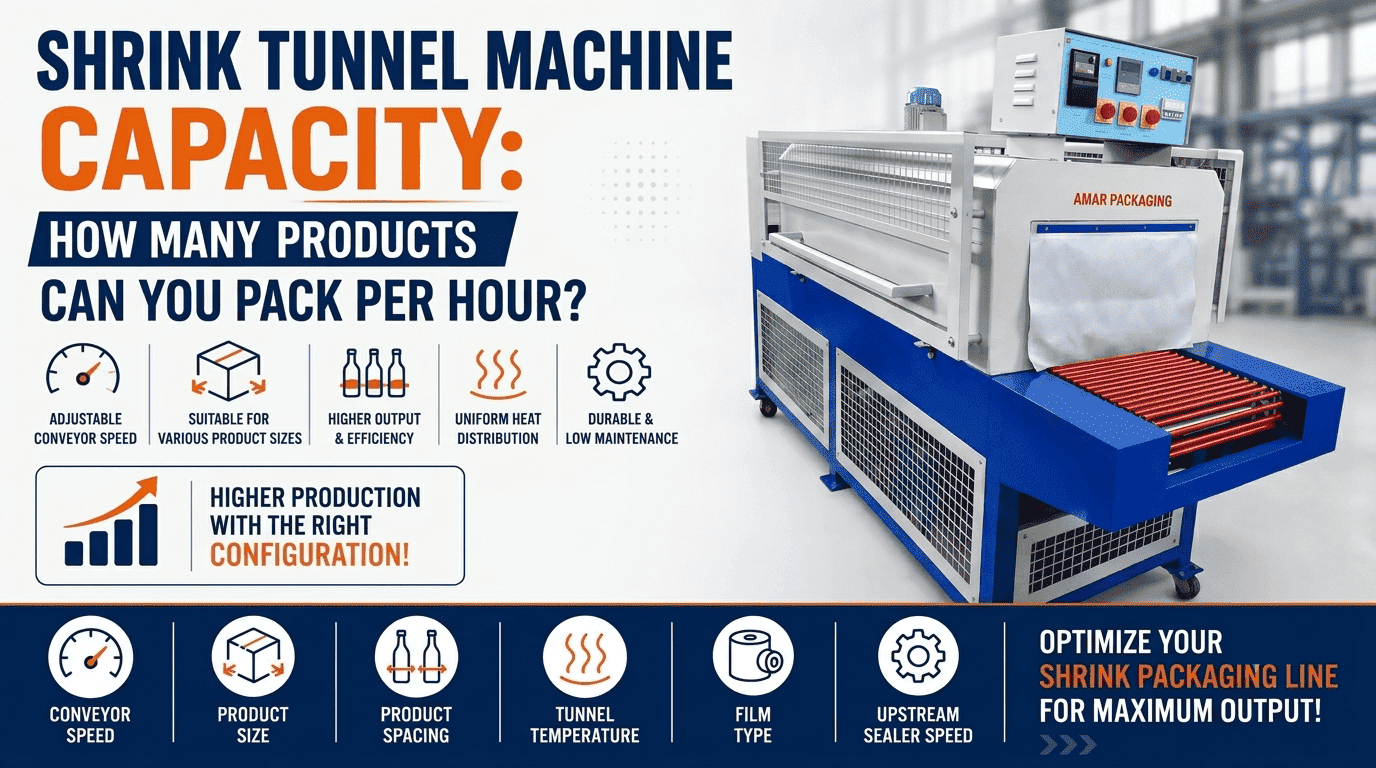
For manufacturers, FMCG companies, food processors, pharmaceutical businesses, and other industries, a shrink tunnel machine plays an important role in automated shrink packaging. It uses controlled heat to shrink plastic film tightly around a product or product bundle, creating a secure, professional and consistent package.
One of the most important questions when selecting a shrink tunnel machine is production capacity:
How many products or packs can a shrink tunnel machine process per hour?
There is no single answer because actual production depends on several factors, including product dimensions, product spacing, conveyor speed, tunnel chamber size, shrink film, heating conditions, upstream sealing equipment and the overall packaging-line configuration.
This guide explains how a shrink tunnel machine works, how its capacity is calculated, what affects production per hour, and how to select the right machine for your packaging requirements.
A shrink tunnel machine is a heat-shrinking packaging machine that uses controlled hot air to shrink plastic film around a product or product bundle.
The product is first wrapped or sealed with suitable shrink film. It then travels through the heated tunnel on a conveyor. As the film passes through the controlled heating zone, it contracts around the product and forms a tight package.
A shrink tunnel machine can be used as part of a packaging system with equipment such as:
Common Applications of Shrink Tunnel Machines
Shrink tunnel machines are used across a wide range of industries, including:
The correct machine configuration depends on the product size, packaging format, required output and type of shrink film being used.
The working process of a shrink tunnel machine can be divided into several stages:
Product Wrapping
The product or product bundle is covered with suitable shrink film.
Film Sealing
An L-sealer, web sealer, sleeve wrapper or other sealing system closes the film around the product.
Product Infeed
The wrapped product enters the shrink tunnel through the conveyor system.
Controlled Heating
Hot air circulates inside the tunnel and transfers heat to the shrink film.
Film Shrinking
The film contracts and conforms closely to the shape of the product or bundle.
Finished Pack Discharge
The shrink-wrapped product exits the tunnel and can move to cooling, inspection, secondary packaging or palletizing.This means the shrink tunnel machine is normally one part of the complete packaging line. Its production capacity should therefore be considered together with the equipment feeding it.
The production capacity of a shrink tunnel machine depends on the complete packaging application.
Important variables include:
A simple theoretical calculation is:
Packs Per Hour = Packs Per Minute × 60
For example, if a packaging line processes 20 packs per minute:
20 × 60 = 1,200 packs per hour
However, theoretical capacity should not automatically be treated as practical production capacity. Loading, product spacing, film changes, machine adjustments, changeovers and upstream equipment can reduce actual output.
For this reason, the best way to determine the capacity of a shrink tunnel machine is to evaluate the actual product and complete packaging configuration.
Different packaging applications require different production levels.
Rather than assigning one universal capacity to every shrink tunnel machine, manufacturers should evaluate production according to their product and packaging configuration.
| Production Requirement | Typical Consideration |
|---|---|
| Small-scale production | Manual or semi-automatic feeding and flexible operation |
| Medium-scale production | Conveyorised semi-automatic or automatic configuration |
| High-volume production | Automatic feeding, continuous sealing and higher conveyor throughput |
| Industrial production | Integrated packaging line designed around the required output |
The actual number of packs per hour should be confirmed based on product dimensions, pack configuration, film characteristics, tunnel settings and upstream machine capacity.This approach is more reliable than selecting a machine only from a maximum conveyor-speed specification.
A more practical capacity estimate can be made by considering conveyor speed and product pitch.
Product Pitch = Product Length + Gap Between Products
For example, if:
Then:
Product pitch = 10 + 2 = 12 inches
Convert the conveyor speed to inches per minute:
50 × 12 = 600 inches/minute
Then:
600 ÷ 12 = 50 packs/minute
The theoretical hourly output becomes:
50 × 60 = 3,000 packs/hour
If an operational efficiency factor of 85% is applied:
3,000 × 0.85 = 2,550 practical packs/hour
This example demonstrates why actual production depends on more than conveyor speed.
The same shrink tunnel machine can produce different outputs depending on product size, spacing, operating conditions and line efficiency.
Products Per Hour vs Packs Per Hour
When discussing shrink tunnel machine capacity, it is important to distinguish between products and packs.
A pack may contain multiple individual products.
For example, if six water bottles are shrink-wrapped together:
1 pack = 6 bottles
If the packaging line produces:
1,000 packs/hour
then the individual product output is:
1,000 × 6 = 6,000 bottles/hour
Therefore, manufacturers should specify whether their production requirement is measured in:
This avoids confusion when comparing different packaging machines or requesting a quotation.
Several factors influence the actual production capacity of a shrink tunnel machine.
Product size directly affects tunnel requirements and production planning.
Large cartons and multipacks may require:
Smaller products can generally be arranged with a smaller product pitch, potentially allowing more units to pass through the tunnel per minute.
Shrink tunnel machine speed determines how quickly products travel through the heating chamber.
A variable-speed conveyor allows the operator to adjust product movement according to:
However, increasing conveyor speed does not automatically increase usable production.
The product must receive sufficient heat exposure for the film to shrink properly.
Product pitch is another important factor affecting production.
If products are placed far apart, fewer products can enter the tunnel per minute.
If products are efficiently spaced while maintaining the required clearance for the application, more packs can potentially be processed using the same conveyor speed.
For this reason, machine capacity should be calculated using the actual product arrangement rather than a conveyor speed alone.
The shrink tunnel machine chamber size must accommodate the largest product or pack configuration being processed.
Important dimensions include:
A machine should be selected according to the maximum product dimensions and packaging arrangement rather than only the expected average product size.
The film used for packaging also affects shrink tunnel performance.
Common shrink films include:
Different films have different shrink characteristics and processing requirements.
The tunnel temperature, airflow and conveyor speed should therefore be adjusted according to the selected film and product application.
The film must receive adequate heat exposure to shrink correctly.
Dwell time refers to the time the product remains inside the heating zone.
If conveyor speed is increased without maintaining adequate heating conditions, the film may not achieve the desired shrink quality.
A well-designed shrink tunnel machine balances:
Temperature + Airflow + Dwell Time + Conveyor Speed
to achieve consistent packaging results.
This is one of the most important factors when determining practical production capacity.
A shrink tunnel cannot process more wrapped products than the equipment feeding it.
For example:
Upstream sealer = 1,200 packs/hour
Shrink tunnel = 2,000 packs/hour
The complete packaging line cannot realistically produce 2,000 finished packs per hour because the sealer is supplying only 1,200 packs per hour.
Therefore, the overall packaging-line capacity is influenced by its slowest production stage.
A common mistake is to evaluate the shrink tunnel separately from the rest of the packaging line.
A complete shrink packaging process may include:
Product Loading → Sealing → Shrink Tunnel → Cooling → Inspection → Secondary Packaging
Every stage needs to support the required production rate.=====
For example:
Packaging Stage | Capacity |
Product feeding | 1,500 packs/hour |
Sealing | 1,200 packs/hour |
Shrink tunnel | 1,800 packs/hour |
Cooling/output | 1,500 packs/hour |
The practical line capacity will be constrained by the 1,200 packs/hour sealing stage.
This is why manufacturers should evaluate the complete line before selecting a high-capacity shrink tunnel machine.
Theoretical production and actual factory output are not always the same.
Several operational factors can reduce effective capacity:
Product Changeovers
Different product sizes may require adjustments to the machine, film or conveyor settings.
Manual Loading
If products are manually fed, operator speed and consistency can influence production.
Film Changes
Changing film rolls creates downtime and should be considered when calculating daily production.
Machine Adjustments
Temperature, conveyor speed and airflow may need adjustment when changing products.
Maintenance and Cleaning
Routine maintenance and cleaning reduce available production time but are necessary for reliable operation.
Warm-Up and Start-Up
The time required to bring the tunnel to operating conditions should be considered when calculating actual shift output.
For this reason, buyers should evaluate practical production capacity, not only the theoretical maximum.
The right shrink tunnel machine configuration depends on production volume, product type and available labour.
Semi-Automatic Shrink Tunnel Machine
A semi-automatic system may require manual product loading or feeding.
It can be suitable for:
Actual output can depend significantly on operator handling and upstream equipment.
Automatic Shrink Tunnel Machine
An automatic system can be integrated with:
Automatic systems are generally more suitable for businesses requiring consistent, continuous production with reduced manual handling.
High Capacity Shrink Tunnel Machine for Industrial Production
For high-volume applications, a high capacity shrink tunnel machine should be selected according to the complete production requirement.
Depending on the application, an industrial configuration may include:
The objective should not simply be the highest possible conveyor speed.
The better objective is:
Required Output + Consistent Shrink Quality + Reliable Continuous Operation
A machine that delivers consistent packaging at the required production rate can be more valuable than a machine with a higher theoretical speed that cannot maintain the required shrink quality.
Before purchasing a shrink tunnel machine, prepare the following information for the machine manufacturer.
Determine your current and expected production.
For example:
Current requirement: 600 packs/hour
Expected requirement: 1,000 packs/hour
Allowing reasonable production growth can help prevent the machine from becoming a bottleneck too soon.
Provide:
Use the largest product dimensions that the machine will need to process.
Specify whether the machine will process:
Specify the film type and thickness being used.
Determine whether you need:
Tunnel dimensions, conveyor height and machine layout should fit the available production area.
Whenever possible, conduct a product trial before finalizing the machine configuration.
A trial can help determine suitable:
Mistake 1: Choosing Only by Conveyor Speed
A high conveyor speed does not automatically mean high practical output.
Mistake 2: Ignoring the Upstream Sealer
The tunnel cannot process more products than the sealing system can supply.
Mistake 3: Confusing Products With Packs
Always specify whether your target is products/hour or packs/hour.
Mistake 4: Ignoring Product Spacing
Product pitch directly affects how many packs can travel through the tunnel per minute.
Mistake 5: Using Maximum Rated Capacity as Guaranteed Production
Rated capacity may be based on specific product and operating conditions.
Mistake 6: Skipping Product Trials
Testing the actual product and film helps establish realistic machine settings before purchase.
AmarPack Machines Pvt. Ltd. manufactures shrink tunnel and shrink wrapping solutions for different product sizes, packaging formats and production requirements.
Machine configuration can be evaluated according to:
For manufacturers with different production requirements, the machine should be configured around the actual application rather than selected only from a standard capacity figure.
If you are evaluating a shrink tunnel machine, sharing your product dimensions, packaging configuration, film type and required production rate can help determine a suitable machine configuration.
The capacity of a shrink tunnel machine is not determined by one specification alone.
Actual production depends on the relationship between:
Product Size + Product Spacing + Conveyor Speed + Film + Heating + Dwell Time + Upstream Sealer Capacity
A machine with a high theoretical conveyor speed may not deliver high practical production if the product requires longer heating time or the upstream sealing machine cannot supply enough packs.
For this reason, manufacturers should select a shrink tunnel machine based on their complete packaging application rather than relying only on a maximum packs-per-hour figure.
If you are planning to increase production or automate your shrink packaging process, provide your product dimensions, pack configuration, film type and required packs per hour. These details can be used to evaluate the appropriate shrink tunnel machine configuration for your production line.

Founded in 1998 in Mumbai, India, AmarPack Machines Pvt. Ltd. is one of India’s leading manufacturers and exporters of premium packaging machines. Read More
Get a quick quote from our experts. Fast response guaranteed!