The Indian packaging industry stands at a pivotal transformation point. With the sector projected to reach ₹2.3 trillion by 2025, manufacturers are increasingly investing in advanced automation technologies to stay competitive. From AI-driven predictive maintenance to sustainable packaging solutions, the landscape is evolving rapidly—and companies that fail to adapt risk being left behind. As an industry expert who has witnessed the remarkable growth of packaging automation in India, I’ve identified 10 critical technology areas that are reshaping how manufacturers approach efficiency, sustainability, and profitability. This comprehensive guide addresses the most pressing challenges facing Indian packaging manufacturers today and provides actionable insights for technology adoption
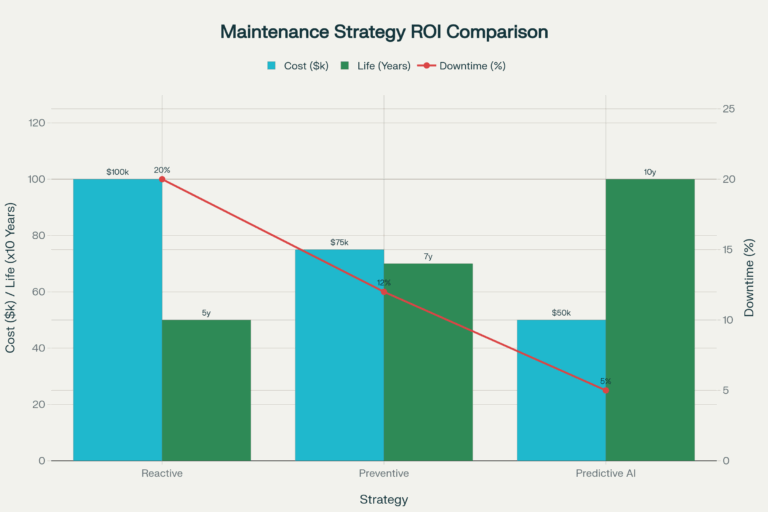
The chart titled Maintenance Strategy ROI Comparison clearly demonstrates the financial and operational benefits of evolving from reactive to more proactive maintenance approaches. The Reactive strategy, while the least planned, incurs the highest Cost at $100k and results in the shortest equipment Life at 5 years and the highest Downtime at 20%. Stepping up to a Preventive strategy immediately shows an improved return, dropping the cost to $75k, extending life to 7 years, and cutting downtime to 12%. The most substantial gains are realized with the Predictive AI strategy, which achieves the lowest Cost at $50k, maximizes equipment Life to 10 years, and minimizes operational Downtime to just 5%. This data powerfully illustrates that the initial investment and effort required for advanced planning and technology, particularly with Predictive AI, yields significantly better performance and a higher overall Return on Investment.
1. Predictive Maintenance ROI The Foundation of Smart Manufacturing
The Hidden Costs of Reactive Maintenance
Traditional maintenance approaches are bleeding Indian manufacturers dry. Unplanned downtime alone costs the manufacturing sector over ₹2,000 crores annually, with packaging lines particularly vulnerable due to their high-speed, continuous operations. Consider this: A typical VFFS machine operating at 150 bags per minute loses approximately ₹45,000 in revenue for every hour of unplanned downtime. Multiply this across multiple machines and shifts, and the financial impact becomes staggering.
AI Powered Predictive Maintenance: A Paradigm Shift
Modern predictive maintenance systems deliver remarkable ROI: Studies show that AI enabled predictive maintenance can reduce unplanned downtime by up to 40% while cutting maintenance costs by 1560%. For Indian packaging manufacturers, this translates to: Reduced Equipment Failures: Early detection prevents 85% of catastrophic breakdowns Real-World Implementation Strategy Leading Indian packaging companies are deploying IoT sensors to monitor: Vibration patterns in filling machines and sealers Temperature fluctuations in heat-sealing systems Motor current signatures in conveyor systems Hydraulic pressure variations in press operations Extended Equipment Life: Assets last 2040% longer with proactive care Optimized Labor: Maintenance teams focus on value-adding activities rather than emergency repairs
Real-World Implementation Strategy
Leading Indian packaging companies are deploying IoT sensors to monitor:
- Vibration patterns in filling machines and sealers
- Temperature fluctuations in heat-sealing systems
- Motor current signatures in conveyor systems
- Hydraulic pressure variations in press operations
Extended Equipment Life: Assets last 2040% longer with proactive care
Optimized Labor: Maintenance teams focus on value-adding activities rather than emergency repairs
Case Study: A Mumbai-based flexible packaging manufacturer implemented predictive
maintenance across their VFFS lines and achieved 23% reduction in maintenance costs while
improving OEE from 76% to 89% within 18 months.
2. Total Cost of Ownership (TCO) Analysis: Beyond the Price Tag
The TCO Reality Check
Most Indian manufacturers make the costly mistake of focusing solely on equipment purchase price. However, the initial cost represents less than 10% of total lifetime expenses. The remaining 90% includes energy, maintenance, labor, and downtime costs—areas where smart investments yield exponential returns.
Hidden Costs That Erode Profitability
Energy Consumption: Packaging equipment typically consumes 15-25% of a facility’s total energy. Modern servo-driven systems reduce energy consumption by 30-50% compared to pneumatic alternatives.
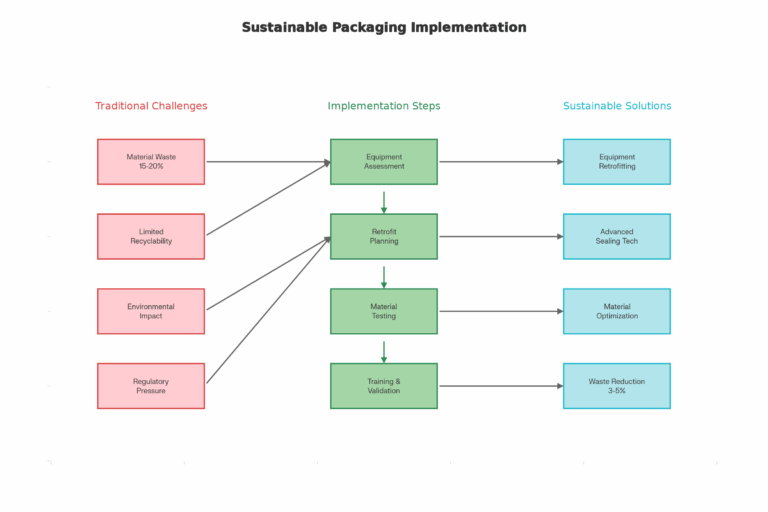
Material Waste: Poor equipment calibration leads to 15-20% material waste. Advanced packaging machines with precision controls reduce this to 3-5%, saving significant costs in high-volume operations.
Labor Inefficiencies: Manual interventions, changeover delays, and quality issues inflate labor costs. Automated systems with quick-changeover capabilities reduce labor requirements by 40-60%
TCO Optimization Framework
For Indian packaging manufacturers, a comprehensive TCO analysis should include:
Initial Investment (10-15% of total cost)
Operating Costs (35-40%): Energy, materials, labor
Maintenance (20-25%): Preventive, predictive, emergency repairs
Downtime Impact (15-20%): Lost production, overtime, expedited shipping
End-of-Life Value (5-10%): Resale, recycling, disposal costs
ROI Calculation Example: A ₹50 lakh automated packaging line with 8% annual maintenance costs but 35% higher efficiency will break even within 2.5 years compared to manual operations, considering labor savings and reduced waste.
3. Key Regional Manufacturing Hubs
The Bioplastics Challenge
India’s push toward sustainable packaging is accelerating, driven by consumer awareness and regulatory pressure. However, processing biodegradable and compostable materials on existing VFFS equipment presents unique technical challenges.
Material-Specific Challenges
Sealing Temperature Sensitivity: Bioplastics often require narrower temperature ranges (±2°C) compared to conventional films (±5°C). This demands precise thermal control systems.
Film Handling Characteristics: Biodegradable films may be:
Stiffer and less flexible, affecting forming operations
More susceptible to tearing, requiring gentler handling
Moisture-sensitive, demanding climate-controlled environments
Equipment Retrofitting Solutions
Modern VFFS machines can be adapted for sustainable materials through:
Advanced Sealing Jaws: Temperature-controlled systems with precise heat distribution.
Film Tension Control: Servo-driven unwind systems prevent material damage.
Modified Cutting Systems: Laser cutting reduces material waste by 3% compared to mechanical cutting.
Enhanced Controls: Recipe-based systems store optimal parameters for different materials.
Implementation Timeline: Most VFFS retrofits for bioplastics can be completed in 2-4 weeks with minimal production disruption.
4. Packaging 4.0 & AI-Driven Quality: The Intelligence Revolution
The Industry 4.0 Imperative
Packaging 4.0 represents the integration of cyber-physical systems, IoT, cloud computing, and cognitive computing into packaging operations. For Indian manufacturers, this isn’t just about technology—it’s about survival in an increasingly competitive global market.
AI-Powered Quality Control Systems
Modern AI systems excel at:
Real-time defect detection with 99.9% accuracy
Predictive quality management based on process parameters
Adaptive process control that self-optimizes based on feedback
Vision System Integration: AI-powered cameras inspect up to 2,000 products per minute, detecting defects invisible to human operators while maintaining detailed quality records for traceability.
Digital Twin Technology
Leading Indian packaging companies are implementing digital twins to:
Simulate equipment performance before physical changes
Optimize production schedules based on real-time demand
Predict maintenance requirements with 95% accuracy
ROI Metrics for Industry 4.0 Implementation
Companies implementing Packaging 4.0 solutions report:
20% improvement in productivity within 6 months.
15% reduction in quality defects through AI-driven control.
25% decrease in changeover times via digital optimization