

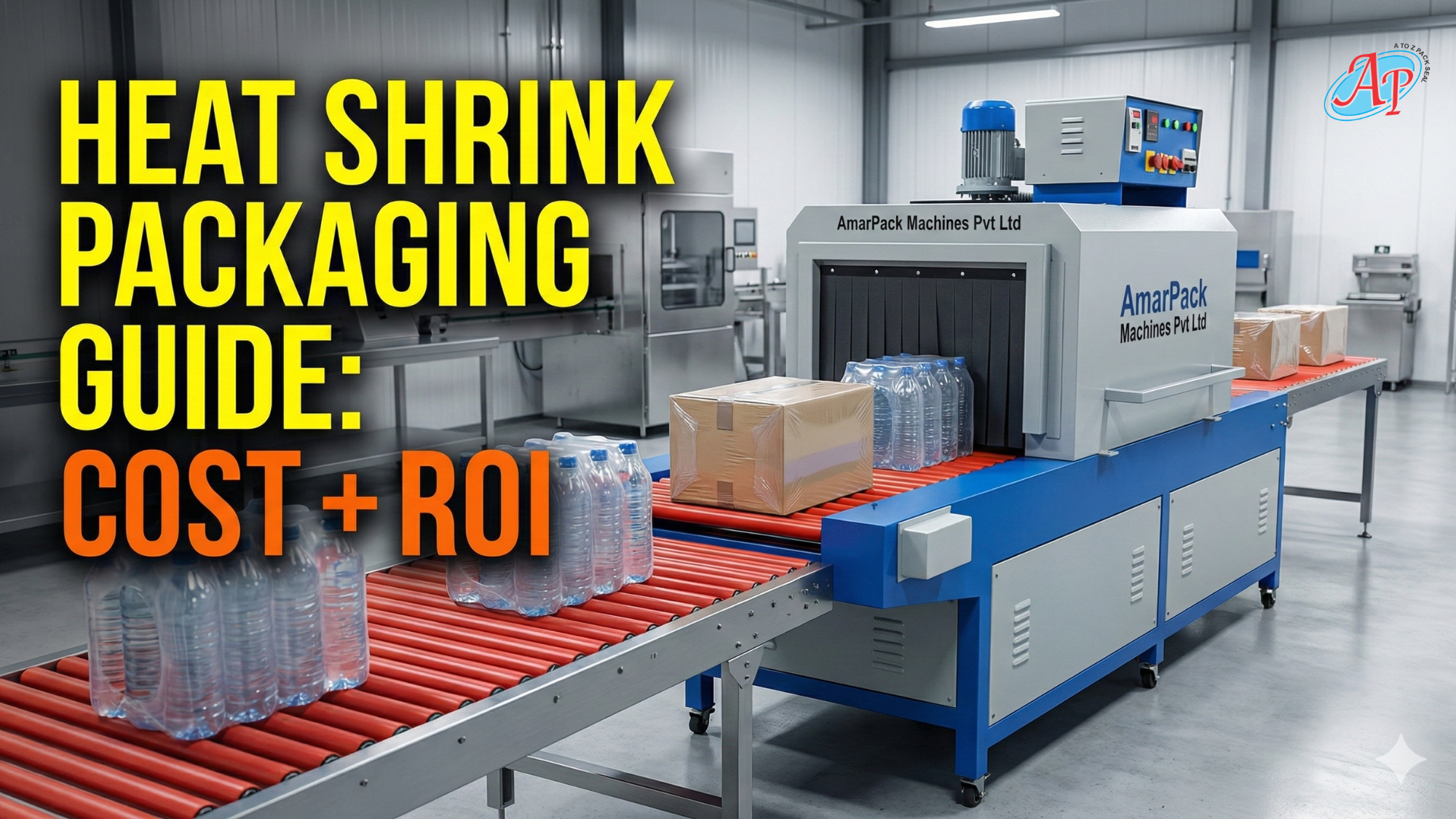
Why Your Packaging Line Needs Heat Shrink Technology: Benefits, Cost & Real-World Examples (2025 Guide) Heat Shrink Packaging Technology: Benefits, Cost Breakdown & ROI Guide 2025 Ai Generated When Kiran Patil, Operations Head at a mid-sized beverage company in Nagpur, walked into her new role, she immediately noticed a bottleneck:➡️ Hand-wrapped boxes, slow throughput, high product damage, and constantly rising labor expenses. Her first major upgrade?A heat shrink packaging system. Within six months: Efficiency increased by 43% Product damage dropped to almost zero Packaging cost per unit reduced noticeably Retailers praised the improved shelf-ready appearance Sarah’s story is no exception. Across global manufacturing—from beverages and FMCG to pharma and electronics—heat shrink technology is transforming packaging lines. This guide shows you exactly why, backed by data, ROI calculations, and real industry examples. What is Heat Shrink Packaging Technology? (And Why It Matters in 2025) Heat shrink technology uses polymer-based shrink film that contracts around products when exposed to controlled heat. The result is a tight, protective, tamper-evident, and visually appealing wrap. Unlike traditional cardboard or stretch wrap, heat shrink packaging offers: 360° product visibility Strong protective sealing Lower material consumption High-speed processing Consistency and automation readiness Modern systems include: Shrink Tunnel Machines Web Sealers L-Bar Sealers Automatic Shrink Wrapping Systems The packaging landscape in 2025 demands: ✔ Higher speed ✔ Lower cost-per-package ✔ Sustainability ✔ Multi-size flexibility ✔ E-commerce friendly packaging Heat shrink technology meets all these requirements simultaneously. 7 Game-Changing Benefits of Heat Shrink Packaging Technology 1. Superior Product Protection That Customers Can Trust Shrink film forms a tight, weather-resistant, tamper-evident protective layer.A vitamin manufacturer in New Jersey saw product returns drop by 67% after switching from cardboard boxes to heat shrink bundling. Key protection advantages: Moisture & dust resistance UV shielding Visible tamper evidence Excellent for long-distance logistics Stabilizes multipacks (cans, bottles, jars) Prevents product scuffing & label damage 2. Massive Labor Cost Reduction (40–60% Savings) Manual packaging consumes significant manpower. Automation with heat shrink packaging dramatically reduces labor dependency. Patil Electronics Manufacturer Data: Before: 4 workers — 150 units/hour After: 1 operator — 400 units/hour Yearly savings: $187,000 The operator simply loads products—the machine handles sealing, wrapping & shrinking. 3. Lower Material Costs (30–50% Per Unit Savings) Shrink film is cheaper and lighter than boxes, clamshells, or rigid packaging. Real example:A beverage company switched from cardboard carriers to shrink film for 12-can packs and saved 2.25 rs per pack (approx).Across 2 million units, that’s 280,000 rs annual savings (approx). This is why heat shrink packaging is now preferred in: Beverage multipacks FMCG bundles Cosmetics & personal care Pharma bottles Snacks & food products 4. High-Speed Packaging that Scales Production Speed comparison: Packaging Method Throughput Manual wrapping 5–10 units/min Stretch wrap 15–25 units/min Heat shrink systems 30–150 units/min High-speed lines can exceed 180+ packs/minute, enabling manufacturers to: Run larger batches Reduce overtime Avoid adding extra shifts Increase weekly output significantly 5. Adaptability for Multiple Products (Fast Changeovers) Heat shrink systems handle a wide range of products without custom tooling. Example:A snack company runs 5 sizes of chip bags with under 10-minute changeovers (previously 45–60 minutes using boxes). Shrink film naturally conforms to: Bottles & cans Pouches & packets Boxes, cartons Electronics Tools Cosmetics Pharma bottles 6. Premium Shelf Appearance That Boosts Sales Crystal-clear shrink film delivers: High transparency Neat presentation Tight finish Branding visibility Retail-ready multipacks Brands using printed shrink film often report improved shelf appeal and increased consumer trust. 7. Sustainability Advantages That Matter in 2025 Modern shrink films are lighter, recyclable, and optimized for reduced carbon footprint. Eco benefits: Up to 70% less packaging material vs. boxes Recyclable PE & POF films Bio-based (PLA) shrink films available Lower shipping weight → reduced fuel emissions Zero staples, tapes, adhesives A European distributor achieved carbon-neutral packaging using recycled-content shrink film. Heat Shrink Packaging Cost Breakdown (2025 Pricing) Let’s break down transparent equipment cost ranges. Entry-Level Shrink Wrapping Machine (Portable) 📌 Price: 86,500 – 96,500📌 Speed: 10–30 products/min (depends on product size)📌 Ideal For: Small manufacturers, startups, trial runs Standard Or Heavy Duty Shrink Wrapping Machine 📌 Price: 128,000 – 236,000📌 Speed: 30–60 products/min (depends on product size)📌 Ideal For: FMCG, cosmetics, pharma, food, Large-scale factories & 24/7 production Web Sealer or L-Sealer With Shrink tunnel Machine 📌 Price: 118,000 – 350,000+📌 Speed: 100–150+ products/min (depends on product size and machine model)📌 Ideal For: FMCG, cosmetics, pharma, food, Large-scale factories & 24/7 production Operating Cost (Monthly) Film: ₹5,000 – ₹15,000 per month(Depends on film micron, product size & daily output) Electricity: ₹4,000 – ₹9,000 per month(Heating chamber + conveyor load, based on 6–8 hours/day usage) Maintenance: ₹500 – ₹2,000 per month(Cutters, Teflon, heaters, blower servicing, routine lubrication) Labor: 40% – 60% Reduction in Manpower(Automation reduces loading, sealing & conveying effort) ➡️ Total Monthly Cost: ₹6,000 – ₹20,000 per month ROI Calculation (Real Example) Total Investment (Average for Standard/Heavy Duty Line): 📌 ₹1,28,000 – ₹2,36,000(or higher for Web Sealer/L-Sealer with Shrink Tunnel) Monthly Savings: Labor Savings: ₹18,000 – ₹40,000 per month(due to reduced manual sealing, packing & handling) Material Savings: ₹8,000 – ₹15,000 per month(precise film cutting + reduced wastage vs manual packing) Total: ₹20,000 – ₹55,000 per month Payback Period:📌 3.5 – 6 Months(Industry Benchmark for India: 3–8 Months) (Read More To Know More About ROI Calculator) 3 Real-World Case Studies Across Industries Case Study 1: Beverage Manufacturing (Nagpur) Challenges: Damage during transport, slow packaging speedSolution: Automatic side sealer + printed shrink filmResults: Speed: +156% Damaged goods: -89% Labor cost: -$94,000 Retail presence: +23% Case Study 2: E-Commerce Warehouse (Banglore) Challenges: Multiple box sizes, slow pick-and-packSolution: Universal shrink bundlingResults: Box inventory: Reduced from 47 SKUs → 12 Packaging time/order: -62% Shipping cost: -18% Packaging complaints: -77% Case Study 3: Pharma Bottles & Supplements (Mumbai) Challenges: Tamper-evident complianceSolution: Shrink bands + full shrink wrapsResults: FDA compliance achieved Packaging cost: -42% Speed: +89% How to Choose the Right Heat Shrink Packaging System Step 1: Determine Your Throughput < 10 units/min → Manual L-Bar Sealer 10–50 units/min → Semi-Automatic System 50–100 units/min →
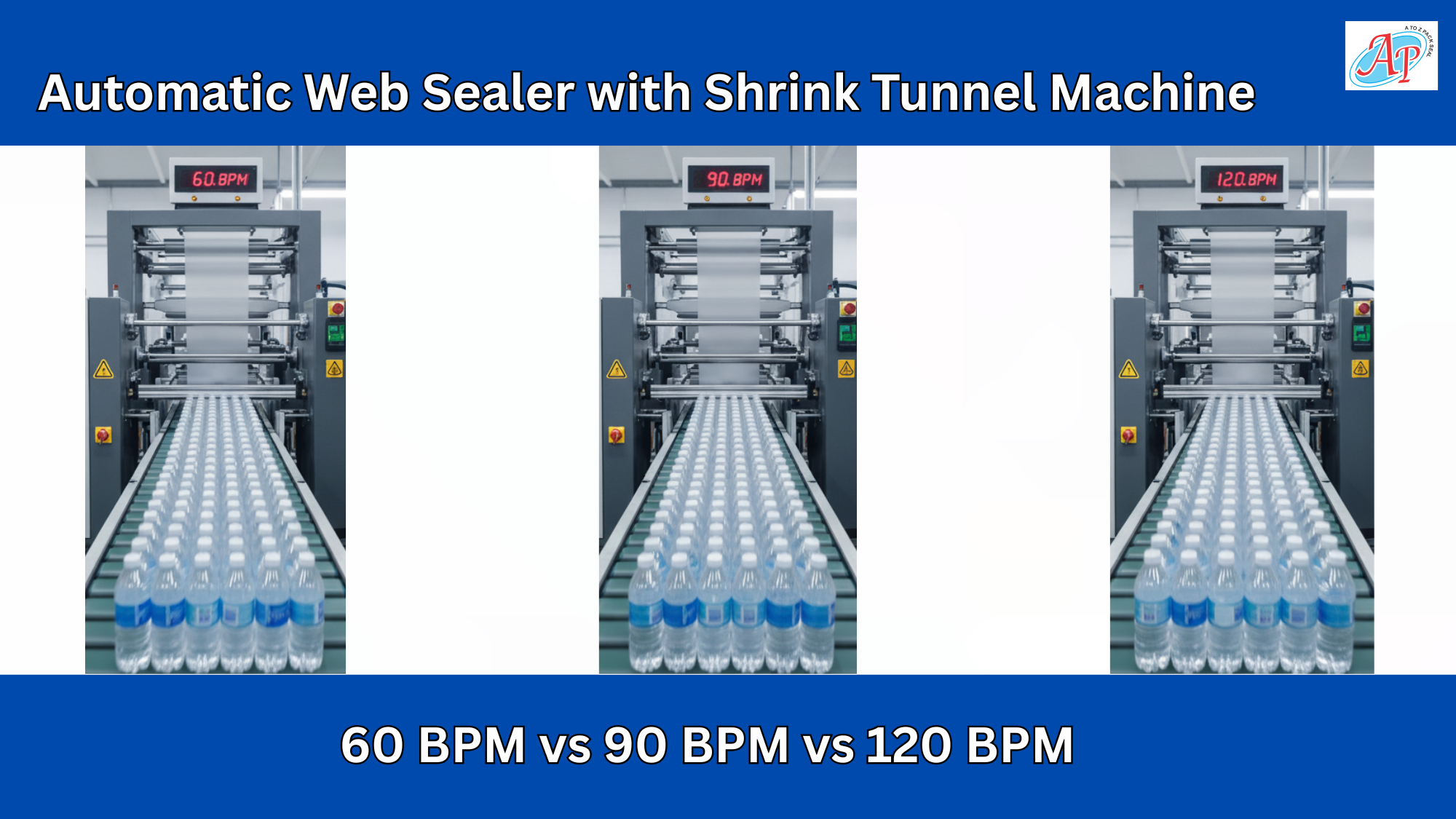
The Essential Guide to Choosing Your Web Sealer With Shrink Tunnel: 60 BPM vs 90 BPM vs 120 BPM Capacity Comparison
The Essential Guide to Choosing Your Web Sealer With Shrink Tunnel: 60 BPM vs 90 BPM vs 120 BPM Capacity Comparison 60 BPM vs 90 BPM vs 120 BPM Capacity Comparison Ai Generated I. Introduction: The Capacity Paradox In the competitive landscape of Fast-Moving Consumer Goods (FMCG) and beverage manufacturing, optimizing the high-speed packaging line is non-negotiable. For many Production Directors, the first consideration when selecting an end-of-line shrink packaging machine is the advertised speed rating: 60 BPM, 90 BPM, or 120 BPM Shrink Machine Capacity Comparison. This initial metric, however, often provides an incomplete picture of actual production capability. The assumption—that doubling a machine’s Bottles Per Minute (BPM) rating will predictably double usable output—is a common oversight that can lead to substantial financial loss through unrealized efficiency. True performance and profitability are defined not solely by nominal BPM, but by the resultant Packs Per Minute (PPM) and the machine’s foundational ability to maintain high Overall Equipment Effectiveness (OEE). The Problem: Outgrowing Medium-Speed Production Many businesses start their journey with semi-automatic or lower-volume automatic machines, typically operating in the 30–40 BPM range. As market share grows and product demand intensifies, these foundational machines quickly become the critical bottleneck in the entire production system, limiting the capacity of otherwise efficient fillers and labelers. The necessity to scale necessitates a move to the medium-speed production tier (60–90 BPM) or immediately jumping to high-speed (120 BPM and beyond). This leap is not merely a speed upgrade; it is a fundamental shift in required capital investment, technology (mechatronics), and operational complexity. The decision requires a robust justification based on Total Cost of Ownership (TCO) and expected ROI of Shrink Wrappers, analyzing not just the sticker price but the sustained efficiency provided by the machine. II. The Solution: A Technical Comparison of Throughput, PPM, OEE, Footprint & ROI This report provides a detailed technical and financial comparison of the three primary automatic shrink wrapping machine tiers (60 BPM, 90 BPM, and 120 BPM). The analysis shifts the strategic focus from the linear metric of BPM to the operational metrics of PPM and OEE. Definition of BPM (Bottles Per Minute): BPM refers to the speed at which individual units (bottles, jars, or cans) are fed into the machine’s collation zone. This speed is typically constrained or synchronized by upstream equipment like the filler or labeler. How BPM Converts into PPM (Packs Per Minute): PPM is the vital throughput calculation metric, representing the number of finished, sealed, and shrunk bundles (e.g., 6-packs, 12-packs) exiting the line every minute. The conversion is calculated by dividing the machine’s nominal BPM by the quantity of individual units required in the specified collation (pack format). For instance, if a machine handles a 120 BPM input: Collation Format (Bottles/Pack) Bottle Quantity (N) Nominal PPM (120 BPM / N) 6-Pack (3×2 Collation) 6 20 PPM 12-Pack (4×3 Collation) 12 10 PPM 24-Pack (6×4 Collation) 24 5 PPM This relationship illustrates that a 120 BPM machine, if running a heavy 24-pack collation, achieves an output of only 5 packs per minute. Therefore, the true comparison must be grounded in the achievable PPM output for common pack formats. III. The Core Comparison: Specs & Throughput Technical Specification Comparison — BPM to PPM Output The increase in speed from 60 BPM to 120 BPM necessitates a complete redesign of the machine architecture, impacting infrastructure, power demands, and film handling capability. The 90 BPM tier serves as the functional transition point where advanced technologies begin to dominate mechanical systems. Table 1 provides a technical overview based on standard single-lane operations. Table 1: Technical Specification Comparison — BPM to PPM Output Metric 60 BPM 90 BPM 120 BPM Estimated PPM (Common Formats) 5–8 PPM 8–12 PPM 10–15 PPM Annual Volume (2 Shifts) ~10M Bottles ~15M Bottles ~20M+ Bottles Power Consumption (Connected Load) 12–18 kW 18–25 kW 25 kW+ Footprint Size Compact Linear (Small) Standard Linear (Medium) Extended / Dual-Lane Options (Large) Film Supported LDPE/PE (Thicker Gauge) LDPE/PE/LLDPE Thin-Film Optimized (LLDPE Focus) Automation Level Entry Auto (Pneumatic/Mechanical) Mid Auto (Basic Servo, PLC) High-Speed Auto (Full Servo Control) The annual volume figures represent estimated output based on operating two 8-hour shifts daily, five days a week, assuming a conservative average OEE target of 75–85%. The doubling of speed from 60 BPM to 120 BPM directly translates into a potential doubling of annual output (from approximately 10 million bottles to over 20 million bottles) if all other operational factors are maintained. Machine Design & Performance Differences The capacity differences are underpinned by critical variations in mechanical and electronic design required to achieve continuous motion at high velocity. Sealing Technologies (Hot Knife vs Continuous Servo Sealing) The seal bar operation is arguably the most significant factor constraining machine speed and reliability. 60 BPM (Hot Knife/Wire): Machines in the medium-speed production tier often utilize traditional constant heat sealing elements, such as Teflon-coated hot knives or wire seal bars. These systems typically use a reciprocating motion, requiring the product flow to pause momentarily while the seal is made and the film is cut. While highly reliable for thicker Low-Density Polyethylene (LDPE) film, the stop-start nature fundamentally limits speed. Hot knife sealers are built for strength and speed and handle thicker films that require significant heat. 120 BPM (Continuous Servo Sealing): To achieve continuous, high-speed output, the sealing process must be dynamic. This requirement mandates continuous motion side-sealing functions driven by integrated servo motor control. The entire sealing assembly, controlled precisely by the actuator, moves synchronously with the conveyor and the product group, wrapping, cutting, and sealing the film without interrupting the continuous product stream. This sophisticated synchronization utilizing servo technology is necessary to ensure packaging is smoother, fully automated, and precise, maximizing the throughput of the high-speed packaging line. Infeed & Collation System Differences Handling individual containers at speeds of 120 BPM requires far more meticulous control than at 60 BPM. Medium-Speed Handling (60 BPM): Collation systems at this level typically rely on simpler mechanical pushers, gate systems, or pneumatic sorting devices. While these are adequate for achieving rates up to 60 BPM, they are highly susceptible to performance degradation,
How Proper Packaging Automation is Essential to Reduce Product Damage During Transit
How Proper Packaging Automation is Essential to Reduce Product Damage During Transit How Packaging Automation Help Reduce Product Damage During Transit Ai Generated I. Introduction: The High Stakes of Delivery Failure in the Indian Supply Chain The logistics sector in India stands at a critical juncture, characterized by rapid expansion and immense complexity. Driven by robust industrial activity and a booming digital commerce landscape, the sector is projected for significant growth, with projections indicating a Compound Annual Growth Rate (CAGR) of 10.5%. This trajectory positions India for economic ascent; however, this speed of growth amplifies operational risks, demanding meticulous attention to fundamental supply chain functions, particularly proper packaging. A. Quantifying the Economic Burden of Inefficient Logistics For modern supply chain managers, the cost of inefficient logistics represents a substantial drag on profitability. A recent assessment by the National Council of Applied Economic Research (NCAER) indicated that India’s total logistics cost for the 2023–24 fiscal year was estimated at 7.97% of its Gross Domestic Product (GDP). While this figure shows signs of slowing growth due to government infrastructure initiatives, it remains a critical indicator of the massive economic incentive available for companies that successfully target and eliminate inefficiencies. Transit damage, often an uncalculated cost, contributes significantly to this burden through direct product loss, complex reverse logistics, replacement shipping expenses, and strained inventory cycles. Compounding this challenge is the nature of India’s e-commerce market, where a high proportion of orders utilize Cash-on-Delivery (COD). Alarmingly, 25% to 30% of COD orders result in Returns-to-Origin (RTOs). When a product arrives visibly damaged, RTO is guaranteed, transforming a preventable packaging failure into a double loss encompassing product cost and multiple logistics fees. The investment in robust packaging solutions is, therefore, a strategic defense against these high, systemic costs. B. The Reputational Erosion: When Delivery Fails The consequences of product damage extend far beyond the balance sheet; they strike directly at a brand’s integrity and long-term viability. Reliable, undamaged delivery is a fundamental customer expectation that underpins consumer trust and loyalty. In the age of instantaneous digital feedback, a single negative delivery experience can trigger public complaints and social media backlash, deterring new customers. The quantitative risk associated with reputational damage is severe. Businesses that incur four or more negative articles online face the risk of losing up to 70% of prospective customers. This non-linear risk means that seemingly minor delivery failures can lead to disproportionately large financial and market losses. By consistently utilizing secure packaging to deliver products intact and on time, organizations not only safeguard but actively enhance their enterprise value, positioning their brand identity around integrity and reliability. II. Deconstructing Failure: Understanding the Physics of Transit Damage Effective transit damage prevention relies on a granular understanding of the mechanical and environmental forces that packages endure throughout the supply chain. These stresses are particularly intense in India’s logistics environment, where transport conditions can be unpredictable. Four primary forces define the hazards that necessitate technically advanced packaging. A. Shock and Impact (Sudden Forces) Shock refers to sudden, intense forces, such as those experienced when a package is dropped, subjected to rough handling, or encounters mechanical impacts during the loading and unloading processes. For delicate items like electronics or glassware, impact is an immediate source of catastrophic failure. Mitigation strategies for shock require a combination of high-quality primary packaging cushioning and rigid load securement. For high-value or highly sensitive items, specialized cushioning materials like foam inserts, often precision-cut to match the product’s dimensions, are deployed to restrict movement and provide exceptional shock absorption. B. Vibration (Repetitive Forces) Vibration presents a continuous and insidious threat. It is a constant factor in road transport—the most common, yet most expensive non-air transport mode in India at ₹3.78 per tonne-kilometer (PTPK). Sustained road travel creates repetitive, low-amplitude stress that leads to product abrasion, shifting, and the loosening of components within a package. The critical mitigation strategy here is ensuring unit load stability. Secondary packaging automation is essential for fusing multiple packages into a single, rigid unit, thereby minimizing internal movement and preventing friction damage. For extremely heavy and delicate machinery, engineers may specify specialized vibration mitigation tools, such as multi-directional pads or Skid-Mates, which attach to the underside of a skid to absorb vibration over long transit distances. C. Compression (Static Forces and Stacking Load) Compression failure occurs when packages collapse under the static weight of other items stacked above them during warehousing or multi-stacked transportation. This phenomenon highlights a critical technical requirement: the secondary packaging, typically corrugated cartons, must possess adequate Box Compression Strength (BCT). Manufacturers must move beyond anecdotal estimates and utilize compression testing to determine the maximum predictable compressive load a carton can withstand before deforming or failing. Furthermore, structural engineers understand that the product inside the carton often contributes to the package’s overall strength. If the product itself is rigid, it can help support the vertical stacking load. Conversely, if the product is fragile or irregular, the carton must be over-engineered to carry the entire load without internal support. D. Environmental Degradation (Moisture, Dust, and Corrosion) Exposure to environmental factors—particularly high humidity, dust, and moisture—can compromise package integrity and product quality. A lack of protection against these factors can cause the primary containment (like corrugated boxes) to break down, necessitating time-consuming and costly repackaging. Mitigation requires high-quality, weather-resistant barrier films and hermetic sealing. This is particularly crucial for temperature-sensitive items, pharmaceuticals, and industrial metal components susceptible to rust and corrosion. The following matrix summarizes the essential link between transit hazards and the packaging solutions necessary to overcome them: Transit Hazard Mitigation Matrix: Linking Damage Causes to AmarPack Solutions Transit Hazard Mechanism of Damage Risk Level (India Context) Protective Packaging Strategy Relevant AmarPack Machine Solution Shock and Impact Sudden G-forces (drops, shunting). High (Manual handling, road transport) Cushioning (foam/dampeners), rigid primary support, load retention. Fully Automatic L-Sealers and Box Strapping Machines. Vibration Repetitive movement leading to friction, abrasion, and shifting. Extreme (Road dominated, rough transport) Unit load stability, containment force, fusing individual packages into a unit load. Automatic Shrink Wrapping
How an Automatic Web Sealer with Shrink Tunnel Revolutionises Rice Bag Group Packaging in India
How an Automatic Web Sealer with Shrink Tunnel Revolutionises Rice Bag Group Packaging in India Automatic Web Sealer with Shrink Tunnel | Rice Packaging Machine India Ai Generated Introduction — The Urgent Need for Packaging Automation in the Indian Rice Sector India stands as the undisputed global leader in rice exports, commanding a colossal share of the international market. With annual exports frequently exceeding 20 million tonnes — representing over 30% of global rice trade and generating billions of dollars in revenue — the operational efficiency of India’s rice mills directly dictates global food security and national economic stability. However, despite advancements in milling and logistics, a critical bottleneck remains: manual secondary packaging. This is where modern solutions like the Automatic Web Sealer with Shrink Tunnel from AmarPack Machines Pvt Ltd are transforming operations. By automating rice bag bundling and shrink wrapping, these machines eliminate inconsistencies, reduce labor dependency, and ensure export-ready packaging quality. The Problem: Operational Vulnerabilities in Manual Group Packaging Historically, many large mills utilized highly manual processes or semi-automated systems for collating and securing multiple retail bags (such as 5kg or 10kg units) into transit-ready groups. This practice is severely prone to errors, slow throughput, and excessively high operational costs. The reliance on human intervention introduces three significant operational pain points that erode profitability and compromise quality: Inconsistent Sealing and Product Loss: Manual sealing techniques often suffer from variability in heat application and pressure. This inconsistency leads to weak seals, causing individual pouches to open or nitrogen to leak, which can compromise the entire bundle chain. A single faulty seal risks the loss of multiple kilogrammes of high-value rice during handling or transit. Labor Dependency and Inaccuracy: India faces an acute shortage of reliable labor for intensive packing tasks. Manual processes are inherently slow, increasing labor costs, and unreliable in terms of weight variation or precise collation, leading to market complaints (less weight) or costly product giveaway (excess weight). Environmental and Transit Vulnerability: The heavy rice bags endure rigorous logistics, from stacking in warehouses to long-haul transport in containers. During India’s highly humid monsoon season, manual packaging fails to provide the necessary moisture barrier, making the packaged goods susceptible to humidity, leading to mold, mildew, and structural breakdown. These operational risks are financially untenable for businesses operating at the immense scale of the Indian rice export market. The industry requires a high-speed, repeatable, and robust system. The strategic answer lies in advanced automation. The Strategic Solution: The Automatic Web Sealer with Shrink Tunnel The introduction of the Automatic Web Sealer with Shrink Tunnel represents the definitive transformation in rice bag group packaging throughout India. This integrated system provides a robust solution that delivers exponential improvements in speed, ensures unparalleled product protection, and secures global market compliance. This Automatic Packaging Machine is now the essential industrial tool for any mill seeking to transition from operational risk management to predictable, profitable growth. By adopting this Automatic Shrink Wrapping Machine, manufacturers are improving throughput reliability and achieving a superior return on investment (ROI) that secures their competitive edge in international markets. Want to automate your rice packaging line and secure your supply chain? Here’s how… What Is an Automatic Web Sealer with Shrink Tunnel? (Mechanism and Material Science) The Automatic Web Sealer with Shrink Tunnel is a highly specialized, integrated industrial system engineered for secondary packaging applications, particularly the collation and secure wrapping of heavy, multi-unit items such as rice bags, beverage cartons, or industrial goods. It combines two distinct processes—collating and wrapping—into a single, high-speed automated workflow, producing a package that is tamper-evident, moisture-resistant, and structurally durable. Defining the Two-in-One Automation System The system is fundamentally defined by its two sequential stages: The Web Sealer (Bundler): This machine acts as the entry point, automatically collating the primary products (individual rice bags) into a defined group size (e.g., 4 x 5kg bags) and wrapping them in a protective sleeve of film. This is the precision stage that removes human variability from the grouping process. The Shrink Tunnel: The subsequent heating chamber provides controlled, uniform thermal energy. This heat causes the specific film material to constrict tightly and conform precisely to the product shape, maximizing unitization, package integrity, and overall stability. This technology is widely adopted across high-volume food, beverage, and grain packaging lines where structural integrity and unitization for transport are paramount. Material Science: Why LDPE/LLDPE is Non-Negotiable For the secure group packaging of heavy commodities like rice bags—which can weigh up to 25kg and must withstand considerable mechanical stress during handling and container stacking —the selection of film material is a critical design element. Low-Density Polyethylene (LDPE) and Linear Low-Density Polyethylene (LLDPE) films are the mandated industry standards for this heavy-duty application. Unlike lighter films (such as polyolefin), LDPE is known for its superior tear and puncture resistance. This material strength is a non-negotiable requirement for groups of heavy rice bags, ensuring the package maintains integrity throughout the demanding, often rugged, logistical environment. The inherent durability of LDPE serves as a proactive risk mitigation strategy, protecting against mechanical failure caused by load shifting or forklift handling, which are common sources of freight damage. Furthermore, LDPE, due to its properties, is widely utilized and generally approved for bundling food products, ensuring compliance in the secondary packaging layer. Looking for the ideal film partner for your new Automatic Shrink Wrapping Machine? Read on to see its operational mechanics… How the Two-Part Packaging System Works (Precision Engineering in Action) The effectiveness of the Automatic Web Sealer with Shrink Tunnel system is rooted in the precise synchronization of its two distinct stages, which collectively transform a loose collection of bags into a secure, unitized block suitable for export. Stage 1 — The Web Sealer (Automatic Collation and Sealing) The first stage focuses on accurate grouping and the application of the heavy-gauge shrink film sleeve. Automated Indexing and Sleeving The individual rice bags are automatically transferred from the primary packaging line (e.g., the filler and sealer) onto the web sealer’s infeed conveyor. An indexing system precisely collates them into the required multi-pack configuration (e.g., two 10kg bags side-by-side, or four 5kg bags grouped together). This
Why Fully Automatic Shrink Wrapping Machines Are Becoming a Global Standard in 2025
Why Fully Automatic Shrink Wrapping Machines Are Becoming a Global Standard in 2025 Global Packaging Automation Trends 2025 | Fully Automatic Shrink Wrapping machine Ai Generated Across the globe, industrial manufacturers are facing twin pressures: soaring labor costs and the unrelenting demand for higher throughput driven by e-commerce expansion. For too long, packaging operations have remained a bottleneck. This is where the Fully Automatic Shrink Wrapping Machine provides the solution. Unlike semi-automatic systems that still require operator feeding and sealing, automatic systems integrate seamlessly into the production line, handling product collating, film application, and sealing without manual intervention. By 2025, this level of automation isn’t just an upgrade; it’s the global standard. This shift is being driven by the need for operational necessity, IoT integration, and crucial demands for sustainability and superior quality control. Businesses leveraging industrial shrink wrap automation are not just keeping pace—they’re setting it. Maximizing Operational Efficiency and Throughput This section directly addresses the primary B2B concern: getting more product out faster, consistently, and reliably. Unprecedented Speed and Consistency A. High-Speed Cycling: Human limitations—fatigue, shift changes, and variable skill—are completely removed from the equation. A modern automatic shrink wrapper is designed for continuous, high-speed output often exceeding 60 Pieces Per Minute (PPM). This capability ensures peak production during all hours of operation. B. Reduction in Bottlenecks: Integrated automatic systems utilize advanced sensors and servo drives to ensure a smooth, continuous flow from the infeed conveyor through the seal bar and into the shrink tunnel. This engineered synchronization minimizes system stops and jams, drastically reducing downtime and operational bottlenecks that plague manual lines. Drastic Reduction in Labor Costs and Errors A. Reallocation of Resources: The ROI on automation isn’t just about cutting salaries; it’s about shifting skilled personnel away from repetitive, low-value packaging tasks toward higher-value roles, such as quality control, complex machine maintenance, and upstream process management. This reallocation of resources boosts overall workforce productivity. B. Minimizing Repetitive Strain Injury (RSI): Workplace safety is a growing corporate concern and liability. Fully automatic equipment eliminates the need for operators to perform strenuous, repetitive motions required in manual or semi-automatic sealing, helping companies meet workplace safety compliance standards and mitigate RSI-related claims. Financial Case: The True ROI and TCO Advantage While the initial capital expenditure (CapEx) for a fully automatic machine is higher, the financial arguments supporting the move are compelling when analyzing the Total Cost of Ownership (TCO). Optimizing Film Usage and Reducing Material Waste A. Precision Tensioning: Modern, automatic wrappers are equipped with highly sensitive, servo-driven film feeds. These sensors apply the exact necessary amount of film based on the product’s dimensions, minimizing material overage. This precision tensioning capability leads to a significant and sustained reduction in material costs and waste compared to manual over-wrapping. B. Energy Efficiency: Today’s machines feature advanced, well-insulated shrink tunnels and intelligent heat recovery systems. These designs require less energy to achieve a perfect seal and shrink, making the system an energy-efficient asset that directly contributes to a lower Total Cost of Ownership (TCO). Calculating the Long-Term Return on Investment (ROI) A. Payback Period Metrics: When factoring in savings on labor (often two or more full-time employees), reduced film waste, lower energy consumption, and fewer damage claims, the investment return typically yields a 12 to 24-month payback period. B. Predictable Operating Expense (OpEx): The costs associated with human labor (wages, benefits, absenteeism, and high turnover) are volatile. In contrast, the operating expense (OpEx) of a fully automatic machine is defined by a predictable and manageable preventative maintenance schedule, offering stability in financial planning. The Role of Automation in Quality and Standardization For B2B brands, packaging quality is a crucial component of brand perception and distribution compliance. Achieving Perfect Seal Integrity, Every Time A. Uniform Heat Application: Automated systems utilize computer-controlled, uniform heat and pressure across the seal bar. This eliminates weak seals and inconsistent product appearance caused by human error or fatigue, ensuring a flawless, tamper-evident seal integrity for every single unit. B. Damage Reduction: A consistently tight and uniformly wrapped product is structurally more secure. This tighter packaging significantly reduces product shifting, scuffing, and internal damage during warehousing and transit, leading to lower claims, fewer product returns, and improved customer satisfaction. Meeting Global Regulatory and Retail Standards A. Traceability and Compliance: Critical in the food, pharmaceutical, and beverage industries, automatic wrappers support compliance by integrating machine data logging. They record operational parameters, such as seal temperature and cycle time, providing essential traceability and documentation. B. Retailer Requirements: Standardization is non-negotiable for modern supply chains. Automatic systems produce consistently dimensioned, square, and stackable wrapped units. This meets the increasingly strict packaging dimension and stacking requirements of major global retailers and automated distribution centers. Integration with Industry 4.0: The Future of Packaging The future of packaging is smart, connected, and predictive. Fully automatic shrink wrappers are central to the Industry 4.0 movement. PLC Control and Remote Diagnostics A. Seamless System Integration: Utilizing modern Programmable Logic Controllers (PLCs), the automatic wrapper acts as an intelligent node within the production line. It communicates flawlessly with upstream equipment (like fillers) and downstream systems (like case packers and robotic palletizers), achieving total system harmony. B. Predictive Maintenance: Advanced machine sensors monitor vibration, motor temperature, and other key variables. These sensors enable the system to forecast potential mechanical failures, allowing managers to move from expensive, reactive repairs to planned, scheduled, and predictive maintenance. Data-Driven Performance Monitoring (OEE) A. Tracking OEE (Overall Equipment Effectiveness): The wrapper generates real-time data on the three pillars of efficiency: Availability (uptime), Performance (speed), and Quality (yield). This OEE monitoring gives plant managers an immediate, data-backed view of true efficiency, allowing for instant adjustments and continuous improvement. Conclusion: Automation is No Longer Optional The transition to fully automatic shrink wrapping machines is no longer a strategic option; it is a foundational requirement for any competitive global operation in 2025. The benefits are clear and quantifiable: maximized throughput, demonstrable ROI and TCO advantages, consistent quality that protects your brand, and seamless integration with the
Packaging Automation ROI Calculator: Real Cost Savings for Indian Manufacturers in 2025
Packaging Automation ROI Calculator: Real Cost Savings for Indian Manufacturers in 2025 Packaging Automation ROI Calculator (2025) | Real Cost Savings for Indian Manufacturers Ai Generated Executive Summary (TL;DR) Indian Packaging Automation Market (2025): USD 6,009.4M → projected USD 11,769.3M by 2033 (7.8% CAGR). ROI Payback: 12–24 months typical; some plants recover costs in <12 months. Average Savings: 60% reduction in labor costs 15–25% savings in material waste 3–4× throughput increase Government Incentives: PLI schemes + 100% capital deduction = up to 30% faster ROI. Key Sectors Benefiting: FMCG, Pharmaceuticals, Automotive Components, Food & Beverage. Let Our Expert Calculate Your Personalized ROI: to estimate your exact annual savings, payback period, and 10-year value creation potential. Introduction: Why ROI on Packaging Automation Matters in 2025 In 2025, Indian manufacturers are racing toward automation as margins shrink and labor costs climb. The packaging automation market is projected to reach USD 11.7 billion by 2033, a clear indicator of strategic transformation. Today’s industrial leaders — CEOs, CFOs, and plant heads — face one crucial question: “How fast can automation start paying for itself?” This comprehensive ROI guide and calculator reveal the exact financial logic behind automation, proving why packaging automation isn’t just an upgrade — it’s a profitability engine for the modern Indian factory. The Hidden Costs Eroding Profitability 1. The Labor Cost Trap: Rising Wages & Hidden Expenses Wage inflation in India is relentless. In 2025: Minimum wages range from ₹783–₹1,035/day (₹20,358–₹27,040/month). Add statutory costs (PF, ESI, gratuity), training (₹15k–₹25k/employee), and attrition losses (8–12 months). A typical packaging line with 6 operators across 3 shifts costs ₹18–22 lakh annually.Automation cuts this by 30–70%, freeing workers for value-added roles like QC or maintenance — not layoffs, but labor optimization. 2. Material Waste & Inconsistent Quality Manual packaging lines silently bleed profit through: 5–8% average material waste Inconsistent seals causing rejections, customer complaints, and DCGI violations 💡 Example:A pharma exporter lost ₹45 lakh due to tamper seal failure — preventable with servo-controlled sealing. Automated VFFS/HFFS systems maintain ±0.5mm accuracy and reduce waste by 15–25%.For a plant using 500 kg film/day at ₹450/kg, reducing waste from 7% to 2% saves ₹4.1 lakh/month = ₹49.2 lakh/year. 3. Downtime & Throughput Bottlenecks Manual changeovers (30–45 minutes) limit productivity.During festive demand spikes (40–60%), manual lines simply cannot scale. Automated VFFS machines: 60–120 packs/min Manual: 20–30 packs/min Unplanned downtime costs: ₹8,000–₹15,000/hour Automation increases OEE by 25–40%, unlocking millions in annual capacity value without new floorspace. Dissecting the ROI Calculator: From Assumption to Precision 💡 ROI Formula ROI (%) = (Total Annual Savings – Total Investment) ÷ Total Investment × 100 Where: Component Description Labor Cost Savings Reduction in headcount or redeployment value Material Efficiency Gains Reduction in waste % × total packaging spend Productivity Gains Increased throughput × contribution margin Quality Cost Reduction Fewer defects, returns, and rejections Investment Equipment, installation, training, AMC (3–5 yrs financing) Typical Payback: 12–18 months (8–12 for high-volume plants) Example ROI Calculation (Snack Manufacturer) Metric Manual Automated Annual Labor ₹36 lakh ₹14.4 lakh Material Waste 7% (₹3.8 lakh) 2% (₹1.1 lakh) Throughput 30 packs/min 100 packs/min Annual Savings ₹48.3 lakh Total Investment ₹50 lakh ROI (1 Year) 96.6% Payback Period 12.4 months Key Input Variables: What the Calculator Uses Labor Configuration: Operators × shifts × loaded monthly cost Material Waste %: Film, cartons, and rework losses Throughput Requirement: Current vs. desired output (units/min) Capital Budget: Equipment, installation (10–15%), training (₹50k–₹1.5 lakh) Government Incentives: PLI (4–6% on incremental sales) State-level subsidies (10–25%) 100% capital deduction for modern equipment 👉 Result: Real-world ROI projections CFOs can present to boards. The Three Pillars of Quantifiable Savings Pillar 1: Strategic Labor Reallocation Automation is reallocation, not retrenchment.Reassign workers to: QC inspection (vision system validation) Preventive maintenance Upstream material handling These roles improve retention and productivity.Automated lines operate 20 hours/day with no fatigue, producing 4,800–12,000 units/day vs. 2,000–3,000 manually. Pillar 2: Guaranteed Material Efficiency Servo-driven VFFS/HFFS machines ensure: ±1% fill accuracy ±0.5mm film alignment 15–30 N/15mm seal strength Example:800 kg/month of ₹1,200/kg blister film.Reducing waste from 6%→2% = 32 kg saved = ₹4.61 lakh/year. Bonus:Energy-efficient servo systems reduce power bills 30–40%. Pillar 3: Scalability & Consistency Automation delivers: 24/7 uptime without fatigue Robotic palletizing: 600–1,200 cases/hour IoT dashboards for predictive maintenance Smart lines = 30% waste reduction + 25% OEE improvement.For pharma exporters: automated serialization ensures DCGI, DSCSA, and EU-FMD compliance at 400 packs/min. Strategic ROI Amplifiers for Indian Manufacturers Government Incentives & Tax Benefits PLI Schemes: 4–6% incentives on incremental sales 100% Capital Goods Deduction: Immediate depreciation = 25% tax savings State-Level Subsidies: 10–25% machinery rebate, 15–30% power tariff relief Stamp Duty Exemptions: For manufacturing expansions 💡 Impact: A ₹50 lakh automation project may cost ₹35–37 lakh net, improving ROI payback from 14 months → 9 months. Beyond Financial ROI: Strategic Gains Workplace Safety: Reduced repetitive strain injuries → lower ESI claims Regulatory Compliance: Serialization, QR codes, GMP traceability Employer Branding: Safer, tech-driven workplaces attract talent Future-Proofing: Insulation against labor shortages and market volatility Conclusion: Automation is No Longer Optional Automation is not a futuristic investment — it’s your 2025 survival strategy. Labor costs: ₹20,000–₹27,000/month and rising Material waste: 5–8% hidden losses Downtime: ₹8,000–₹15,000/hour in lost throughput Meanwhile, automated lines deliver:✅ 60% labor reduction✅ 15–25% material savings✅ 3–4× throughput increase✅ 12–18 month payback✅ 10-year net value > ₹4 crore Frequently Asked Question Q1. What is the typical ROI period for packaging automation in India? Most manufacturers achieve ROI within 12–24 months, with high-volume plants recovering investments in under a year. Q2. How do I calculate my packaging automation ROI? Use the formula: (Total Annual Savings – Total Investment) ÷ Total Investment × 100. Input labor, waste, throughput, and investment data for accuracy. Q3. What industries benefit most? FMCG, pharma, automotive components, and food processing — sectors with high packaging volume and quality compliance requirements. Q4. Are there government incentives available? Yes. PLI schemes, 100% capital deduction, and state-level subsidies can reduce your net automation cost by 20–30%. Q5. Is automation replacing workers? No —
Standard vs Heavy-Duty Shrink Wrapping Machines: Which One Fits Your Packaging Line?
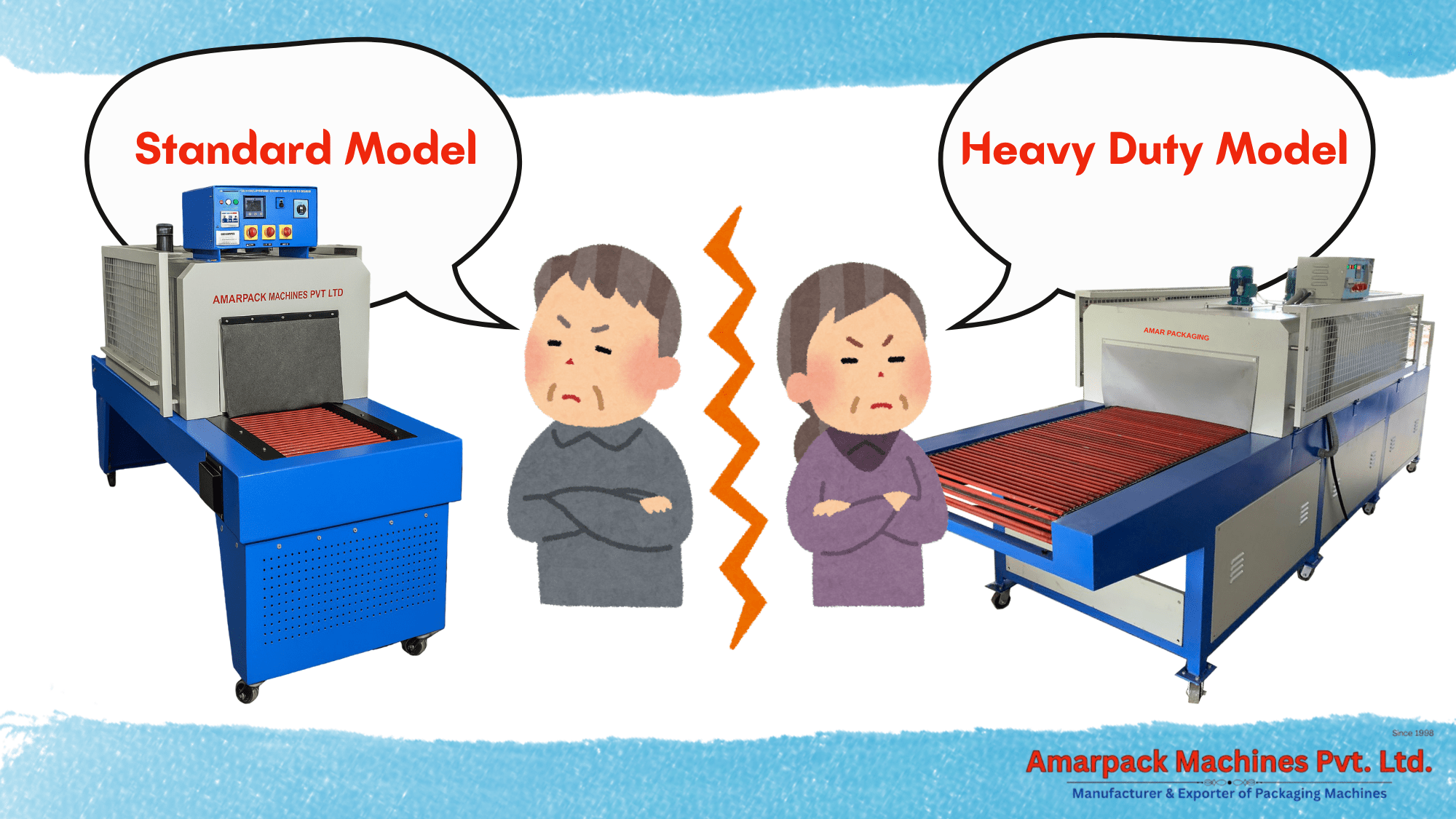
Standard vs Heavy-Duty Shrink Wrapping Machines: Which One Fits Your Packaging Line? How To Choose Between Standard OR Heavy Duty Model Ai Generated Choosing between a Standard Shrink Wrapping Machine and a Heavy-Duty Shrink Wrapping Machine can define the speed, durability, and efficiency of your entire packaging line. Whether you’re running an FMCG, food & beverage, or industrial production unit, understanding these differences ensures you invest in a system that matches your exact packaging needs. In this guide, we’ll break down both machine types — exploring their features, applications, technical differences, and ideal use cases — so you can confidently select the right model for your operation. 1. Understanding Shrink Wrapping Machines Shrink wrapping machines use heat to shrink a plastic film tightly around products, providing protection, tamper resistance, and a polished retail finish.At AmarPack Machines Pvt Ltd, we design three core variants: Portable (APST-100): Compact and mobile for small batches. Standard (APST-200): Ideal for medium-scale continuous packaging. Heavy-Duty (APST-300): Built for high-volume, industrial-strength operations. This blog focuses on comparing the APST-200 Standard Shrink Wrapping Machine and APST-300 Heavy-Duty Shrink Wrapping Machine, two of India’s most trusted models. 2. What Is a Standard Shrink Wrapping Machine? The Standard Shrink Wrapping Machine (Model: APST-200) is engineered for medium-volume production units requiring consistency, versatility, and reliability. Key Features Adjustable speed from 6–20 packs per minute Precision-controlled heating system (0–300°C) Fully recirculating air tunnel for uniform shrinking Compatible with LDPE/LLDPE films of various thicknesses Low power consumption and smooth live roller conveyor system Ideal For FMCG and retail multipacks Bottled water and beverage packaging Pharmaceuticals and personal care containers Medium-sized factories seeking dependable daily output 🟢 Learn more about this model:Standard Shrink Wrapping Machine – APST-200 3. What Is a Heavy-Duty Shrink Wrapping Machine? The Heavy-Duty Shrink Wrapping Machine (Model: APST-300) is built for continuous, large-scale industrial packaging. Designed with rugged construction and high-capacity tunnels, it delivers unmatched performance for operations demanding 24/7 productivity. Key Features Power-packed 9–10 KW heating system 18″–20″ tunnel opening for larger or bulkier products Enhanced air circulation for even shrink results at high speeds Supports high-thickness LDPE films for maximum protection Heavy-duty conveyor for large cartons, bottles, or industrial components Ideal For Bulk packaging units (food, beverage, chemical, lubricants) Industrial goods and logistics companies Export-grade packaging requiring durability and visual consistency 🟢 Learn more about this model:Heavy Duty Shrink Wrapping Machine – APST- 300 4. Standard vs Heavy-Duty Shrink Wrapping Machine: Detailed Comparison Specification Standard (APST-200) Heavy-Duty (APST-300) Production Scale Medium Large / Continuous Speed 6–20 packs per minute 15–40 packs per minute Tunnel Size 12″ x 12″, 14″ x 14″, 16″ x 14″ 18″ x 16″, 20″ x 18″ Power 9 KW, 3 Phase 9–10 KW, 3 Phase Film Type LDPE / LLDPE LDPE (High Thickness) Motor ½ HP 1 HP Structure Mild Steel / Optional SS Heavy-Duty MS Body Best For Medium-volume FMCG & pharma packaging Industrial, export, and bulk operations Standard Model Heavy Duty Model https://youtu.be/biIx4gj5gcI?si=ywEcrvdfqbIhWLYchttps://youtu.be/6ImqCtIWWig?si=FLwkVGL896SHgte2 5. Which Machine Should You Choose? Selecting between the Standard and Heavy-Duty shrink wrapping machines depends on your production capacity, product type, and operational goals. ✅ Choose the Standard Shrink Wrapping Machine (APST-200) if you: Have medium-scale daily output (up to 1,200 packs/day). Need flexibility to handle different product sizes. Want a cost-effective, energy-efficient system. Operate in FMCG, pharma, or retail sectors. 💪 Choose the Heavy-Duty Shrink Wrapping Machine (APST-300) if you: Run a high-volume production line (1,200–2,500 packs/day). Require continuous operation with minimal downtime. Use high-thickness films or package heavy cartons and bottles. Manage industrial or export packaging operations. 6. Why AmarPack Machines Pvt Ltd? For over 25 years, AmarPack Machines Pvt Ltd has been India’s trusted Shrink Wrapping Machine Manufacturer , providing customized packaging solutions to more than 1000+ industrial clients across India and abroad. 🔹 Why Choose Us ISO 9001:2015 & CE Certified Manufacturing In-house engineering and R&D 24/7 nationwide service & technical support Proven track record of performance and ROI Custom design options — from conveyor extensions to PLC control Explore our complete range:➡️ Shrink Tunnel Machines➡️ Web Sealer with Shrink Tunnel➡️ L-Sealer with Shrink Tunnel 7. Critical Buying Factors for Your Business Both Standard and Heavy-Duty Shrink Wrapping Machines deliver exceptional results — but the right choice depends on your production volume and product mix. If you’re a mid-sized manufacturer looking for efficiency, cost savings, and professional-grade packaging, the APST-200 Standard Shrink Wrapping Machine is your perfect match. For industrial-scale packaging lines demanding 24/7 reliability, choose the APST-300 Heavy-Duty Model for superior durability and performance. Frequently Asked Question 1. What is the main difference between Standard and Heavy-Duty Shrink Wrapping Machines? The Standard model handles medium-scale operations, while the Heavy-Duty version is designed for continuous, large-volume production. 2. Can both machines use the same shrink films? Yes, both support LDPE and LLDPE films, though the Heavy-Duty machine is better for thicker, industrial-grade films. 3. How do I know which model suits my business? Consider your daily output, film type, and available space. Our engineers provide free consultation to match your line’s exact requirements. 4. Are AmarPack machines customizable? Absolutely. You can choose optional stainless-steel construction, variable speed control, or PLC automation based on your needs. 5. How much maintenance do these machines require? Both are low-maintenance with durable components. AmarPack offers nationwide service and spare part support. Why Choose AmarPack Machines Pvt Ltd 25 Years of Experience You Can Trust Since 1998, Amar Packaging has been helping pharmaceutical companies across India and worldwide with reliable packaging solutions. With over two decades of experience, they understand exactly what pharma businesses need. Located in Mumbai, India’s pharmaceutical hub, Amar Packaging has direct access to the latest technology and skilled technicians. This means better service and faster support for your business. Direct manufacturer pricing eliminates middleman costs, giving you better value for your investment. Customization options ensure you pay only for features you actually need Free consultation helps you choose the right machine for your specific needs without any pressure to buy. Installation and training services ensure your team knows how to
The Complete Guide to Smart Packaging Automation: 10 Game-Changing Technologies Transforming Indian Manufacturing in 2025
The Complete Guide to Smart Packaging Automation: 10 Game-Changing Technologies Transforming Indian Manufacturing in 2025 The Indian packaging industry stands at a pivotal transformation point. With the sector projected to reach ₹2.3 trillion by 2025, manufacturers are increasingly investing in advanced automation technologies to stay competitive. From AI-driven predictive maintenance to sustainable packaging solutions, the landscape is evolving rapidly—and companies that fail to adapt risk being left behind. As an industry expert who has witnessed the remarkable growth of packaging automation in India, I’ve identified 10 critical technology areas that are reshaping how manufacturers approach efficiency, sustainability, and profitability. This comprehensive guide addresses the most pressing challenges facing Indian packaging manufacturers today and provides actionable insights for technology adoption The chart titled Maintenance Strategy ROI Comparison clearly demonstrates the financial and operational benefits of evolving from reactive to more proactive maintenance approaches. The Reactive strategy, while the least planned, incurs the highest Cost at $100k and results in the shortest equipment Life at 5 years and the highest Downtime at 20%. Stepping up to a Preventive strategy immediately shows an improved return, dropping the cost to $75k, extending life to 7 years, and cutting downtime to 12%. The most substantial gains are realized with the Predictive AI strategy, which achieves the lowest Cost at $50k, maximizes equipment Life to 10 years, and minimizes operational Downtime to just 5%. This data powerfully illustrates that the initial investment and effort required for advanced planning and technology, particularly with Predictive AI, yields significantly better performance and a higher overall Return on Investment. 1. Predictive Maintenance ROI The Foundation of Smart Manufacturing The Hidden Costs of Reactive Maintenance Traditional maintenance approaches are bleeding Indian manufacturers dry. Unplanned downtime alone costs the manufacturing sector over ₹2,000 crores annually, with packaging lines particularly vulnerable due to their high-speed, continuous operations. Consider this: A typical VFFS machine operating at 150 bags per minute loses approximately ₹45,000 in revenue for every hour of unplanned downtime. Multiply this across multiple machines and shifts, and the financial impact becomes staggering. AI Powered Predictive Maintenance: A Paradigm Shift Modern predictive maintenance systems deliver remarkable ROI: Studies show that AI enabled predictive maintenance can reduce unplanned downtime by up to 40% while cutting maintenance costs by 1560%. For Indian packaging manufacturers, this translates to: Reduced Equipment Failures: Early detection prevents 85% of catastrophic breakdowns Real-World Implementation Strategy Leading Indian packaging companies are deploying IoT sensors to monitor: Vibration patterns in filling machines and sealers Temperature fluctuations in heat-sealing systems Motor current signatures in conveyor systems Hydraulic pressure variations in press operations Extended Equipment Life: Assets last 2040% longer with proactive care Optimized Labor: Maintenance teams focus on value-adding activities rather than emergency repairs Real-World Implementation Strategy Leading Indian packaging companies are deploying IoT sensors to monitor: Vibration patterns in filling machines and sealers Temperature fluctuations in heat-sealing systems Motor current signatures in conveyor systems Hydraulic pressure variations in press operations Extended Equipment Life: Assets last 2040% longer with proactive care Optimized Labor: Maintenance teams focus on value-adding activities rather than emergency repairs Case Study: A Mumbai-based flexible packaging manufacturer implemented predictivemaintenance across their VFFS lines and achieved 23% reduction in maintenance costs whileimproving OEE from 76% to 89% within 18 months. 2. Total Cost of Ownership (TCO) Analysis: Beyond the Price Tag The TCO Reality Check Most Indian manufacturers make the costly mistake of focusing solely on equipment purchase price. However, the initial cost represents less than 10% of total lifetime expenses. The remaining 90% includes energy, maintenance, labor, and downtime costs—areas where smart investments yield exponential returns. Hidden Costs That Erode Profitability Energy Consumption: Packaging equipment typically consumes 15-25% of a facility’s total energy. Modern servo-driven systems reduce energy consumption by 30-50% compared to pneumatic alternatives. Material Waste: Poor equipment calibration leads to 15-20% material waste. Advanced packaging machines with precision controls reduce this to 3-5%, saving significant costs in high-volume operations. Labor Inefficiencies: Manual interventions, changeover delays, and quality issues inflate labor costs. Automated systems with quick-changeover capabilities reduce labor requirements by 40-60% TCO Optimization Framework For Indian packaging manufacturers, a comprehensive TCO analysis should include: Initial Investment (10-15% of total cost) Operating Costs (35-40%): Energy, materials, labor Maintenance (20-25%): Preventive, predictive, emergency repairs Downtime Impact (15-20%): Lost production, overtime, expedited shipping End-of-Life Value (5-10%): Resale, recycling, disposal costs ROI Calculation Example: A ₹50 lakh automated packaging line with 8% annual maintenance costs but 35% higher efficiency will break even within 2.5 years compared to manual operations, considering labor savings and reduced waste. 3. Key Regional Manufacturing Hubs The Bioplastics Challenge India’s push toward sustainable packaging is accelerating, driven by consumer awareness and regulatory pressure. However, processing biodegradable and compostable materials on existing VFFS equipment presents unique technical challenges. Material-Specific Challenges Sealing Temperature Sensitivity: Bioplastics often require narrower temperature ranges (±2°C) compared to conventional films (±5°C). This demands precise thermal control systems. Film Handling Characteristics: Biodegradable films may be: Stiffer and less flexible, affecting forming operations More susceptible to tearing, requiring gentler handling Moisture-sensitive, demanding climate-controlled environments Equipment Retrofitting Solutions Modern VFFS machines can be adapted for sustainable materials through: Advanced Sealing Jaws: Temperature-controlled systems with precise heat distribution. Film Tension Control: Servo-driven unwind systems prevent material damage. Modified Cutting Systems: Laser cutting reduces material waste by 3% compared to mechanical cutting. Enhanced Controls: Recipe-based systems store optimal parameters for different materials. Implementation Timeline: Most VFFS retrofits for bioplastics can be completed in 2-4 weeks with minimal production disruption. 4. Packaging 4.0 & AI-Driven Quality: The Intelligence Revolution The Industry 4.0 Imperative Packaging 4.0 represents the integration of cyber-physical systems, IoT, cloud computing, and cognitive computing into packaging operations. For Indian manufacturers, this isn’t just about technology—it’s about survival in an increasingly competitive global market. AI-Powered Quality Control Systems Modern AI systems excel at: Real-time defect detection with 99.9% accuracy Predictive quality management based on process parameters Adaptive process control that self-optimizes based on feedback Vision System Integration: AI-powered cameras inspect up to 2,000 products per minute, detecting defects invisible to human operators while maintaining detailed quality records for traceability.
Complete Shrink Wrapping Machine Buyer’s Guide 2025 | Semi vs Fully Automatic Explained
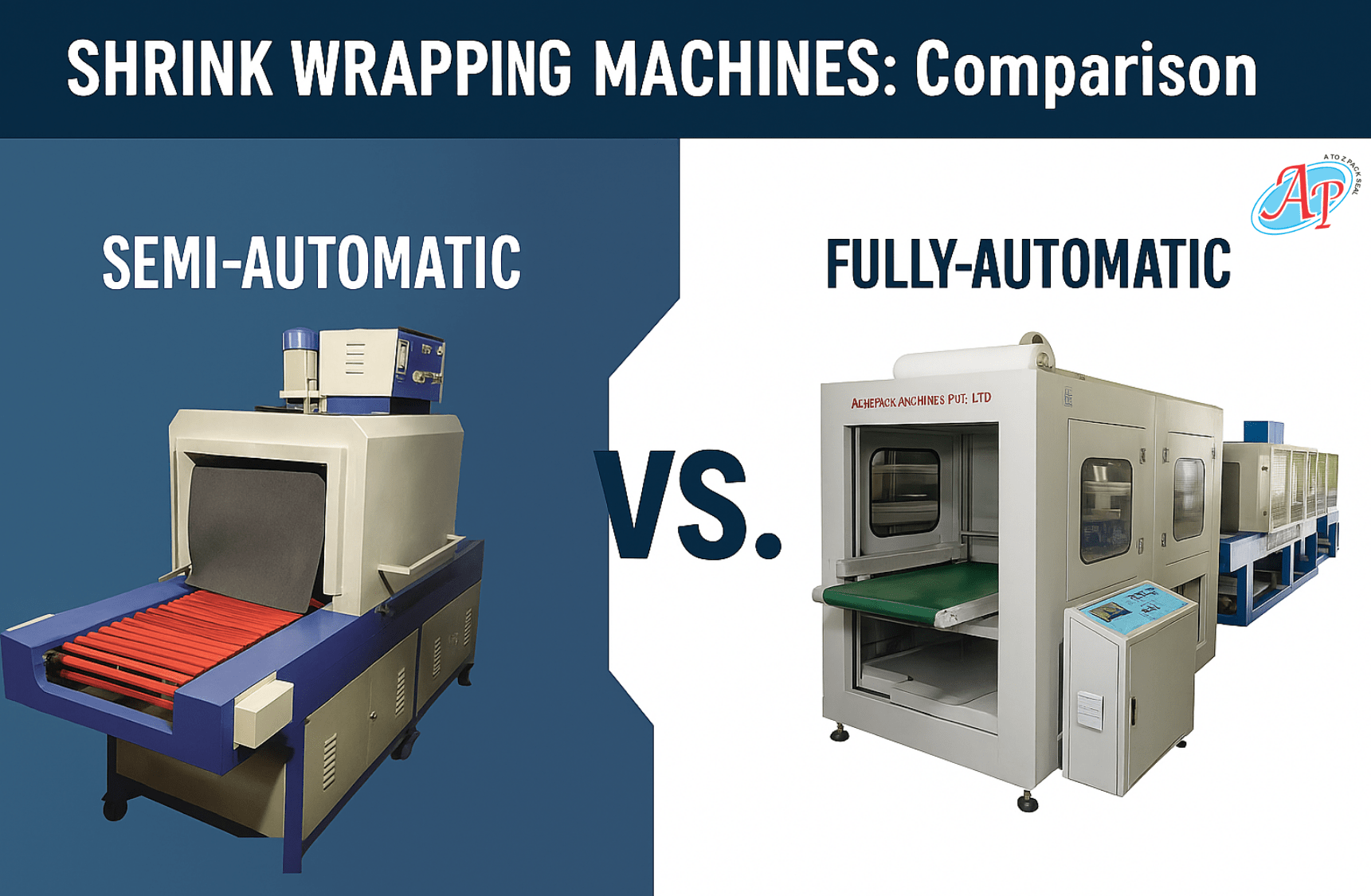
Complete Shrink Wrapping Machine Buyer’s Guide 2025 | Semi vs Fully Automatic Explained How to Choose Between Semi-Automatic vs Fully Automatic Systems Ai Generated I. Introduction When it comes to industrial packaging automation, few decisions carry as much weight as selecting the right Shrink Wrapping Machine. The wrong investment can bottleneck production, inflate labor costs, and limit scalability—turning what should be a growth enabler into an operational liability. This 2025 Buyer’s Guide breaks down everything you need to know about choosing between Semi-Automatic and Fully Automatic Shrink Wrapping Systems. Whether you run a growing startup or a high-volume manufacturing unit, this guide will help you make a data-driven, future-ready decision. At the heart of this choice lie three pivotal factors:👉 Volume — How many packages per minute you need to process.👉 Budget — How much you can allocate for capital investment vs. long-term operating costs.👉 Labor — How you plan to balance manual intervention with automation. II. Shrink Wrapping Fundamentals: Defining the Technology A. What is Shrink Wrapping? Shrink wrapping is a process that covers a product or bundle with a thermoplastic film, which shrinks tightly around it when exposed to heat. It provides a tamper-evident seal, protection from dust and moisture, and enhances retail shelf appeal. Common industrial applications include: Bundling bottles, cans, or cartons into multipacks. Protecting goods during transport or storage. Enhancing presentation for retail packaging (e.g., cosmetics, books, or software boxes). B. Key Machine Types L-Bar Sealers – Most common and cost-effective, ideal for single product packaging. Side Sealers – Designed for continuous packaging of longer products or variable lengths. Sleeve Wrappers (Web Sealers) – Used for wrapping trays, bottles, or bundled products together. C. Core Components A Shrink Wrapping Machine primarily includes: Sealing Mechanism: Can be pulse (instant heat sealing) or constant heat (continuous operation). Heat Tunnel: Uses hot air circulation to shrink the film evenly, ensuring smooth and wrinkle-free packaging. III. Semi-Automatic Shrink Wrapping Systems: How They Work A. Definition & Operation A Semi-Automatic Shrink Wrapping Machine requires manual loading and/or unloading by an operator. Once placed, the machine seals and shrinks the film automatically, making it a hybrid between manual and fully automatic systems. B. Key Advantages Lower Initial Investment: Affordable entry point for SMEs. High Flexibility: Handles multiple product sizes and short production runs with ease. Compact Footprint: Ideal for small facilities or limited floor space. Quick Changeovers: Minimal downtime when switching SKUs. C. Key Disadvantages Lower Throughput: Output depends on operator efficiency. Higher Labor Costs: Each cycle requires manual handling. Seal Consistency: Quality may vary depending on operator skill. D. Ideal Use Cases Best suited for startups, contract packers, and small-scale manufacturers processing up to 15–20 packages per minute (PPM). Perfect for variable product mixes and seasonal operations. IV. Fully Automatic Shrink Wrapping Systems: How They Work A. Definition & Operation A Fully Automatic Shrink Wrapping Machine integrates with conveyors to automate the entire process—from product feeding to sealing and shrinking. Human intervention is limited to film roll replacement and system monitoring. B. Key Advantages Maximum Throughput: Capable of 25+ PPM, ideal for high-volume operations. Reduced Labor Dependency: Significantly cuts manual involvement. Precision Sealing: Consistent, professional-grade finish every time. Designed for 24/7 Operation: Supports continuous or multi-shift production. C. Key Disadvantages High Capital Cost: Larger upfront investment required. Complex Maintenance: Requires trained technicians for servicing. Longer Setup Time: Product changeovers may need configuration adjustments. D. Ideal Use Cases A perfect match for large-scale manufacturing, FMCG packaging, bottle bundling, or printing operations where volumes exceed 25 PPM and consistency is critical. V. Detailed Comparison Table Comparison: Semi-Automatic vs. Fully Automatic Shrink Wrapping Machines Feature Semi-Automatic System Fully Automatic System Production Speed 15 – 20 Packs Per Minute (PPM) 25 – 60+ Packs Per Minute (PPM) Daily Output (8hr Shift) ~7,000 – 9,000 packs/day 12,000 – 28,000+ packs/day Labor Requirement High (1 Operator per machine) Minimal (Monitoring only) Machine Cost Low (₹80,000 – ₹2,50,000) High (₹2,00,000 – ₹8,86,000+) Ideal For Startups, Variable SKUs, Seasonal Mass Production, Standardized SKUs Key takeaway: If your facility is scaling and you foresee steady growth, investing in automation now will yield long-term savings and better production consistency. VI. Critical Buying Factors for Your Business A. Current & Projected Volume Your current throughput and 3-year growth forecast should dictate the machine choice. Plan for peak loads to avoid rapid obsolescence. B. Product and Packaging Variety If you run multiple SKUs or frequently change packaging sizes, opt for Semi-Automatic systems. For uniform, repetitive production lines, Fully Automatic offers better efficiency. C. Integration Requirements Does your line include conveyors, labelers, or batch coders? A Fully Automatic Shrink Wrapping Machine can seamlessly integrate with these systems for end-to-end automation. D. Film Considerations (2025 Trends) Modern packaging emphasizes sustainability—machines optimized for thinner POF, LDPE, or biodegradable shrink films offer both cost and environmental benefits. Frequently Asked Question 1. What is a Shrink Wrap Machine? A Shrink Wrap Machine is an automated or semi-automated system used to tightly seal products using a thermoplastic shrink film. Once wrapped, the film is heated in a shrink tunnel, conforming snugly to the product’s shape. This process protects items from dust, moisture, and tampering, while also improving retail appearance. Common industries using shrink wrapping include food, beverages, cosmetics, printing, and pharmaceuticals. 2. What Does Shrink Wrapping Cost? The cost of shrink wrapping depends on the type of machine, film, and production volume. Semi-Automatic Shrink Wrapping Machines typically range from ₹80,000 to ₹2,50,000, ideal for small and medium-scale businesses. Fully Automatic Shrink Wrapping Machines can cost between ₹2,00,000 and ₹8,86,000+, depending on size, speed, and integration level. In terms of operational cost, the shrink film (LDPE, POF, or PVC) and electricity for the heat tunnel are the primary recurring expenses. 3. What is a Fully Automatic Shrink Wrapping Machine? A Fully Automatic Shrink Wrapping Machine automates the packaging process by integrating L-Sealer or Web Sealer attachments with a Shrink Tunnel. These attachments handle product feeding, film sealing, and heat shrinking automatically — eliminating most manual intervention. The L-Sealer
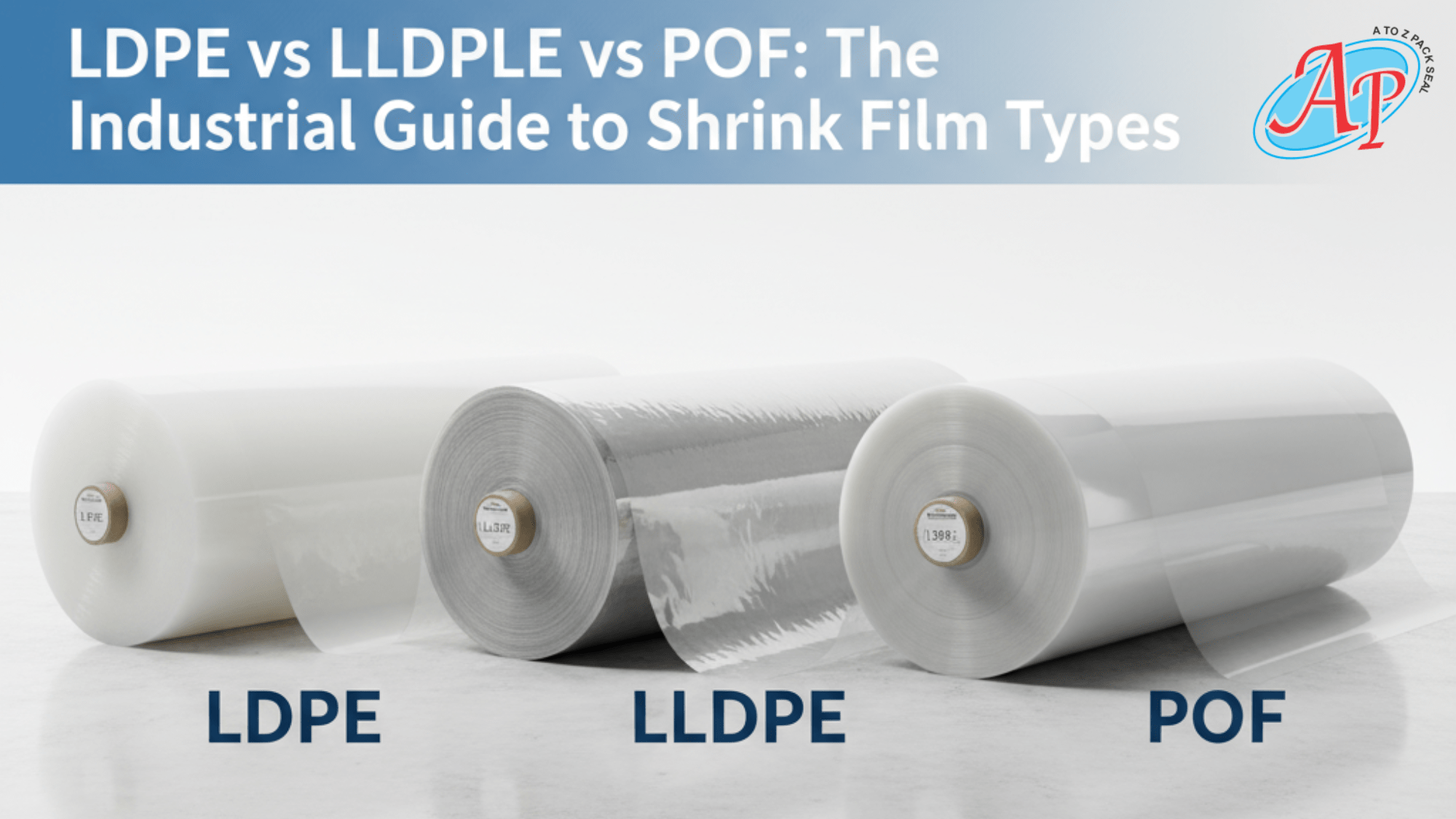
LDPE, LLDPE, POF: The Industrial Guide to Shrink Film Types
LDPE, LLDPE, POF: The Industrial Guide to Shrink Film Types LDPE vs LLDPE vs POF Shrink Film When it comes to industrial shrink wrapping operations, choosing the right film type directly impacts packaging efficiency, product protection, and operational costs. Understanding the technical differences between LDPE, LLDPE, and POF films ensures optimal machine compatibility and a professional-quality finish. 🧾 What is LDPE Shrink Film? LDPE (Low-Density Polyethylene) features a highly branched molecular structure that provides exceptional flexibility and robust protective strength.It begins shrinking at approximately 110–120°C and performs optimally at 125–160°C — perfect for heavy-duty, industrial packaging. Key Characteristics: Superior strength and puncture resistance — ideal for boxes, cartons, and sharp-edged products Density range: 0.917–0.93 g/cm³ (thickness from 0.4 mil to 40 mil) Operates with high-thickness films (up to 1200 gauge) 100% recyclable and FDA-approved for food contact 🧾 What is LLDPE Shrink Film? LLDPE (Linear Low-Density Polyethylene) combines flexibility and strength through a linear molecular structure with short, controlled branches.It delivers higher tensile strength and puncture resistance than LDPE — often at a thinner gauge, resulting in lower material cost. Advanced Features: Highest flexibility and impact resistance among shrink films Up to 20% material savings while maintaining durability Ideal for high-volume, heavy-duty packaging lines Excellent for stretch and multi-pack applications 🧾 What is POF Shrink Film? POF (Polyolefin) is the premium-grade film used in retail, food, and pharmaceutical packaging.Made from a blend of polyethylene and polypropylene, it provides superior clarity, seal strength, and safety. Premium Attributes: Exceptional optical clarity and glossy finish for product display FDA-approved for food and pharma contact Shrink temperature: 90–120°C with 2–3 sec dwell time 100% recyclable and emits no harmful fumes Film Comparison: LDPE vs LLDPE vs POF Property LDPE LLDPE POF Shrink Temperature 110–160°C 110–160°C 90–120°C Clarity Good Good Exceptional Strength High puncture resistance Highest tensile strength Strong seal strength Flexibility High Highest Good Cost Moderate Cost-effective Premium Applications Heavy-duty, industrial goods High-volume operations Food & retail Environmental 100% recyclable Recyclable 100% recyclable Critical Machine Compatibility Requirements Temperature Control Systems Each film type needs precise temperature matching for optimal shrink quality. LDPE/LLDPE: 125–160°C with 12–19 sec dwell time POF: 90–120°C with 2–3 sec dwell time Machine Configuration for Heavy-Duty Films To achieve perfect results with LDPE/LLDPE: Fully recirculating air system for even heat distribution High-power heaters (9–12 KW) for consistent chamber temperature ±2°C temperature precision for consistent film shrinkage Adjustable conveyor speeds for proper dwell time management Why the APST-120 is Engineered for High-Thickness LDPE/LLDPE The APST-120 Standard Shrink Wrapping Machine is built for heavy-duty LDPE and LLDPE operations.Its engineering precisely aligns with industrial-grade film requirements. Key Advantages: 9 KW fully recirculating air system with 12 × SS U-type heaters ensures uniform heat distribution Temperature range of 0–300°C with auto-regulated control for consistent performance Heavy-duty live roller conveyor system for smooth, vibration-free product flow Robust MS body structure designed for 24/7 industrial operation 🎯 This precision system prevents film tearing and guarantees a perfect shrink finish — every time. Machine Images Machine Video https://youtu.be/QJJQc7oQPik?si=aXvj20iza2tFuGsJ Film Selection Decision Matrix Choose When You Need Best For LDPE Maximum strength, puncture resistance Industrial, chemical, or sharp-edged packaging LLDPE Cost-efficiency, flexibility High-volume, sustainable operations POF Clarity & retail presentation Food, pharma, and consumer products Optimizing Shrink Wrapping Performance Temperature Guidelines LDPE Films: 125–160°C LLDPE Films: 120–160°C POF Films: 90–120°C 💡 Pro Tip: Use slightly lower temperatures with longer dwell times for smoother film finish and fewer wrinkles. Common Issues & Fixes Uneven Shrinkage: Improve air recirculation Film Tearing: Lower heat or increase dwell time Poor Seal Quality: Check bar temperature & film tension Cost-Benefit Insights LDPE/LLDPE Advantages Fewer packaging failures due to stronger film Reduced damage in transit and longer shelf life Up to 20% cost savings with LLDPE thinner gauges POF Returns Premium clarity → better product presentation Food-safe and eco-friendly operation Less machine maintenance and improved worker safety Amarpack Machines Pvt. Ltd. – Driving Growth in Packaging Industry https://youtu.be/xwLN7tl9guY FAQ’s Q1. Is LLDPE better than LDPE for stretch wrapping? Yes. LLDPE’s linear structure provides higher tensile strength and flexibility — ideal for stretch and multipack applications. LDPE is stronger for shrink film wrapping. Q2. Does LDPE shrink film melt at high temperatures? LDPE starts melting at 176°C (350°F) and burns at 343°C (650°F). Shrinking happens safely between 110–160°C, well below its melting point. Q3. What temperature should shrink wrapping machines be set to? For most applications: LDPE/LLDPE: 120–160°C POF: 90–120°C Q4. Can POF and LDPE films be used interchangeably? No. POF requires lower temperatures and gives better clarity, while LDPE handles heavier products. Always adjust machine settings accordingly. Q5. Which shrink film is best for heavy-duty applications? LDPE is the best for industrial applications requiring maximum strength and puncture resistance. For flexible heavy-duty use, LLDPE is an excellent balance. Conclusion Choosing the right shrink film impacts your packaging quality, operational efficiency, and cost-effectiveness. LDPE = Maximum strength LLDPE = Flexibility & cost efficiency POF = Clarity & food-grade safety If you’re moving to heavy-duty LDPE or LLDPE films, machine capability becomes crucial.The APST-120 Standard Shrink Wrapping Machine is engineered for these films — ensuring consistent temperature control, durability, and perfect shrink results. 👉 Contact AmarPack Engineers for a custom consultation on the APST-120 Model Series and elevate your packaging efficiency today. Request a Free Machine Quote Contact Form Demo First NameLast NameEmailPhone NumberYour MessageSubmit Form