
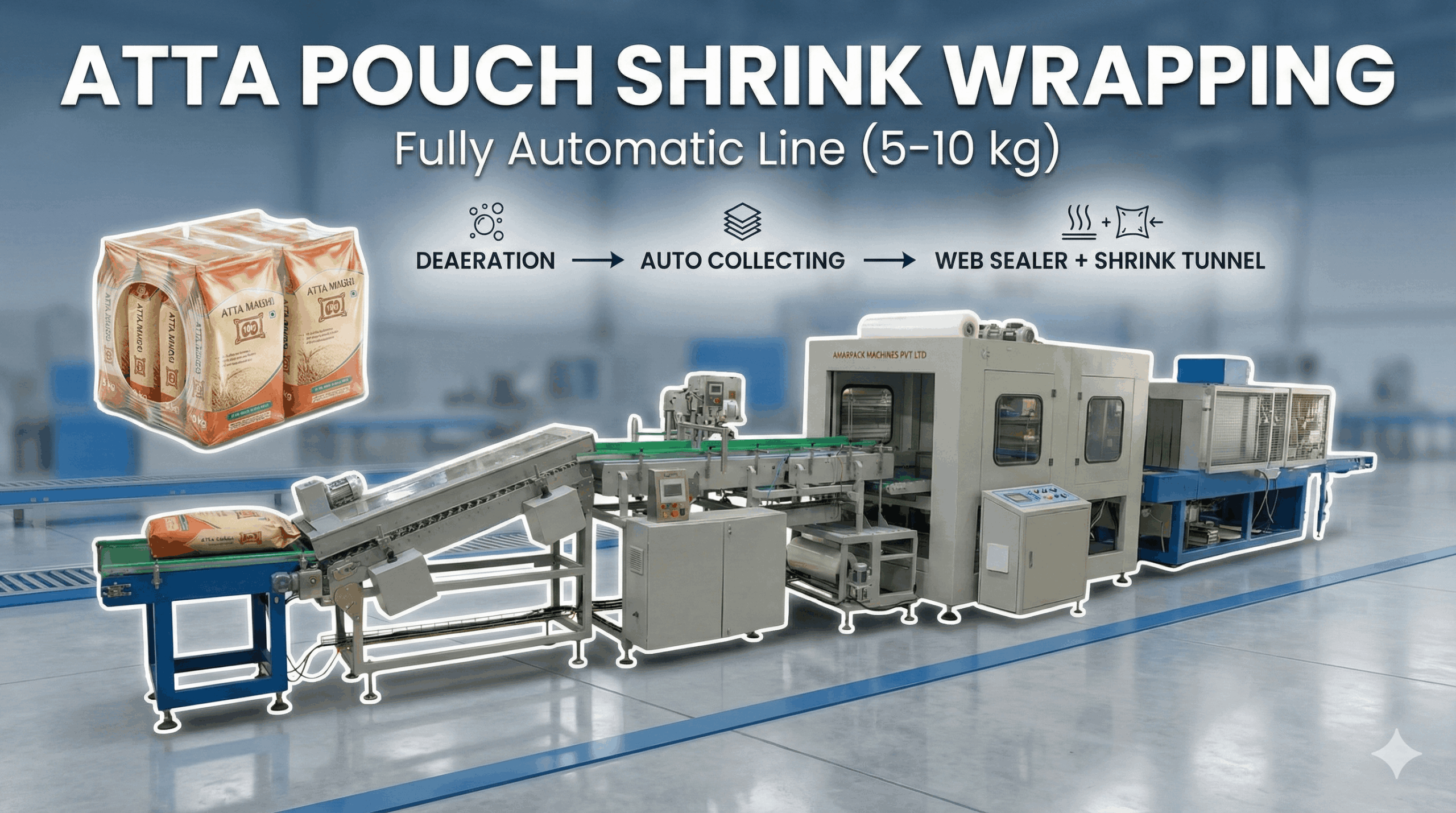
Deaeration to Dispatch-Ready Multipacks: The Engineering Behind Atta Pouch Shrink Bundling (5–10 kg) What happens after the pouch is sealed — and why it matters more than most plants admit Flour and atta plants put enormous effort into primary packaging — filling accuracy, seal integrity, pouch aesthetics, line speed. That investment is justified. But the real operational chaos typically starts after that stage, when finished 5 kg and 10 kg packs hit the conveyor and immediately begin misbehaving. Soft pouches act like balloons. They won’t stack square. They drift out of alignment. Secondary packing becomes a constant compromise between speed and damage control. If you’ve watched teams manually bundle at the end of an atta line, you know what follows: inconsistent group counts, skewed packs, film that shrinks cleanly on one bundle and wrinkles on the next — and the recurring nightmare of trapped air expanding under tunnel heat. This is why the industry conversation has shifted. It’s no longer “Do we need shrink bundling?” It’s “How do we make shrink bundling work consistently?“ In India and Nepal, this is precisely where an atta pouch packaging machine strategy stays incomplete without secondary packaging — because dispatch efficiency is won or lost in the last 12 meters of the line. Why Atta Pouches Create Specific Secondary Packaging Problems Atta pouches look uniform off the filler. They aren’t. Small variations in fill weight, air retention, and seal geometry compound quickly downstream: Air retention is the biggest culprit. Pouches with excess trapped air have a springy, inconsistent shape. They resist squaring during collation. Then, inside the shrink tunnel, that trapped air expands against the film — causing ballooning, loose wrap, wrinkles, or in severe cases, burst pouches. Group formation depends on consistent pouch geometry. If individual packs aren’t square and dense, the bundle going into the web sealer is already compromised. Tunnel heat amplifies whatever is wrong upstream. Misalignment becomes a jam. Inconsistent bundle density becomes uneven shrink. Most plants don’t fail because they lack a shrink tunnel. They fail because the secondary process skips one critical discipline: controlling pouch shape before heat and film are applied. This is the core logic behind a fully automatic atta bag deaeration and shrink wrapping workflow — treating secondary packaging as a controlled process chain rather than a sequence of loosely connected stations: Deaeration → Grouping → Pushing → Web Sealing → Shrink Tunnel → Cooling/Outfeed What Deaeration Actually Does (It’s Shape Control, Not Just Air Removal) “Remove the air” sounds straightforward. The operational reality is more precise: deaeration is shape conditioning. When pouches enter secondary packaging with excess air, they behave as compressible cushions. Collating them into a clean matrix — 4 packs for 5 kg bundles or 2 packs for 10 kg — becomes a fight. The packs push back against squaring. Then heat makes things worse. A dedicated deaeration and stacking conveyor system (Model: APCSWS-360) addresses this mechanically. It’s a pre-conditioning stage that densifies pouch geometry before grouping, so everything downstream runs more predictably. The system specifications reflect the application demands: Conveyor length: 3,000 mm | Width: 650 mm | Working height: 810 mm Upper roller height: adjustable up to 200 mm SS-304 rollers (OD 90–100 mm) for consistent contact with pouch surfaces Industrial load rating: 250–300 kg Belt thickness: 5–8 mm This is mechanical repeatability — not operator pressure, not guesswork. The pouch enters the tunnel stage already conditioned. How the Shrink Tunnel Actually Works Shrink wrapping is often explained vaguely — “film goes in loose, comes out tight.” The physics is more useful than the marketing language. A web sealer shrink tunnel machine performs two sequential operations: Sleeving and sealing: the product group is wrapped in film and formed into a closed sleeve. Controlled heating and dwell: the sleeve passes through a heated zone long enough for the film to contract uniformly around the load. The tunnel is a controlled energy transfer problem. You’re balancing three variables simultaneously: How evenly heat is distributed across the film surface How long the bundle stays in the heated zone (dwell time) How well the bundle geometry holds as film tension increases In atta applications, the bundle is not a rigid carton — it’s a cluster of compressible, semi-flexible pouches. That’s why upstream deaeration determines whether the tunnel produces clean bundles or becomes a daily troubleshooting task. The tunnel in this workflow uses: SS fin-type tubular heaters: 10–12 units at 1.5 kW each Conveyor inside the tunnel: SS-304 mesh chain or roller conveyor for heat stability Exit cooling: adjustable dual fans — because film continues to “set” during the cooling phase, not just during heat exposure Tunnel opening: 650 mm (W) × 500 mm (H) That last dimension is worth paying attention to. If your grouped bundle geometry — including pouch bulge after deaeration — exceeds that opening, you don’t have a shrink wrapping problem. You have an upstream shape-control problem. https://youtu.be/Wd3WW8s1X-0 The Full Line Flow: Station by Station Secondary packaging becomes predictable when every station behaves as part of one synchronized system. Here’s how the fully automatic atta bundling line runs: 1. Infeed Finished pouches arrive from the primary line onto an infeed conveyor. The objective at this stage is consistent orientation and spacing — not speed. Irregular spacing here creates surges that throw off deaeration and grouping downstream. 2. Deaeration and Stacking The APCSWS-360 compresses and conditions pouch geometry before collation. Adjustable roller height accommodates real-world variation in pouch fill levels. The result is a mechanically repeatable process that behaves the same on shift 1 and shift 3. 3. Collecting and Grouping After deaeration, pouches enter the automatic collecting system. The movement is engineered, not improvised: Ball-screw mechanism for vertical stacking movement Forward/back transfer onto a holding conveyor PLC-controlled tilting conveyor rotation with proximity sensing This builds stable groups matching actual dispatch patterns: 4 packs per bundle for 5 kg, 2 packs per bundle for 10 kg. Rated output is 3 bundles per minute — which replaces manual grouping, manual film handling,
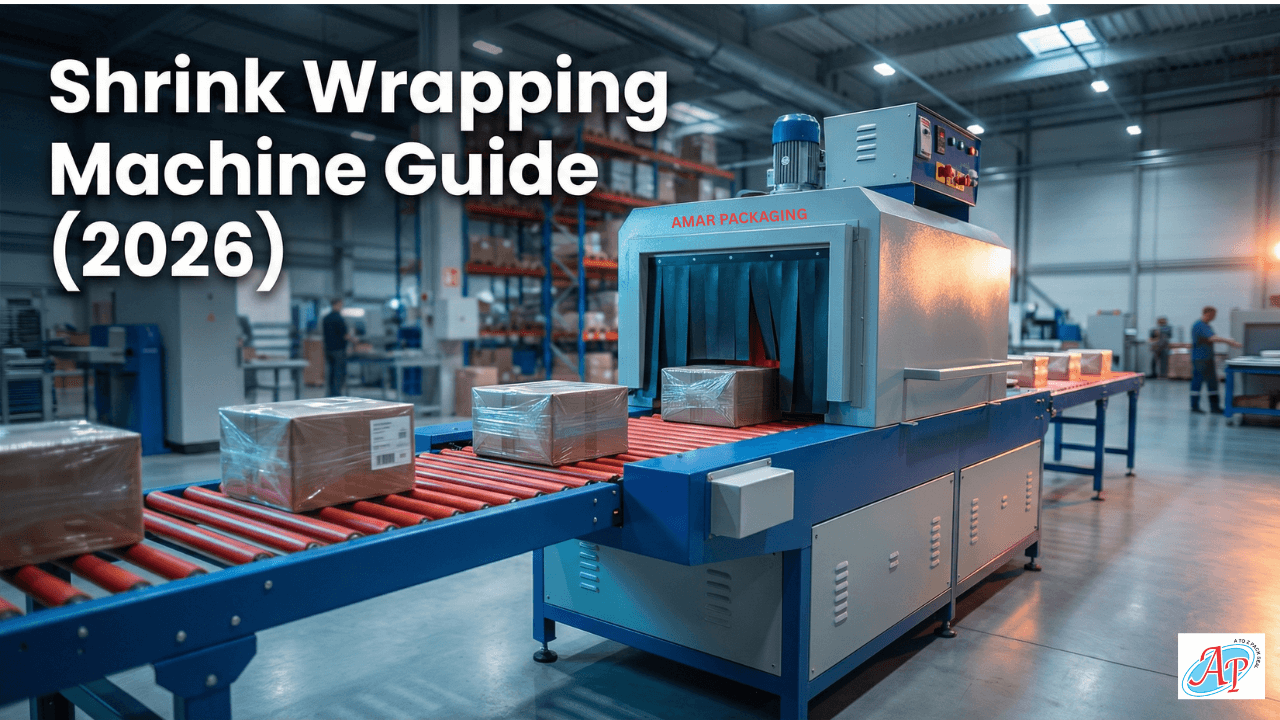
Heat Shrink Tunnel Machine: Working, Specs & Buying Guide (2026)
Heat Shrink Tunnel Machine: Working, Specs & Buying Guide (2026) If you’re trying to standardize packaging quality (tight shrink, clean edges, fewer rejects) while keeping production moving, a shrink tunnel machine is usually the point where a packaging line stops being “manual jugaad” and starts behaving like an actual system. And if you’re searching for a shrink wrapping machine, here’s the truth: most buyers use that term for the complete shrink packing setup (sealing + tunnel). In this guide, we’ll break down the working, the specs that actually matter, and how to buy the right machine in 2026 without overpaying or under-sizing. Portable Shrink Tunnel Standard Shrink Tunnel Heavy Duty Shrink Tunnel Table of contents What a heat shrink tunnel machine is Shrink tunnel machine vs shrink wrapping machine How a shrink tunnel machine works (step-by-step) Technical specs that matter (with APST-200 reference specs) Performance checklist (speed, temperature stability, conveyor) Film compatibility: LDPE/LLDPE/POF (what to choose) Buying guide (2026): how to select the right machine Maintenance + safety expectations in 2026 FAQs (your requested questions) 1) What is a Heat Shrink Tunnel Machine? A heat shrink tunnel machine is a heated chamber (tunnel) that uses controlled hot air to shrink packaging film tightly around a product or bundle. Products travel through the tunnel on a conveyor, the film shrinks uniformly, and you get a sealed, tamper-evident, transport-friendly pack. In industrial setups, the tunnel is designed for: uniform airflow, stable temperature control, continuous operation, and predictable output consistency. 2) Shrink Tunnel Machine vs Shrink Wrapping Machine (the buyer’s confusion, solved) Here’s the simplest, most practical definition: Shrink tunnel machine = the heating tunnel section that shrinks film. Shrink wrapping machine = often used to describe the system (sealer + tunnel + conveyor), or sometimes just the tunnel depending on the seller. That’s why you’ll see product pages titled “shrink wrapping machine” while the core industrial component is the shrink tunnel machine itself (because the tunnel determines finish quality, speed, and power consumption). Compare Standard vs Heavy Duty Shrink Tunnel Machine models before buying. 3) How does a Shrink Tunnel Machine work for packaging? A working shrink line is basically a 5-step ritual: Step 1: Product collating (grouping) Products are arranged as single packs, multipacks, trays, cartons, or bundles before wrapping. Step 2: Film wrapping Film (commonly LDPE/LLDPE/POF) is wrapped around the product. Step 3: Sealing (optional but common) Depending on your setup, sealing can be done by L-sealer / web sealer / manual sealing methods. Then the pack is sent forward into the tunnel. Step 4: Heat shrinking inside the tunnel Inside the shrink tunnel machine, recirculating hot air shrinks film evenly around the pack. A recirculating airflow system is specifically valued for uniform shrinking and energy efficiency. Step 5: Cooling + setting the finish A cooling section improves clarity and “sets” the shrink so the pack holds shape and doesn’t loosen after exiting. https://youtu.be/WjlKkEO01Ps 4) Technical Specs that Matter (and the specs buyers ignore at their own peril) Below are real-world spec parameters you should compare before you buy any shrink tunnel machine or shrink wrapping machine. A) Tunnel size (your product decides this, not your ego) Tunnel dimensions decide: what fits, what doesn’t, and how much air volume must be heated. Example reference sizes for a standard industrial tunnel include 12″×12″, 14″×14″, 16″×14″. Rule of thumb: keep 25–50 mm clearance around the product on all sides for clean airflow (more clearance for irregular shapes). B) Conveyor type (this controls stability + finish) Conveyor choice affects: pack alignment, wobble, seal distortion, and shrink uniformity. A common industrial configuration is live roller rod conveyors for smooth product flow and reduced damage. Many systems also offer conveyor variants like mesh belt / Teflon belt / slat conveyors depending on product type. C) Production speed (don’t buy based on “max speed” marketing) Look for an adjustable range. A typical industrial reference spec is 6–20 packs per minute (adjustable). Real output depends on: operator loading, sealing method, film type, product geometry, tunnel temperature stability. D) Temperature range + control accuracy (this is where quality comes from) A useful tunnel supports up to 0–300°C (auto-controlled) to handle common shrink films and thicknesses. For consistent finish at higher throughput, precision control matters—some industrial setups highlight ±2°C accuracy and zone-based heating for uniform shrink across different product sizes. E) Heating system & energy efficiency Modern tunnels increasingly use hot-air recirculation for more even heat distribution and better efficiency. Example: fully recirculating air system with stated efficiency improvements. Some designs also claim significant reductions in power consumption via improved recirculation and reduced heat loss. F) Heater configuration Heater layout affects warm-up time and shrink uniformity. Example configuration: 12× SS U-type heaters with fins. G) Power requirement (site readiness check) Industrial tunnels commonly run on 3 Phase, 440V, with a reference example of 9 kW. H) Motor specs Motor sizing ties to conveyor load and continuous use. A reference spec includes 1/2 HP or 1/4 HP AC motor. I) Customization options (where serious buyers win) In 2026, buyers should expect customization like: SS body options, variable speed, extension conveyors. 5) Example Specs Snapshot (Standard Industrial Heat Shrink Tunnel) If you want a quick benchmark checklist for a mid-production shrink tunnel machine, here’s a reference spec set: Model code: APST-200 (reference) Tunnel sizes: 12″×12″, 14″×14″, 16″×14″ Conveyor: live roller rod conveyors Speed: 6–20 packs/min adjustable Temperature: 0–300°C auto-controlled Heating: recirculating air system Heaters: 12× SS U-type with fins Power: 3-phase 440V, ~9 kW Cooling chamber: integrated That combination is typically positioned as a stable “workhorse” zone between portable entry-level machines and heavy-duty automatic lines. 6) Shrink Film Compatibility in 2026: What to use and why it matters Film choice decides: shrink appearance, seal strength, durability during transport, and even tunnel temperature behavior. Many

Fully Automatic Rockwool Shrink Wrapping Machine: Complete Guide for Insulation Manufacturers
Fully Automatic Rockwool Shrink Wrapping Machine: Complete Guide for Insulation Manufacturers Rockwool packaging looks simple until it starts failing on the shop floor: loose packs after rebound, seals opening during handling, slab edges getting crushed at transfer points, and film punctures showing up right before palletizing. In insulation plants, those problems don’t just create ugly packs — they create rework, downtime, unstable pallets, and customer complaints. This guide breaks down how a fully automatic rockwool shrink wrapping machine (conveyor → grouping → pusher → web sealer with shrink tunnel machine → outfeed) solves the most common insulation packaging issues for rolls, batts, and slabs/boards. You’ll learn process flow, film selection, troubleshooting, maintenance, and an ROI framework so engineering and procurement teams can evaluate the right solution with confidence. PlastIndia 2026 (theme “Bharat Next”) was a reminder that the next decade of plastics manufacturing will reward factories that treat operations as systems—materials, machines, people, and packaging all tied together. From a practical perspective, here’s where I expect the industry to move next—based on the direction of the ecosystem and the real constraints manufacturers face: 6.1 End-of-line automation becomes the fastest ROI zone Many processors can’t justify replacing major conversion equipment every few years. But end-of-line upgrades (conveying, sealing, shrink, vacuum packing, labeling discipline) often deliver faster ROI because they reduce labor variability, reduce damage, and increase dispatch throughput. 6.2 Packaging will be treated as compliance infrastructure As sustainability and traceability demands intensify, packaging will increasingly be designed for measurable outcomes: material reduction, recyclability, batch traceability, and transport efficiency. The “zero-waste” framing around PlastIndia 2026 is a cultural signal pointing in that direction. 6.3 Factories will standardize packing specs like they standardize product specs In mature operations, packing becomes a controlled specification: seal strength, film gauge, shrink profile, pack count, label placement, and pallet pattern. This is how manufacturers stop losing money after they’ve already done the hard part (making the product). Why Rockwool Packaging Needs Specialized Shrink Wrapping Rockwool (and similar mineral wool insulation) behaves differently than cartons or rigid FMCG packs. It compresses, releases, sheds dust, and hates sharp impacts on edges. Packaging must protect product geometry and keep packs stable through rough logistics. Common packaging problems in insulation plants Edge damage on slabs/boards during pushing, sealing, or conveyor transfers Loose packs that “breathe” after compression and lose shape in transit Seal opening from dust contamination, low dwell time, or wrong film grade Film punctures/tears caused by abrasive fibers, corners, or strapping contact Wrinkles and dog-ears that look cheap and stack poorly Inconsistent compression leading to variable pack height and pallet instability Dust environment issues: sensors, heaters, and sealing surfaces get dirty faster What “good packaging” means for insulation manufacturers “Good” insulation packaging is not only about appearance. It’s about measurable production outcomes: Seal integrity that survives handling and pallet movement Consistent pack dimensions (especially height) for pallet stability Controlled compression without permanent deformation Low rejects (holes, open seals, poor shrink) and minimal rework High uptime with predictable preventive maintenance Clean handling that respects dust-heavy environments Specialized shrink wrapping is about control—of compression, sealing, and shrinking—so rolls, batts, and slabs ship stable and arrive undamaged. What Is a Fully Automatic Rockwool Shrink Wrapping Machine? A fully automatic line is designed to take product directly from production (or accumulation), group it into packs, wrap it in film, seal it, shrink it, and discharge finished packs with minimal manual intervention. Simple definition (for non-technical readers) A fully automatic rockwool shrink wrapping machine is a packaging line that automatically: groups insulation products (rolls/batts/slabs), wraps them in shrink film, seals the film, and shrinks it with controlled heat to create a tight, protective pack. It replaces manual wrapping, hand-taping, and inconsistent sealing with repeatable automation. https://youtu.be/i7sVzRlbroc What is a web sealer with shrink tunnel? A web sealer with shrink tunnel is an automated system that wraps products in center-folded shrink film, seals the film as a continuous “web,” then heat-shrinks it in a tunnel to create a tight, protective pack. It’s ideal for insulation rolls, batts, and slabs because it supports high throughput and consistent seal integrity. In insulation packaging, the web sealer with shrink tunnel machine approach is popular because it can handle: Variable pack lengths (especially for rolls) Bundled formats (batts and slab stacks) Inline compression and controlled pushing into the sealing zone Automatic vs semi-automatic vs manual shrink wrapping Manual shrink wrapping:Operators wrap and seal by hand. Lowest CAPEX, highest labor, and highest variability. Common issues: inconsistent seals, film waste, slower throughput. Semi-automatic shrink wrapping:Some steps are mechanized (e.g., sealing), but grouping/pushing/loading is manual. Better than manual, but still bottlenecked by labor and inconsistent pack geometry. Fully automatic shrink wrapping (recommended for insulation plants):Grouping, pushing, sealing, and tunnel shrinking are synchronized. Best choice when your plant cares about throughput, uptime, consistent compression, and lower rejects. For high-volume insulation packaging, “fully automatic” is less about speed alone and more about repeatability: stable packs, stable pallets, stable production planning. How the Packaging Process Works (Step-by-Step Flow) Most insulation manufacturers want a simple reality check: What happens to my rolls, batts, or slabs minute-by-minute? Here’s the typical flow. Typical inline workflow A common fully automatic line uses this process flow: Infeed conveyor brings rolls/batts/slabs from the line or staging Collecting/grouping system accumulates the correct count (bundle formation) Pusher transfers the grouped bundle into the sealing zone consistently Film delivery + web sealing wraps the bundle and seals the film reliably Shrink tunnel applies controlled heat/airflow to tighten and finish the pack Outfeed conveyor cools and discharges for labeling, inspection, or palletizing This is why many plants prefer a conveyorized line: it reduces manual handling, which reduces damage. Where compression fits for rockwool (important!) Compression can be a superpower—or a quality problem—depending on control. Best practice: apply repeatable compression before sealing, so film is sized and sealed around a stable pack geometry. If packs “rebound” too much after sealing, you’ll see loose packs, wrinkles, and poor pallet stability. If compression is too aggressive, you
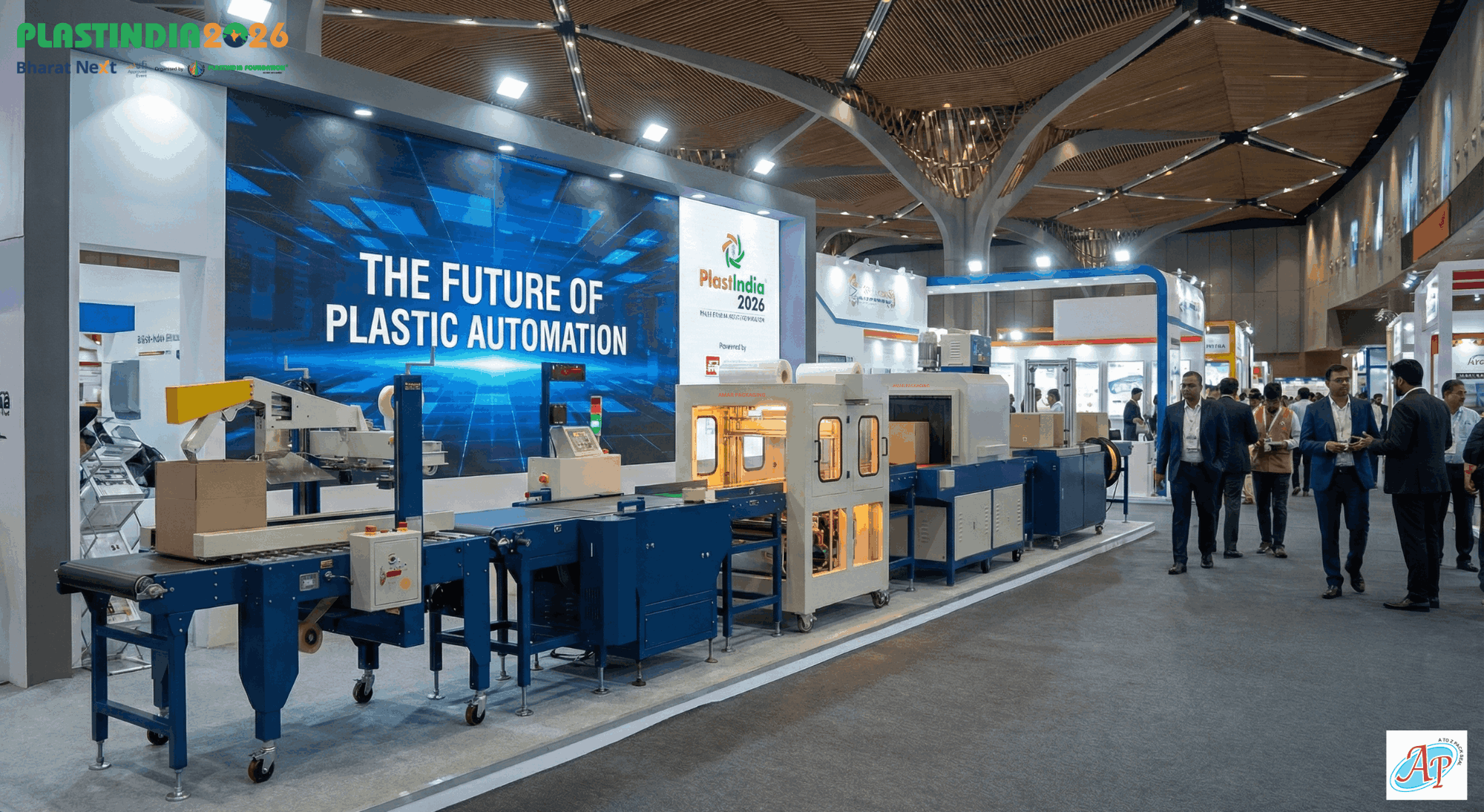
What PlastIndia 2026 Revealed About the Future of Plastic Manufacturing and Packaging Automation
The 2026 Industrial Packaging & Automation Manifesto: Navigating Global Economics, Commodity Volatility, and the Rise of Indian Engineering – [Duplicated] PlastIndia 2026 highlights made one thing obvious: plastics manufacturing is no longer judged only by faster molding or extrusion—it’s judged by dependable output and export-ready dispatch. When polymer producers, processors, recyclers, tooling, automation vendors, and end-of-line packaging suppliers share the same floor, you stop seeing “machines” and start seeing full production systems—and where they break under scale. Held 5–10 February 2026 at Bharat Mandapam, New Delhi, the event surfaced the real upgrade priorities: traceability, inspection, OEE discipline, and especially end-of-line packaging automation (sealing, shrink, vacuum, labeling, and stabilization). Below is a practical, factory-focused breakdown of the PlastIndia 2026 key trends that matter after the part is produced—because that’s where damage, delays, and margin leakage usually begin. 1. Introduction to PlastIndia 2026 PlastIndia has always had a particular gravity in the Indian plastics ecosystem because it sits at the crossroads of three realities: India’s scale (massive domestic demand across FMCG, pharma, automotive, construction, and consumer goods) India’s export ambition (global buyers pushing tighter specs, traceability, and packaging compliance) India’s modernization curve (factories upgrading from operator-dependent lines to repeatable, instrumented, automated systems) PlastIndia 2026 reinforced that this is not just an exhibition of “plastic machines.” It’s a showcase of manufacturing workflows: compounding → conversion (injection/extrusion/blow/thermoforming) → finishing → QC → packing → dispatch. The show’s official framing also emphasized the industry’s next phase and sustainability-driven operations. 2. Key Industry Trends Observed at PlastIndia 2026 When you strip away the marketing gloss, the dominant theme was simple: predictability at scale. Buyers aren’t only chasing speed anymore—they’re chasing stable output, stable quality, stable documentation, and stable delivery timelines. That forces changes across the production chain. 2.1 Automation that targets bottlenecks, not just cycle time Many factories already improved molding or extrusion cycle times over the last decade. The next productivity ceiling is usually not the press; it’s the human-dependent steps around it: manual counting, manual bagging, inconsistent sealing, ad-hoc labeling, and packing variability that becomes expensive during dispatch or exports. At PlastIndia 2026, the “automation story” wasn’t only robots on a pedestal. It was the quieter upgrades: conveyorized movement, sensor-driven reject logic, in-line checks, and end-of-line packing that doesn’t collapse when labor shifts change. 2.2 Measurement culture: OEE, scrap visibility, and traceability Factories that scale reliably tend to instrument their lines. That means tracking OEE (Overall Equipment Effectiveness), capturing scrap reasons, and linking batch data to packing and dispatch records. This matters because export customers increasingly want not just a product—but the story of how it was made, packed, and protected. 2.3 “Sustainability” becoming operational, not decorative A key operational signal: PlastIndia 2026 was positioned with strong emphasis on circular economy practices and a “zero-waste” direction for the event itself. :contentReference[oaicite:2]{index=2} That matters because sustainability has moved from slogans to audits: segregation, recyclability, packaging reduction, and transport efficiency are now cost and compliance variables—not just branding. 2.4 Packaging as a performance multiplier The smartest manufacturers treat packaging as part of manufacturing—not as a last-minute shipping activity. Why? Because packaging is where you protect margin. Damage, contamination, scuffing, moisture exposure, and seal failures don’t just cause returns—they trigger customer distrust and chargebacks. PlastIndia 2026 showcased many ways factories are reducing this risk by formalizing end-of-line packaging systems. 3. Rising Importance of Packaging Automation in Plastic Manufacturing In plastics, the product’s value can be destroyed after it’s “successfully manufactured.” That’s the paradox. Plastic components—whether molded caps, containers, profiles, sheets, trays, automotive parts, or engineered components—often fail in the market due to post-production handling: abrasion, dust contamination, deformation from stacking, UV exposure in yard storage, or inconsistent packing that creates transit damage. Packaging automation is rising because it solves three factory realities simultaneously: Protection: stabilizing the product against dust, moisture, scratches, and deformation Throughput: keeping pace with high-output molding/extrusion lines without labor becoming the bottleneck Standardization: making every shipment look and behave the same—critical for exporters and repeat industrial buyers Within that context, several packaging technologies naturally appeared as “default tools” for modern plastics operations—because they’re versatile, cost-effective, and easy to integrate. 3.1 Shrink tunnel machines: stabilization for transport and storage A shrink tunnel machine is less about aesthetics and more about load stability. Shrink packaging can convert loose, shift-prone packs into tight, tamper-evident bundles. In plastics, this is common for: bundling bottles, jars, containers, and closures grouping blister trays, thermoformed packs, and thin-wall items that scuff easily securing small components into standardized dispatch units The industrial advantage is repeatability: consistent shrink tension and consistent pack geometry reduce warehouse handling issues and improve pallet utilization—an unglamorous but high-impact cost lever. 3.2 Web sealers with shrink tunnel: continuous packing for high-output lines A web sealer with shrink tunnel fits naturally where output is continuous: extrusion profiles, high-volume molded items, or production cells that cannot afford stop-start packing. The “web sealer” approach tends to support higher line speeds and predictable sealing quality, which reduces rework and improves dispatch rhythm. In practical terms, this is the difference between packing being an “event” (operators rushing at the end of the shift) and packing being a flow that matches production. 3.3 L-sealers with shrink tunnel: reliable presentation for retail-ready or export-ready packs An L-sealer with shrink tunnel is often chosen when pack presentation and consistency matter—common in consumer-facing plastic goods, spare parts kits, hardware assortments, or standardized component packs for OEM supply. The main point isn’t retail glamour; it’s sealed integrity and repeatable pack sizing, which helps downstream carton packing and pallet patterning. 3.4 Vacuum packaging machines: cleanliness, space efficiency, and surface protection For many plastic items—especially precision parts, molded components with surface finish requirements, or products shipped into controlled environments—vacuum packaging machines are used to reduce air, minimize oxidation/contaminant exposure, and compress packaging volume. The “vacuum” benefit is rarely about food-style shelf life; it’s about protection and shipping efficiency: keeping dust away from parts used in assembly lines reducing pack movement that causes scuffing saving space for export shipments or high-cost air freight scenarios When you view these machines as “risk reducers” rather than “packing machines,” their adoption trend makes perfect sense—especially for manufacturers trying to reach higher-value buyers. 4. Growing Demand from

The 2026 Industrial Packaging & Automation Manifesto: Navigating Global Economics, Commodity Volatility, and the Rise of Indian Engineering
The 2026 Industrial Packaging & Automation Manifesto: Navigating Global Economics, Commodity Volatility, and the Rise of Indian Engineering Introduction: The Morning Ritual of the Modern Manufacturer It is January 30, 2026. In the corner of every factory manager’s office in India, a screen flickers with a familiar set of numbers. Before the first conveyor belt starts rolling, the check begins: the gold price today has surged to a staggering ₹1,53,150 per 10g for 22-carat gold. Moments later, the silver rate today flashes at a record-breaking ₹4.10 Lakhs per kg. Even in the digital realm, the volatility is palpable; Bitcoin is testing the $80,000 support zone after a 10% tumble, and the dollar rate today holds firm at an all-time high of ₹92.00. Why does a packaging machine manufacturer care about the gold price live or the Hindustan Copper share price (which recently soared to ₹760)? Because these aren’t just numbers on a ticker; they are the pulse of the manufacturing world. They represent the rising cost of raw materials, the fluctuation of import-export margins, and the desperate search for “Real Assets” in a world of digital uncertainty. As the Economic Survey 2026 recently highlighted: Services made India rich, but only manufacturing will make it resilient. In this 4,500-word deep dive, we explore how Automatic Box Shrink Wrapping Machines and End-of-Line (EOL) Automation have become the “New Gold” for businesses looking to hedge against inflation and secure their production futures. Chapter 1: The Macro-Pulse of 2026 — Why Manufacturing is the Ultimate Hedge 1.1 Decoding the Economic Survey 2026 The Economic Survey, tabled just yesterday, paints a fascinating picture for the Indian industrialist. With a projected GDP growth of 7.4%, the focus has shifted toward “Strategic Resilience.” The survey argues that while the gold rate in India reflects investor fear, the growth in Manufacturing GVA (9.13% in Q2) reflects industrial hope. For a manufacturer of Water Bottle Bundles or Cosmetic Boxes, the survey’s “Disciplined Swadeshi” policy means that localizing supply chains is no longer an option—it is a mandate for survival. When the dollar rate today hits ₹92, every imported component for a European shrink wrapper becomes a liability. Conversely, choosing a Made-in-India End-of-Line line becomes a strategic masterstroke. 1.2 The Copper and Silver Connection Take a look at the Hindustan Copper share price. It has surged by over 40% this week. This is driven by the global transition to green energy and AI data centers, both of which are copper-hungry. In our world, copper is the lifeblood of the high-performance motors found in Automatic Box Shrink Wrapping Machine. Similarly, the silver price today in Jaipur and other bullion hubs isn’t just about jewelry. Silver is a critical industrial metal for the high-conductivity contacts in the PLCs (Programmable Logic Controllers) that run your Fully Automatic Web Sealers. When these commodity prices rise, the replacement value of your machinery increases. Your factory floor is essentially a vault of high-value industrial metals, working 24/7 to generate profit. Chapter 2: The Evolution of End-of-Line (EOL) Packaging Automation 2.1 Beyond the “Last Step” Mentality For years, manufacturers viewed the end of the line as an afterthought. You focused on the filler, the mixer, or the molder. But the 2026 economic landscape has changed the math. With labor costs rising and the dollar rate today making manual errors more expensive, the “End-of-Line” has become the “Profit-Center.” End-of-Line (EOL) Packaging refers to the final stages: Case Packing: The art of boxing Soap Bar Multipacks or Tea Boxes. Shrink Wrapping: The science of securing Juice Bottle Packs or Biscuits. Palletizing: The logic of stacking Floor Cleaner Bottle Combos for global export. 2.2 The “Bitcoin” of the Factory Floor: Reliability vs. Volatility If Bitcoin represents speculative volatility, a Fully Automatic EOL System represents “Compounded Stability.” While you cannot predict if Bitcoin will be at $50k or $100k next month, you can predict that a high-quality Stretch Wrapping Machine will reduce your film consumption by 60% every single day. This “guaranteed dividend” is why industrial giants are moving their capital from speculative assets into hard-core automation. Chapter 3: Technical Deep Dive — Web Sealers vs. L-Sealers To understand which machine suits your business, we must look at the mechanics of the two giants in the shrink-wrapping world. 3.1 The Web Sealer: The Heavyweight Champion The Automatic Web Sealer with Shrink Tunnel is designed for the “bulk and bundle” world. It uses two rolls of film—one from the top and one from the bottom—to create a “sleeve” around the product. Best For: Water Bottle Bundles, Soft Drink Multipacks, Canned Food, and heavy Electric Kettle Boxes. The 2026 Advantage: With the Economic Survey emphasizing the growth of the FMCG sector (7.0% private consumption growth), the demand for multi-pack bundling has skyrocketed. Web sealers are the workhorses that handle the throughput. Material Efficiency: Unlike manual wrapping, a modern Web Sealer uses sensors to detect the exact length of the Juice Cartons, cutting the film with 99.9% accuracy. 3.2 The L-Sealer: The Precision Artist The Automatic L-Sealer is the go-to for retail-ready packaging. It uses a single roll of “center-folded” film and an L-shaped sealing bar to wrap the product on all three sides. Best For: Cosmetic Boxes, Perfume Bottles, Mobile Accessory Packs, and Chocolate Gift Boxes. The “Gold Standard” of Presentation: Just as you wouldn’t buy 22-carat gold from a dusty shop, consumers in 2026 won’t buy a High-End Tablet Box if the shrink wrap is loose or crinkled. The L-Sealer provides that “crystal-clear” professional finish that enhances brand perception. Chapter 4: Solving the Labor Crisis — Semi-Automatic vs. Fully Automatic One of the hidden themes of today’s gold rate discussions is the erosion of purchasing power. This has led to a tighter labor market. Workers are demanding higher wages, and manual packaging is becoming a bottleneck. 4.1 The Semi-Automatic Entry Point A Semi Automatic Box Shrink Wrapping Machine is perfect for mid-sized units handling Toy Boxes or Notebook Packs. It requires an operator to place the product, but the machine handles the sealing

The Global Trust, Movitive & Goal: A Comprehensive Guide to Smart Packaging Systems 2026
The Global Trust, Movitive & Goal: A Comprehensive Guide to Smart Packaging Systems 2026 Introduction As we navigate through, Smart Packaging Systems 2026 have reached a critical inflection point in the industrial renaissance. The “Packaging 4.0” era is no longer a futuristic concept; it is the operational standard. For production managers, plant directors, and business owners, the goal has shifted from simple “containment” to “intelligent throughput.” The packaging industry is currently grappling with three simultaneous pressures: a global push for zero-waste circularity, the skyrocketing costs of manual labor, and the demand for hyper-speed e-commerce fulfillment. To survive, companies are turning to advanced Shrink Machines, Vacuum Machines, and Sealing Machines.In this 4,000-word deep dive, we will explore the technical, economic, and environmental facets of modern packaging machinery, providing a roadmap for businesses to scale from manual batch processing to fully autonomous production lines. Chapter 1: The Anatomy of Modern Shrink Wrapping 1.1 Understanding the Thermodynamics of the Shrink Tunnel At the heart of the most efficient packaging lines in 2026 lies the Shrink Tunnel. Unlike the rudimentary heat boxes of the past, modern tunnels utilize Precision Airflow Mapping (PAM). This technology ensures that heat is distributed evenly across all surfaces of a product, eliminating “dog-ears” (loose corners) and “fish-eyes” (bubbles in the film).Why this matters for SEO and Sales:In 2026, aesthetic perfection is mandatory. Whether you are packaging a high-end perfume or a multipack of organic beverages, the “shrink” must be crystal clear. We explore how variable frequency drives (VFDs) in modern tunnels allow for the precise control of conveyor speeds, matching the thermal requirements of different film gauges (from 12-micron ultra-thin POF to heavy-duty 80-micron PE). 1.2 The Evolution of Sealing: From Impulse to Constant Heat The “Seal” is the weakest point of any package—unless it’s engineered correctly. We break down the two primary methods: Impulse Sealing: Ideal for intermittent production, using a burst of electricity to heat a wire. Constant Heat Sealing: The 2026 standard for high-speed lines. Using Teflon-coated heavy-duty knives, these systems provide a “beaded seal” that is virtually unbreakable during transit. Chapter 2: The Vacuum Packaging Revolution & Food Security 2.1 Extending Shelf Life in a Resource-Scarce World In 2026, food waste is a global priority. Vacuum Packaging Machines have become the primary defense against oxidation. By removing 99.9% of oxygen from the chamber, these machines inhibit aerobic bacteria growth, extending the shelf life of proteins and produce by up to 5x. 2.2 Modified Atmosphere Packaging (MAP): The Next Frontier Beyond simple vacuuming, we discuss Gas Flushing. In this process, the oxygen is replaced with a specific mix of Nitrogen and CO2. This is the technology behind “pillow-pack” snacks and fresh-cut salads that remain crisp for weeks. For a business, this means a wider geographic reach for their products without the need for chemical preservatives. Chapter 3: Sustainability and the “Mono-Material” Mandate 3.1 The Death of Multi-Layer Plastics By 2026, many regions have banned non-recyclable multi-layer films. The trend is now Mono-materiality. All-PE (Polyethylene) Streams: We discuss how modern machines have been redesigned to handle the specific melting points of single-polymer films, which were historically difficult to seal. Biodegradable & Compostable Alternatives: A technical look at seaweed-based and PLA films. We analyze the “shrink-force” of these materials and why specific machinery calibrations are required to prevent burning or tearing. 3.2 Reducing the Carbon Footprint of the Machine Itself Sustainability isn’t just about the film; it’s about the energy. We examine the rise of Energy Recovery Systems in packaging machines—systems that capture waste heat from the shrink tunnel and repurpose it to pre-heat the sealing bars, reducing total KWh consumption by up to 30%. Chapter 4: Automation Strategies – From Semi-Auto to Fully Integrated 4.1 The ROI of Moving to Full Automation Many SMEs hesitate to move from semi-automatic L-sealers to fully automatic lines. We provide a Cost-Benefit Analysis (CBA) framework: Labor Savings: One automatic machine can replace 4–6 manual operators. Material Consistency: Manual sealing often leads to 5-10% film waste due to human error. Automation reduces this to <1%. Throughput: Moving from 10 packs per minute (PPM) to 60+ PPM allows businesses to accept larger contracts from retailers like Walmart or Reliance Retail. 4.2 The “Middle Ground”: Modular Automation For businesses in transition, 2026 has introduced Modular Conveyor Systems. These allow a company to start with a standalone Shrink Tunnel and later “plug in” an Automatic Web Sealer or a Robotic Palletizer as the budget allows. Chapter 5: Digital Integration – IoT, AI, and Predictive Maintenance 5.1 The “Living” Machine In 2026, a packaging machine is a data node. Through IIoT (Industrial Internet of Things), sensors monitor the temperature of sealing blades and the tension of film rollers in real-time. Predictive Maintenance: The machine sends an alert to the maintenance team’s smartphone before a belt snaps or a heater fails. Remote Troubleshooting: Using Augmented Reality (AR), technicians can guide on-site staff through repairs from thousands of miles away, eliminating the “downtime” of waiting for a service visit. 5.2 AI and “Right-Sizing” We delve into how AI algorithms now calculate the exact amount of film needed for a specific SKU, adjusting the “stroke” of the sealing bar on the fly. This prevents “over-packaging” and saves miles of film over a production year. Chapter 6: Industry-Specific Smart Packaging Systems 2026 Applications 6.1 Pharmaceuticals: Compliance and Serialization Packaging in the medical field requires 100% traceability. We discuss how shrink wrapping systems now integrate with Inkjet Coding and Vision Systems to ensure that every bottle has a readable 2D barcode before it is bundled. 6.2 E-commerce: The “Box-on-Demand” Shift With shipping costs tied to “Dimensional Weight,” we look at how Automatic Side Sealers allow e-commerce hubs to wrap items of varying lengths (like rugs, umbrellas, or posters) in one continuous flow without stopping for changeovers. Chapter 7: Maintenance, Safety, and Longevity 7.1 The Golden Rules of Machine Maintenance A packaging machine is an investment meant to last 20+ years. We provide a comprehensive maintenance checklist: Daily: Cleaning Teflon residue from sealing wires. Weekly: Lubricating high-speed bearings and checking belt tension. Monthly: Calibrating PLC sensors and inspecting thermal insulation. 7.2 Operator Safety in the 4.0 Era Safety is paramount. We

Why Made-in-India End-of-Line Packaging Lines Are Competing Globally
Why Made-in-India End-of-Line Packaging Lines Are Competing Globally Introduction Made-in-India Packaging Lines Are Competing Globally. As global packaging automation was dominated by machines imported from Europe, Japan, and the United States. “Made in Germany” or “Made in Italy” was often considered the gold standard. But that narrative is changing—fast. Why Made-in-India End-of-Line Packaging Lines Are Competing Globally Today, Made-in-India end-of-line (EOL) packaging lines are not only serving domestic demand but are also being exported across Asia, the Middle East, Africa, Europe, and even the Americas. From stretch wrapping and strapping to conveyor systems and palletizing, Indian manufacturers are proving that world-class automation doesn’t have to come with world-class price tags. Why Price Advantage Matters European packaging machinery typically commands 40-50% price premiums over comparable Indian systems, driven by higher labor costs, stringent environmental compliance expenses, and established brand positioning. An end-of-line packaging line that costs EUR 200,000-250,000 from German or Italian manufacturers can be sourced from Indian companies for USD 120,000-150,000 with equivalent functionality[6]. This price differential proves decisive for emerging markets, SMEs, and cost-conscious manufacturers worldwide. Crucially, this cost advantage does not translate to compromised quality. Indian manufacturers have invested significantly in certifications, quality systems, and technological capabilities, ensuring that cost leadership delivers genuine value rather than diminished performance. India’s Competitive Strengths in End-of-Line Packaging Systems By leveraging efficient labor utilization and streamlined supply chains, Indian manufacturers achieve a 35–45% cost advantage without compromising on quality. This competitive edge is further enhanced by their ability to provide highly customized packaging solutions, offering a flexible alternative to standardized European machinery. Far from being low-tech, these manufacturers invest heavily in R&D and advanced engineering, ensuring their products feature the latest technological innovations. Supported by extensive global service networks across Asia, Africa, and Europe, and a strict adherence to international compliance standards, the Indian manufacturing sector now offers a sophisticated, cost-effective, and reliable choice for the global market. Key Markets Where Made-in-India Lines Are Winning FMCG & Food Processing: Leading the global growth with an 8.6% CAGR, Indian end-of-line systems are now the preferred choice for giants like Nestlé and PepsiCo. This validation by multinational brands underscores the machinery’s reliability in handling everything from dairy to snack foods. Pharmaceuticals: As a high-value segment, Indian manufacturers provide GMP-compliant systems featuring advanced “track-and-trace” technology and pharmaceutical validation (DQ, IQ, OQ), serving critical markets in Africa, the Middle East, and Latin America. Cosmetics & Personal Care: Offering high-precision filling (±1% accuracy) and high-speed operations, Indian machinery is now utilized by premium European and North American luxury brands that require both aesthetic quality and format flexibility. E-commerce Automation: To support thin margins, manufacturers have developed high-speed systems (500+ packages/hour) that feature variable case sizing and automated void-fill technology, fully integrated with modern Warehouse Management Systems (WMS). Make in India Initiative: Catalyst for Global Competitiveness The Indian government has fundamentally reshaped the manufacturing landscape through a multi-layered support system designed to boost global competitiveness. This transformation is driven by three primary pillars: 1. Strategic Policy Reforms Launched in 2014, the “Make in India” initiative has simplified regulatory frameworks and reduced bureaucratic hurdles. Key reforms include the Goods and Services Tax (GST), which streamlined the tax structure, and the creation of Special Economic Zones (SEZs) that provide world-class infrastructure and favorable compliance environments. 2. Infrastructure & Innovation Incentives Production Linked Incentive (PLI) schemes have been a game-changer, providing the financial impetus for manufacturers to: Modernize Facilities: Upgrade to high-level automation and advanced machinery. Quality Assurance: Establish R&D labs and performance validation centers that meet stringent international standards. Global Service: Expand technical support networks across new geographic regions. 3. Export Promotion & Trade Integration To facilitate global expansion, the government has aggressively pursued trade facilitation measures, including: Strategic Agreements: Implementing deals like the CEPA with the UAE and trade pacts with African nations to enhance market access. Simplified Logistics: Reducing barriers through streamlined export documentation and customs procedures. Global Visibility: Supporting international trade missions and assisting firms in achieving global quality certifications. Make in India Initiative: Catalyst for Global Competitiveness Parameter Indian Manufacturers European Manufacturers Advantage Equipment Cost USD 120k – 150k EUR 200k – 250k India (40–50% lower) Customization Excellent Limited India Technology Level Advanced (Industry 4.0) Premium Advanced Comparable Quality Standards ISO, CE, FDA ISO, CE, FDA Comparable Lead Time 8–12 weeks 12–16 weeks India (Faster) Service Response 24–48 hours 3–5 days India (Faster) After-Sales Support Strong regional presence Limited in Asia India Financing Options Flexible terms Rigid terms India Spare Parts Cost 20–30% lower Premium pricing India Training & Support Comprehensive Standard Comparable Where Companies Like AmarPack Fit In https://youtu.be/xwLN7tl9guY Manufacturers like AmarPack Machines Private Limited represent this new generation of Indian packaging solution providers. With decades of experience, AmarPack designs and manufactures: End-of-line automation systems Stretch wrapping and strapping machines Sealing & Shrink packaging solutions Conveyor systems Vacuum Packaging Solutions Built with Indian manufacturing intelligence and global application in mind, such companies demonstrate how Made-in-India packaging lines are now competing— and winning—on the world stage. Frequently Asked Questions What is an end-of-line packaging system? An end-of-line packaging system includes machines such as carton sealers, shrink wrappers, strapping machines, and pallet wrappers used at the final stage of production. Are spare parts easily available for Indian packaging machines? Yes, spare parts for Indian packaging machines are easily available and cost-effective compared to imported machinery, reducing downtime and maintenance costs. Can Indian manufacturers customize packaging machines? Yes, Indian packaging machine manufacturers are highly flexible and can customize machines based on product size, packaging material, layout, and automation level. Do Indian packaging machines meet international standards? Most established Indian manufacturers design machines that comply with ISO, CE, and FDA guidelines, making them suitable for global industrial use. Which is the best packaging machine manufacturer in India? India has many reputed packaging machine manufacturers. The best one depends on machine type, customization needs, after-sales support, and industry experience. Looking to automate your packaging line?Contact AmarPack Machines Pvt Ltd, India’s trusted packaging machine manufacturer serving global markets. Facebook
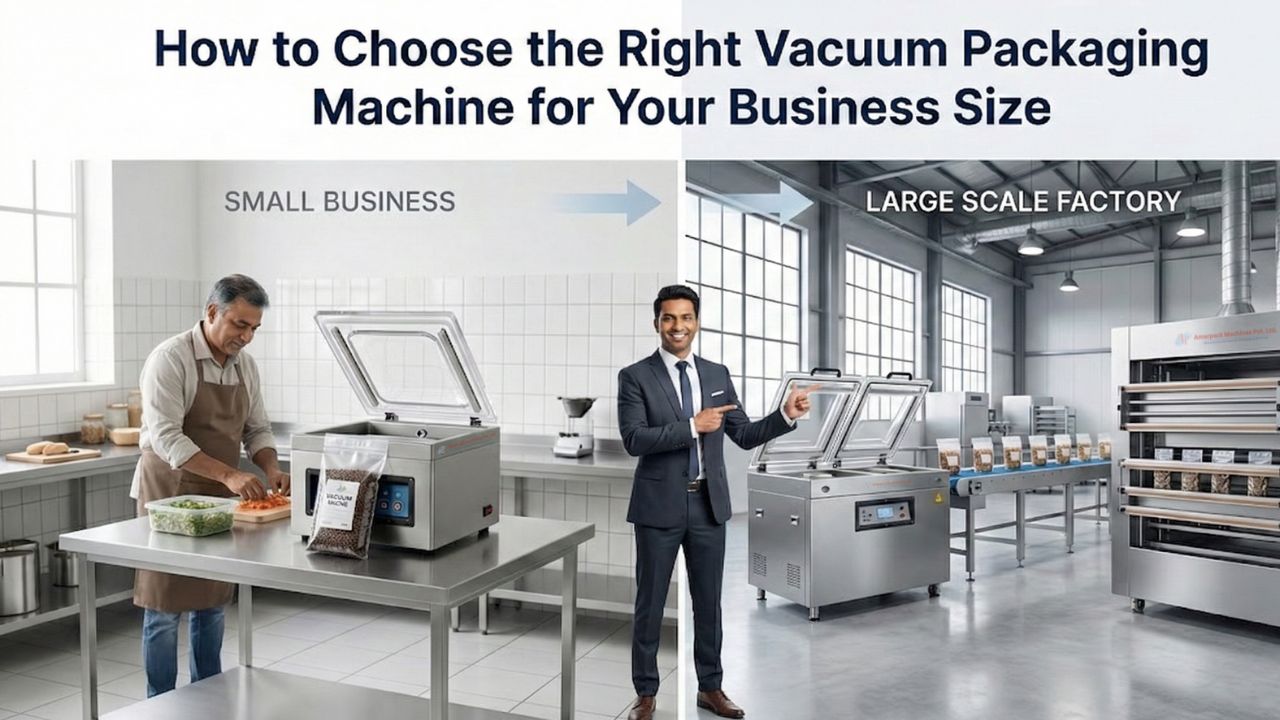
How to Choose the Right Vacuum Packaging Machine for Your Business Size
How to Choose the Right Vacuum Packaging Machine for Your Business Size A Practical Vacuum Packaging Machine Buying Guide India Selecting the right vacuum packaging machine is one of the most critical investments for businesses in food processing, pharmaceuticals, meat and seafood, dairy, and export industries. The wrong choice can lead to production bottlenecks, increased operational costs, product quality issues, and missed growth opportunities. Whether you’re a startup cloud kitchen packaging ready-to-eat meals or a large-scale food processor exporting internationally, your vacuum packaging machine must align with your current production volume, budget constraints, and future scalability requirements. The challenge most businesses face is not finding a vacuum packaging machine—it’s finding the right one. A small business buying an oversized industrial vacuum packaging machine wastes capital and floor space. Conversely, a growing manufacturer stuck with an under-capacity table-top unit faces production delays and customer dissatisfaction. This comprehensive buying guide helps you navigate the decision-making process by matching machine types to business scale, production needs, and long-term growth plans. As a manufacturer offering a complete range of vacuum packaging solutions—from compact table-top models to high-speed double chamber systems—we understand that one size never fits all. Why Business Size Matters When Selecting a Vacuum Packaging Machine Your business size directly determines the type of vacuum packaging machine you need. Here’s why this matters: Production Volume vs Machine Capacity A small meat shop packaging 50-100 packets daily has vastly different requirements than a central kitchen producing 5,000+ vacuum-sealed meal trays per shift. Matching machine capacity to actual production volume prevents both underutilization and overburdening. Capital Expenditure Considerations Small businesses and startups operate with limited budgets. Investing ₹15-20 lakhs in a fully automatic vacuum packaging machine when a ₹2-3 lakh table-top model suffices creates unnecessary financial strain. Conversely, large manufacturers benefit from higher automation despite the premium investment, as labor savings and throughput gains deliver faster ROI. Operational Complexity Manual and semi-automatic vacuum packaging machines suit businesses with smaller teams and simpler workflows. As operations scale, the need for automated feeding, conveyor integration, and continuous operation becomes essential to maintain efficiency. Scalability and Future-Proofing Medium-sized businesses often face the toughest decisions. They need machines that handle current volumes while accommodating 30-50% growth over the next 2-3 years. Choosing a scalable vacuum packaging machine for business growth prevents costly equipment replacements during expansion phases. Floor Space and Infrastructure Table-top vacuum packaging machines occupy minimal space—ideal for cloud kitchens and small processing units. Industrial vacuum packaging machines require dedicated floor areas, three-phase power, and proper ventilation, making them suitable only for established manufacturing facilities. Understanding these distinctions ensures your vacuum packaging machine becomes a productivity asset rather than an operational constraint. Vacuum Packaging Machine Selection Based on Business Scale Let’s break down the ideal vacuum packaging machine recommendations for three distinct business scales. Vacuum Packaging Machines for Small Businesses & Startups Small-scale operations—including boutique food brands, startup meat shops, seafood retailers, artisan cheese makers, cloud kitchens, and dairy startups—require compact, affordable, and easy-to-operate solutions. Typical Production Characteristics: Daily output: 50-500 vacuum-sealed packets Limited floor space Small operational teams (1-3 workers) Budget-conscious investments Simple product range with minimal SKU variations Recommended Machines: 1. Table Top Vacuum Packaging Machine Ideal Business Size: Micro and small businesses, home-based food ventures, startups Key Benefits: Compact footprint requiring minimal floor space Single-phase power compatibility (no infrastructure upgrades needed) Simple operation with minimal training requirements Entry-level investment ranging ₹1.5-3 lakhs Portable and easy to relocate as business evolves Typical Applications: Fresh and processed meat packaging for local butcher shops Cheese and paneer vacuum sealing in dairy startups Marinated products for cloud kitchens and QSR suppliers Dry fruits, nuts, and specialty food items Seafood portions for retail and home delivery Why It’s Cost-Effective for Small Businesses: The table-top vacuum packaging machine delivers professional packaging quality without the industrial price tag. Its manual operation eliminates complex automation costs while still providing consistent vacuum levels and hermetic sealing. For businesses processing 100-300 packets daily, this machine offers the perfect balance between affordability and functionality. 2. Nozzle Type Vacuum Packaging Machine (Table Top) Ideal Business Size: Small to medium food processing units, specialty food manufacturers Key Benefits: Handles liquid and semi-liquid products effectively Prevents liquid spillage during vacuum process Versatile nozzle positioning for different pouch sizes Faster cycle times compared to basic chamber models Suitable for both solid and liquid food applications Typical Applications: Marinated chicken, mutton, and seafood with masalas Wet food products like curries and gravies Pickles and condiments with oil or brine Ready-to-eat meals with sauces Liquid-rich products requiring controlled vacuum extraction Why It’s Cost-Effective for Small Businesses: This vacuum packaging machine for small business operations costs only marginally more than basic chamber models but handles a broader product range. The nozzle mechanism prevents product wastage by controlling liquid extraction, making it ideal for businesses where products contain moisture, marinades, or sauces. Vacuum Packaging Machines for Medium-Scale Manufacturers Medium-scale operations—including regional food brands, multi-city distributors, contract manufacturers, and exporters—require higher throughput, better automation, and reliable consistency. Typical Production Characteristics: Daily output: 500-3,000 vacuum-sealed packets Established manufacturing facility with dedicated packaging area Multiple product lines and SKU variations Quality certifications (FSSAI, export compliance) Growing workforce requiring standardized processes Recommended Machines: 1. Nozzle Type Vacuum Packaging Machine Ideal Business Size: Growing food brands, regional manufacturers, export-oriented units Production Capacity Advantage: Floor-mounted nozzle type vacuum packaging machines process 400-800 packets per shift, handling both dry and wet products with equal efficiency. The larger chamber accommodates bigger pouches and bulk products. Automation Benefits: Semi-automatic operation reduces labor dependency Programmable vacuum levels for different product types Digital controls ensure consistency across batches Gas flushing options for extended shelf life (MAP compatibility) Integrated sealing timers prevent operator error Typical Industries: Meat processing plants supplying modern retail chains Ready-to-eat meal manufacturers for food delivery platforms Export houses packaging value-added seafood Dairy processors packaging paneer, cheese, and butter Processed food manufacturers with regional distribution 2. Close Chamber Vacuum Packaging Machine Ideal Business Size: Medium-scale food processors, pharmaceutical packaging units, component manufacturers

5 Lies Packaging Machine Salesmen Tell You (And How to Spot Them)
5 Lies Packaging Machine Salesmen Tell You (And How to Spot Them) A Practical Packaging Machine Buying Guide India Buying a packaging machine is one of the largest capital investments a factory owner or procurement manager will ever make. In India’s highly competitive manufacturing environment, businesses are under constant pressure to automate quickly, increase output, and reduce labor dependence. Unfortunately, this urgency is often exploited—not only through aggressive sales tactics, but also through machines marketed as “Indian-made” that are largely imported, minimally assembled locally, and sold under private nameplates by trading dealers in major industrial hubs. A wrong machine decision does not just waste money—it quietly destroys profitability. Poor performance, frequent breakdowns, material wastage, missed delivery commitments, and escalating spare-part costs can drain anywhere from ₹5 lakhs to several crores over a machine’s lifetime. This guide exposes five of the most common lies told during packaging machine sales, explains why they are dangerous, and shows you how to verify the truth before signing any contract. Introduction: The Real Cost of Buying the Wrong Packaging Machine When a packaging machine fails to perform as promised, the financial damage extends far beyond the purchase price. Manufacturers experience: Chronic production delays and missed customer deadlines Penalty costs for late shipments High material wastage due to unstable machine performance Escalating repair and spare-part expenses Operational chaos caused by unplanned downtime Factory owners who have made poor machine choices routinely report losses ranging from ₹5,000 to ₹50,000 per day when a critical packaging line fails. The core problem is information asymmetry. Most procurement managers and business owners are not packaging-machine experts. They rely heavily on sales representatives for guidance. Salesmen understand this imbalance and often follow a predictable playbook: create urgency, make bold verbal claims, avoid documentation, and disappear after installation. This article exists to reverse that imbalance. By understanding these five lies—and learning how to verify the truth—you move from being a vulnerable buyer to an informed decision-maker whom vendors respect. Lie 1: This Machine Can Handle Any Product The Claim Salesmen frequently describe machines as versatile, multi-purpose, or future-proof. You may hear statements like: “This machine can pack rice, sugar, spices, powders, snacks—anything you want.” The implication is flexibility and long-term safety. The Reality Packaging machines are engineered for specific product properties, including particle size, moisture content, density, flowability, and packaging material behavior. A machine optimized for free-flowing granules (rice or sugar) will perform poorly with sticky products (gur, dates, pastes) or ultra-fine powders (flour, herbal extracts). Each product type requires different: Feeding mechanisms Sealing temperatures and pressures Hopper designs Dust control systems Forcing a single machine to handle incompatible products creates extreme changeover complexity. Real-world factories report ₹4,000–₹5,500 per changeover when material wastage, recalibration time, and lost production are considered. With just 10 changeovers per month, losses exceed ₹6,00,000 per year. Why It’s Dangerous Overstated versatility causes: Chronic quality problems Excessive material wastage (often 5–15%) Frequent downtime due to constant reconfiguration How to Spot the Truth Demand written confirmation of supported product categories Ask for defined limits: particle size, moisture range, density Insist on a live demonstration using your actual product Visit an operating factory running the same model for your product If a salesman says, “We’ll adjust it after installation,” consider it a red flag. Lie 2: The Machine Will Run at the Speed Shown in the Brochure The Claim Brochures advertise impressive numbers—500 pouches/minute, 1,200 bottles/hour. Salesmen present these as achievable daily outputs. The Reality Brochure speeds represent theoretical maximums achieved under ideal laboratory conditions. In real factories, actual output is usually 40–70% of rated speed due to: Minor stoppages Material variation Sensor recalibration Operator intervention Packaging material inconsistencies A machine rated at 100 units per minute may realistically deliver only 40–70 units per minute in daily operation. Why It’s Dangerous Production planning based on inflated speeds leads to: Missed delivery commitments Forced overtime and night shifts Overworked operators Unrecoverable capital misallocation How to Spot the Truth Ask for minimum sustained output under an 8-hour shift Demand real production data from existing customers Visit three factories using the same model Ask operators how long the machine actually runs without stopping Lie 3: The Warranty Covers Everything for Three Years The Claim Salesmen confidently promise “complete coverage” for three years. The Reality Most industrial warranties are designed to limit liability, not protect buyers. Common exclusions include: Normal wear and tear Operator error Product variation Environmental conditions (humidity, temperature) Electrical fluctuations Critical components may only be covered for 12 months, while others are excluded entirely. Why It’s Dangerous When breakdowns occur, manufacturers often classify failures as excluded conditions, leaving buyers with repair bills of ₹1–2 lakhs or more, even within the warranty period. How to Spot the Truth Obtain the full warranty document, not a summary Ask which components are covered for the entire term Get written clarification for failures after year one Request references for recent honored warranty claims Lie 4: Spare Parts Are Easily Available and Affordable The Claim Salesmen assure buyers that parts are locally available and inexpensive. The Reality Many machines use proprietary components available only from the OEM. Lead times can be 2–4 weeks, while pricing is often 300–400% higher than standard industrial equivalents. Over a 10–15 year lifespan, spare-part dependency can increase ownership cost by 40–60%, translating to ₹10–15 lakhs in additional expense. Why It’s Dangerous During breakdowns, manufacturers control: Price Availability Downtime duration This creates operational hostage situations. How to Spot the Truth Request a complete parts list Identify proprietary vs standard components Ask for pricing and lead times for wear parts Visit factories running older versions of the machine Lie 5: Training Is Minimal—Anyone Can Operate It The Claim Salesmen downplay training: “Online Training is enough.” The Reality Packaging machines are complex electromechanical systems. Insufficient training leads to: Incorrect settings Accelerated wear Poor troubleshooting Chronic downtime A trained operator resolves 80% of issues in minutes. An untrained one causes breakdowns costing ₹1–5 lakhs per incident. Why It’s Dangerous Bad habits form early and
Automatic L-Sealer with Shrink Tunnel Machine: Complete Guide to Industrial Shrink Wrapping Automation
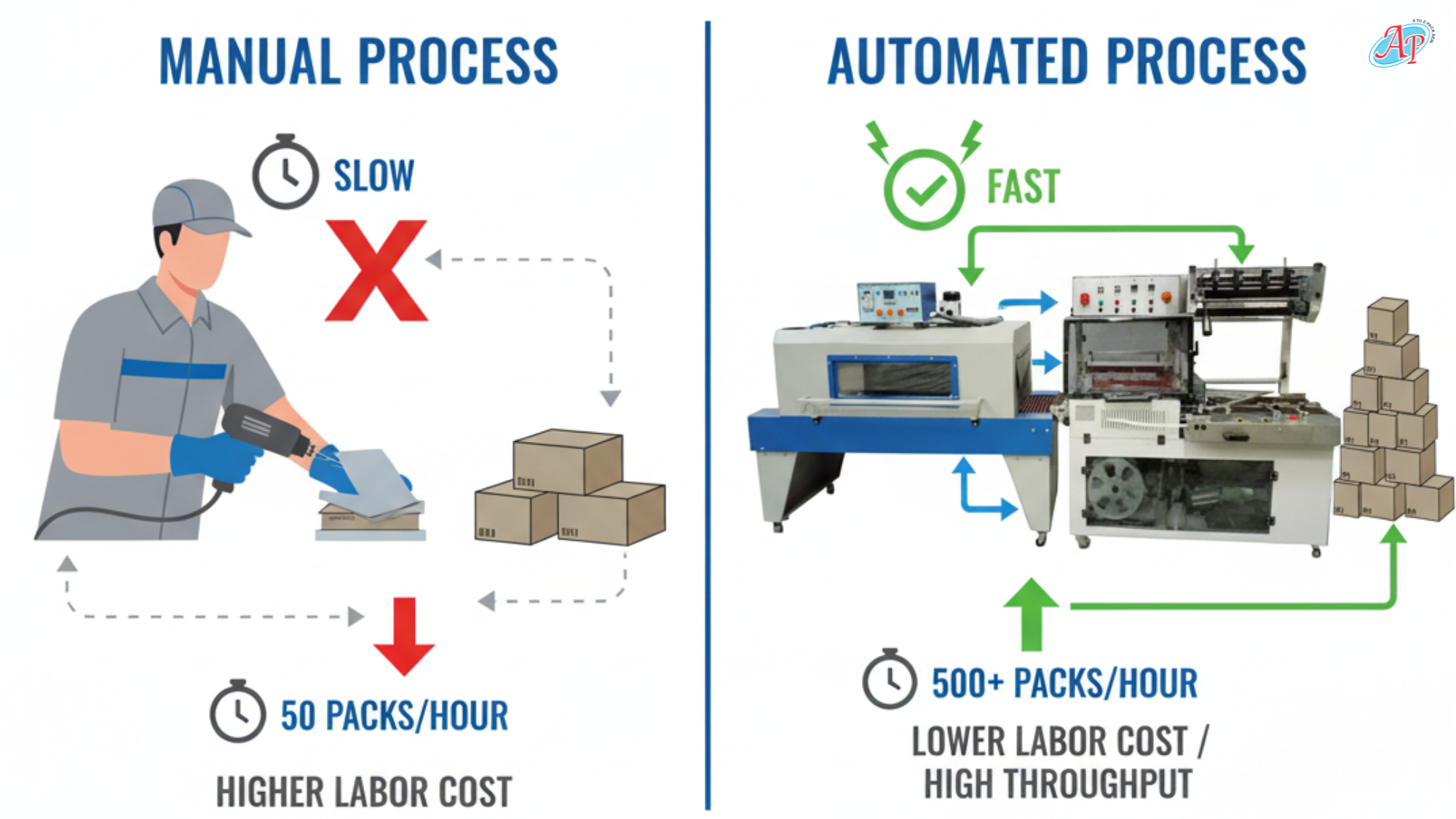
Automatic L-Sealer with Shrink Tunnel Machine: Complete Guide to Industrial Shrink Wrapping Automation Automatic L-Sealer with Shrink Tunnel | Industrial Efficiency Guide As manufacturing operations scale, packaging is often one of the first areas where inefficiencies begin to surface. Manual shrink wrapping, while suitable for low volumes or short production runs, can struggle to deliver consistent results in high-output environments. Variations in sealing quality, higher reliance on operator skill, and slower throughput can affect overall production efficiency. Over time, these inconsistencies can lead to operational friction—rework caused by poor seals, inconsistent package appearance, and challenges in meeting production schedules. For manufacturers handling regular daily output, the cumulative impact of manual shrink wrapping becomes increasingly noticeable. This is where automatic shrink packaging systems, such as the Automatic L-Sealer with Shrink Tunnel Machine, are commonly adopted. Rather than promoting a specific product, this guide explains how the technology works, why manufacturers move toward automation, and how these systems fit into modern industrial packaging workflows. Understanding Automatic Shrink Packaging Technology Shrink wrapping is widely used in industrial packaging because it combines product protection with visibility and professional presentation. The process involves wrapping products in thermoplastic film and applying heat so the film shrinks tightly around the product. The effectiveness of shrink packaging depends on process control—maintaining stable temperature, sealing pressure, and film handling throughout production. In manual operations, these variables rely heavily on operator technique, which can vary over long production shifts. An Automatic L-Sealer with Shrink Tunnel Machine addresses these variables by dividing shrink packaging into two controlled, automated stages: Sealing: The product is enclosed in shrink film using heat-activated sealing. Shrinking: Heat is applied evenly to shrink the sealed film around the product. Automating both stages allows manufacturers to maintain repeatable packaging quality across batches while reducing process variability. What Role Does an L-Sealer Play in Shrink Wrapping? The L-sealer performs the initial sealing stage in automatic shrink packaging. It forms a sealed enclosure around the product using heat-sealing bars arranged in an “L” shape. How L-Sealer Heat Sealing Works When the product is positioned on the conveyor, center-folded shrink film is placed around it. Heated sealing bars descend and apply controlled heat and pressure, sealing two sides of the film simultaneously. This method is particularly suitable for commonly used shrink films such as POF, PVC, and PE. Maintaining proper sealing conditions is essential. If heat or pressure is insufficient, seals may be weak. Excessive heat can degrade film quality. Automatic L-sealers use regulated heating and controlled pressure to maintain stable sealing conditions across repeated cycles. How the Shrink Tunnel Complements the Sealing Process After sealing, products move into the shrink tunnel. The tunnel is a heated chamber designed to apply uniform heat around the sealed package, causing the film to shrink evenly and conform to the product shape. Controlled Shrinking Environment Inside the tunnel, heated air circulates continuously. This controlled environment allows manufacturers to: Adjust temperature based on film type Maintain uniform shrink quality Avoid uneven heating associated with manual heat guns Preserve film clarity and package appearance The tunnel’s conveyor speed and temperature settings can be adjusted to match product dimensions and film characteristics, helping maintain consistent results across production runs. Key Components in an Automatic L-Sealer System While configurations vary, most Automatic L-Sealer systems include: Product infeed conveyor Film feeding mechanism Heat sealing elements Operator control panel Waste film rewinder Discharge conveyor connecting to the shrink tunnel Integrated shrink tunnel with temperature and airflow control Understanding these components helps manufacturers evaluate whether a system aligns with their packaging requirements and available production space. Why Manufacturers Transition from Manual to Automatic Shrink Wrapping The move toward automation is typically driven by operational considerations rather than marketing factors. Consistency and Repeatability: Automated systems deliver uniform sealing and shrink results, reducing variability that can occur with manual handling. Reduced Labor Dependency: Automation allows operators to focus on supervision and quality checks rather than repetitive manual tasks. Predictable Production Output: Packaging speed becomes stable and measurable, supporting production planning and scheduling. Improved Material Control: Controlled film feeding and heat application help reduce unnecessary film waste over time. Scalability: Automatic systems support increased production volumes without requiring proportional increases in packaging labor. Technical Specifications and Operating Parameters When evaluating an Automatic L-Sealer with Shrink Tunnel Machine, manufacturers typically consider: Electrical supply compatibility Power consumption of sealing and tunnel components Supported film types (POF, PVC, PE) Adjustable sealing and tunnel speeds Pneumatic air requirements Maximum product dimensions Machine footprint and total system weight These parameters help ensure compatibility with existing infrastructure and production requirements. Common Applications of Automatic L-Sealer with Shrink Tunnel Machines Depending on product dimensions and packaging requirements, these systems are commonly used for: Packaged food and beverages Consumer electronics and accessories Personal care and cosmetic products Printed materials and media General retail and industrial goods Final suitability depends on product size, film selection, regulatory considerations, and production volume. Where Amarpack Fits into Automated Shrink Packaging Manufacturers evaluating automation often seek suppliers with practical industry experience and understanding of real-world production environments. Since 1998, Amarpack has been involved in developing packaging machinery designed for industrial operating conditions. Amarpack focuses on workflow compatibility, operational reliability, and ease of integration—factors that manufacturers commonly prioritize when introducing automated packaging systems into existing production lines. https://youtu.be/csjMhjVExy0https://youtu.be/Aqckloq6PnIhttps://youtu.be/jLpi_8-T-co Working Demo Of Packaging Machine Manufactured By AmarPack Machines Pvt Ltd For More, Visit Official Youtube Channel: AmarPack Machines Pvt Ltd Conclusion: Automation as a Packaging Strategy An Automatic L-Sealer with Shrink Tunnel Machine represents a structured approach to improving packaging efficiency, consistency, and scalability. By automating sealing and shrinking processes, manufacturers gain greater control over packaging quality while supporting long-term production growth. Understanding how these systems work and where they fit within the broader production workflow enables manufacturers to make informed decisions aligned with their operational needs. Frequently Asked Questions What is the difference between an L-sealer and a shrink tunnel? An L-sealer seals the shrink film around the product, while the shrink tunnel applies controlled heat to