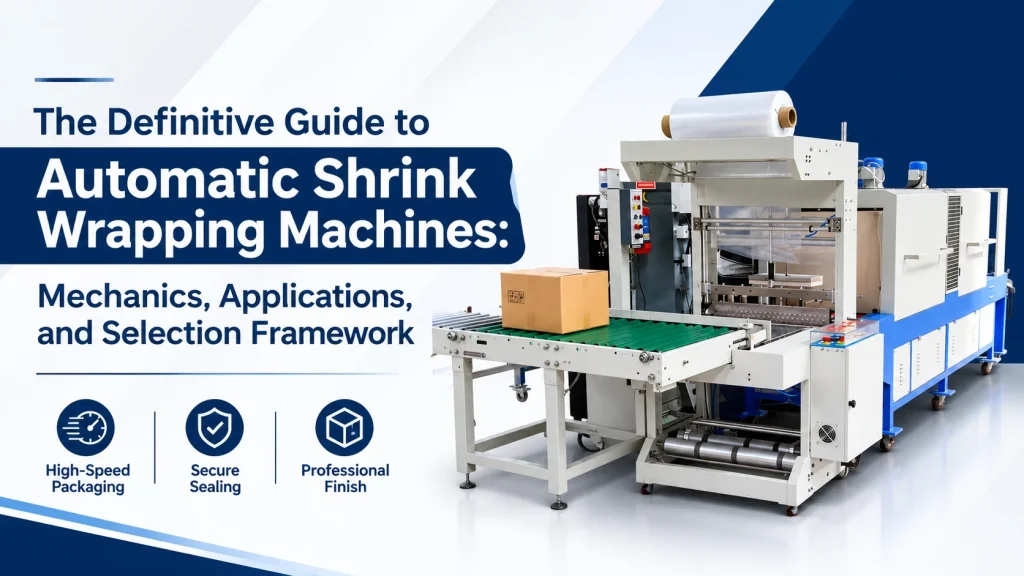
In modern manufacturing, logistics, and retail distribution, end-of-line packaging integrity can make or break a product’s lifecycle. Whether safeguarding pharmaceutical vials from environmental contamination, bundling multi-packs of beverage cans for retail distribution, or unitizing heavy industrial goods, the method of enclosure matters.
Among the various packaging technologies available, the automatic shrink wrapping machine stands out as the cornerstone of high-speed, reliable, and secure packaging automation.
Unlike manual or semi-automatic alternatives that rely heavily on operator dexterity, automatic shrink wrapping systems integrate advanced mechanics, programmable logic controllers (PLCs), and precision thermal dynamics to deliver seamless, continuous-motion packaging.
This guide provides an authoritative, deep-dive examination of automatic shrink wrapping machines—breaking down their core definitions, step-by-step workflows, industrial applications, mechanical variations, and a strategic framework for procurement professionals.
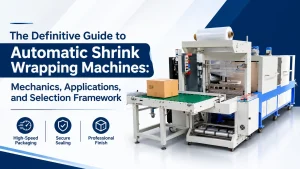
An automatic shrink wrapping machine is an advanced piece of industrial packaging machinery that autonomously encloses a product—or a grouped collection of products—in a thermoplastic polymer film and passes it through a temperature-controlled heating environment.
When exposed to regulated heat inside a shrink tunnel, the polymer molecules in the film (most commonly Polyolefin or Polyethylene) contract uniformly. The result is a skin-tight, tamper-evident, weather-resistant layer that conforms precisely to the item’s contours.
Autonomous Operation: Unlike semi-automatic systems requiring an operator to manually trigger sealing arms or push loads into a tunnel, automatic units interface directly with upstream and downstream conveyor lines. Products feed, wrap, seal, shrink, and discharge continuously without human intervention.
High-Throughput Engineering: Designed for 24/7 manufacturing environments, these systems can process anywhere from 20 to over 100 packs per minute, depending on film gauge, product size, and sealing bar configurations.
To appreciate the engineering sophistication of an automatic shrink wrapping system, one must examine its continuous-motion workflow. The conversion of a flat roll of plastic film into a secure, tight-fitting package follows a synchronized, multi-stage process:
Products arrive from upstream equipment (such as fillers, cartoning machines, or labelers) via motorized infeed conveyors. In high-speed packaging lines, an automated collation mechanism groups items into specific pack patterns—such as a 2×3 beverage 6-pack or stacked pharmaceutical boxes—ensuring consistent alignment before wrapping.
Polymer film (supplied from centerfolded rolls mounted on motorized film racks) is unwound and positioned around the product path. Advanced tension-control systems automatically adjust the film feed rate to match product dimensions, eliminating slack, web tearing, or material waste.
Once the film envelops the product, a high-speed sealing mechanism—such as a continuous motion side-sealer, intermittent cross-seal bar, or L-sealer—closes around the film.
Heated sealing jaws or hot-knife cutters fuse and sever the plastic simultaneously, creating a clean, hermetic, or breathable enclosure without leaving excess “angel hair” (fine plastic filaments caused by poor thermal cut-offs).
The sealed package is immediately transferred via a discharge conveyor into the shrink tunnel. This heavily insulated chamber utilizes variable-speed blowers and precision heating elements (convection or infrared) to circulate balanced thermal energy.
The controlled heat triggers the memory of the oriented polymer molecules, forcing the film to shrink tightly around the product geometry.
Exiting the thermal tunnel, the newly wrapped package passes through a cooling zone (often assisted by cooling fans or ambient airflow). This rapidly sets the polymer structure, preventing the film from stretching or sagging post-exit, before handing the unit off to downstream palletizers or case packers.
| Industry Sector | Typical Application | Primary Objective |
|---|---|---|
| Food & Beverage | Bottled water, canned goods, frozen meal trays | Multipack bundling, promotional grouping, and moisture defense. |
| Pharmaceuticals & Healthcare | Blister packs, medical device kits, bottled syrups | Tamper-evident security, dust prevention, and regulatory compliance. |
| Consumer Goods & Cosmetics | Soap bars, shampoo bottles, boxed electronics | Shelf-appeal enhancement, scratch protection, and multi-unit retail bundling. |
| Industrial & Hardware | Automotive spare parts, electrical cables, tools | Unitization, corrosion mitigation, and secure transit containment. |
| Publishing & Stationery | Textbooks, notebooks, reams of paper | Weatherproofing during transit and preventing page degradation or pilferage. |
Procuring an automatic shrink wrapping machine is a capital investment that demands a rigorous evaluation of operational variables. Use this decision-making framework before requesting vendor quotes:
Evaluate your peak lines per minute (LPM). Do not purchase a machine that operates at maximum capacity out of the gate; build in a 20% performance buffer to account for future growth and mechanical wear.
Polyolefin (POF): Exceptional clarity, odorless, FDA-approved for food, ideal for retail presentation. Requires precise lower sealing temperatures.
Polyethylene (PE): Thicker, tougher, puncture-resistant; ideal for heavy industrial goods and large beverage bundles. Requires higher tunnel BTU capacities. Ensure the machine’s sealing system can cleanly cut and seal your chosen film gauge (measured in microns or gauges).
If your facility handles dozens of SKUs with varying dimensions, look for automatic wrappers featuring recipe storage PLCs that adjust conveyor speeds, sealing heights, and thermal parameters at the touch of a screen, minimizing costly downtime during product switches.
Measure available floor space. Combo systems (sealer + tunnel built on a single chassis) save linear floor space compared to inline separate systems. Additionally, verify electrical requirements (e.g., 3-phase power availability) and compressed air pneumatic supply limits.
An automatic wrapper should never operate in a vacuum. Assess how easily the machine links with existing upstream checkweighers, metal detectors, and downstream automated palletizers or case packers. Standard communication protocols (such as Ethernet/IP or Profibus) ease synchronization.
Founded in 1998 in Mumbai, India, AmarPack Machines Pvt. Ltd. is one of India’s leading manufacturers and exporters of premium packaging machines. Read More
Get a quick quote from our experts. Fast response guaranteed!