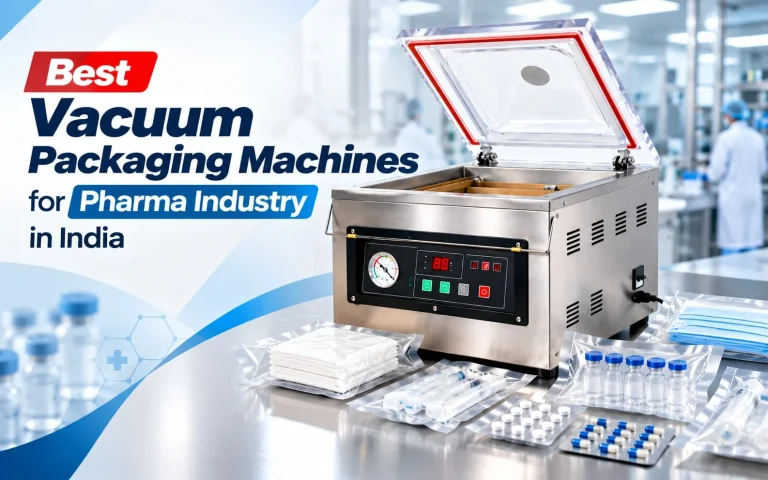
Finding the best vacuum packaging machine is critical for pharmaceutical manufacturing in India, where adherence to stringent quality control, hygiene, and regulatory standards is mandatory.Pharmaceutical manufacturing in India demands adherence to stringent quality control, hygiene, and regulatory standards. The choice of a Best vacuum packaging machine directly affects product integrity, operational efficiency, audit-readiness, and ongoing compliance with India’s updated Schedule M and international GMP frameworks. The selection process must factor in not only technical performance and throughput but also compliance, maintenance, and integration with broader packaging automation systems.
With rising attention to automated packing, traceable batch records, and robust documentation, pharmaceutical procurement teams must combine technical knowledge with a clear understanding of current GMP and regulatory requirements. Below is a comprehensive guide - grounded in global and Indian best practices - addressing how to select, audit, and integrate vacuum packaging for pharmaceutical environments.
AmarPack Machines Pvt Ltd is a trusted name in industrial packaging machinery and has delivered customized packaging solutions to Indian pharma and allied industries since 1998. Backed by ISO 9001:2015 and CE certifications, AmarPack supports clients with end-to-end system design, validation, and compliance, reinforced by deep vertical experience and recognized industry clients. For company background and assurance, see AmarPack Machines – Trusted Packaging Solutions and About AmarPack – 27+ Years of Packaging Expertise.
What Is a Vacuum Packaging Machine?
A vacuum packaging machine removes ambient air from a sealed package, reducing oxygen levels and atmospheric exposure within the pack to protect sensitive products. It differs fundamentally from equipment used to convey materials or clean environments in pharmaceutical plants.
Principles of Operation
- Evacuation: The machine draws out air from the package (chamber or external bag) using a dedicated vacuum pump, achieving a specified pressure setpoint.
- Sealing: Once vacuum level is reached, one or more sealing bars thermally bond the packaging material - typically film or foil - to create an airtight closure.
- Optional Gas Flushing: Some systems inject inert gases (such as nitrogen) before final sealing, limiting residual oxygen for ultra-sensitive pharmaceutical applications or controlled headspace.
Distinctions from Other Vacuum Technologies
- Vacuum conveying: Used to transport powders or particles via negative pressure lines, not for component or product packaging.
- Vacuum cleaning: Industrial housekeeping devices for particulate or dust removal, not for maintaining product integrity through sealed packs.
Clarifying these distinctions is essential to avoid miscommunication during specification and procurement.
Why Pharmaceutical Manufacturers Use Vacuum Packaging
Vacuum packaging is employed selectively in pharmaceutical production for product quality, protection, and process consistency. Its specific functions within pharma are tailored to the unique needs of the product, packaging format, and downstream requirements.
Core Advantages
- Barrier against oxygen and moisture: Critical for APIs, sensitive excipients, or bulk intermediates susceptible to oxidation, hydrolysis, or water uptake.
- Protection from contaminants: Reduces risk of contamination from dust, microorganisms, or atmospheric impurities during storage or transit.
- Tamper evidence: Provides visible assurance against package interference when used in secondary or tertiary packaging.
- Enhanced storage and logistics: Simplifies warehouse transfers and export shipments for components and intermediates that must remain protected.
Pharma-Specific Applications and Practical Boundaries
- Bulk API packaging: Protects raw materials from ambient moisture and oxygen during storage and transport between manufacturing sites.
- Secondary packaging: Used to overwrap blisters, bottles, or strips prior to shipment, especially for export markets or sensitive formulations.
- Component and kit sealing: Useful for pre-filled syringes, ampoules, or high-value packaging kits requiring secure, tamper-evident storage before assembly.
Limitations to Consider
- Vacuum packaging is not a sterilization method and cannot substitute for validated microbial reduction or sterility assurance processes.
- Stability and shelf life demands depend on the total validated system - including pack materials, seal integrity, and process controls - not merely on vacuumization.
- Each application must be validated to demonstrate packaging integrity and compliance, and not all product types or dosage forms are eligible for vacuum packaging as primary containment.
Types of Vacuum Packaging Machines Suitable for Pharma Industry
Selecting the right machine architecture is essential. Pharma operations in India require equipment that supports controlled environments, high repeatability, and efficient cleaning, while meeting strict audit and documentation requirements. The following table contrasts typical machine types:
| Type |
Typical Production Fit |
Strengths |
Points to Assess |
| Single-chamber |
Laboratories, pilot plants, specialty or batch lines |
Compact, cost-effective, simple to set up |
Lower throughput, limited size, manual cycle |
| Double-chamber |
Medium-volume lines with repetitive cycles |
Load/unload between cycles, greater efficiency |
Larger floor footprint, cleaning care needed |
| Continuous-belt (belt vacuum sealer) |
High-volume lines, repetitive packs, automation-ready |
Consistent output, supports automation, fast |
Fixed pack sizes, more complex changeover |
| Thermoform-fill-seal/integrated |
Large-scale, precision or pouch packing lines |
Full automation, minimizes handling, customizable |
Higher cost, requires technical staff |
| With inert gas flush |
Sensitive components, controlled atmosphere needs |
Maintains oxygen-free, protective packaging |
Added gas costs, deeper validation required |
Example: Semi-Automatic Web Sealer Machine for Boxes can be used for bundling, carton packaging, or where high-quality overwrapping is necessary as part of a broader packaging line.
Compatibility with intended production scale, cleanroom zones, and regulatory documentation must be confirmed before equipment purchase.
Factors to Consider When Selecting the Best Vacuum Packaging Machine for Pharma
Procurement and quality teams must jointly approach machine selection, balancing production needs, facility constraints, and compliance priorities.
Key Selection Criteria
- Product type: Is the machine for APIs, intermediates, bulk tablets/capsules, or assembled kits?
- Dosage form or packaging component: Dimensions, fragility, and batch variability.
- Required pack formats: Pouch, blister, ampoule overwrap, or component packs.
- Film/foil compatibility: Material grade, thickness, multi-layer, barrier properties, and sealant compatibility.
- Vacuum and residual oxygen requirements: Maximum allowable oxygen/moisture inside packs (based on stability data).
- Throughput and cycle times: Packages per batch, per shift; needed cycle times to align with upstream and downstream process steps.
- Sealing configuration: Number of sealing bars, seal width, controlled dwell time for reliable sealing.
- Environmental fit: Room classification, equipment cleaning protocols, required levels of particulate and microbial cleanliness.
- Utilities: Power phase, electrical requirements, compressed air, exhaust, and drainage access.
- Automation and integration: Does the equipment support PLC control, recipe management, integration with packaging automation, or electronic batch records?
- Ergonomics and operator access: Placement for safe loading/unloading, clear access for cleaning and maintenance, sealed operator panels.
Where expanded automation is needed, systems should be capable of linking with downstream units, such as shrink tunnels - for which see Industrial Shrink Tunnel Machines by AmarPack - or other secondary packaging lines.
Technical and Compliance Features to Evaluate
Machines intended for pharmaceutical use must offer both strong technical performance and support compliance documentation. When evaluating equipment, focus on the following:
Vacuum Generation and Control
- Vacuum pump design (rotary vane, dry, or oil-free) selected for compatibility with pharma environments.
- Digital vacuum gauges or sensors for precisely setting and monitoring evacuation profiles.
- Advanced control panels (touchscreen HMI/PLC) supporting recipe storage for multiple product types.
Sealing Reliability
- Temperature-controlled heating elements with fine control for repeatable, validated seals.
- Adjustable dwell time for each product/package configuration.
- Multiple parallel sealing bars to improve throughput for multipack operations.
- Seal integrity testing capability - manual or automated inspection systems as appropriate.
Hygienic Design and Material Construction
- AISI 304 or 316 stainless steel in all product contact and external surfaces.
- Polished welds, sloped surfaces, and no particle-trapping seams for fast, efficient cleaning.
- Gaskets, seals, and removable components for rapid disassembly and cross-contamination risk reduction.
System Monitoring, Alarms, and Documentation
- Real-time alarms and interlocks for vacuum, seal, temperature, or operator errors.
- User access management systems, audit trails, and 21 CFR Part 11 readiness for batch processing (when using electronic recordkeeping).
- Data port or integration ability for traceable electronic batch records (EBR) and serialization or barcoding compliance.
After-Sales Support
- Indian-local technical field support - service SLAs for minimal downtime and efficient preventive maintenance.
- Immediate spare parts access and operator training for sustained performance and compliance.
GMP, Qualification, and Validation Requirements for Pharma Vacuum Packaging Machines
To comply with revised Schedule M and international GMP within Indian facilities, buyers must secure adequate qualification and validation for every packaging machine put into use.
Qualification Steps
- User Requirements Specification (URS): Document your precise operational, quality, and regulatory requirements before beginning vendor engagement.
- Risk analysis: Link equipment functions and design features to potential product impact.
- Installation Qualification (IQ): Validate all mechanical, electrical, and utility connections are installed correctly and documented.
- Operational Qualification (OQ): Test the system’s vacuum, sealing, and alarms across all relevant setpoints and product types.
- Performance Qualification (PQ): Demonstrate the packaging machine performs reproducibly with actual product and packaging materials during intended production.
Validation, Record-keeping, and Change Control
- Retain all equipment and process qualification documents and batch records in accordance with site and legal requirements.
- Maintain a validated process for any changes involving equipment parameters, software, or process cycles.
- Where EBR or data management is adopted, ensure computerized systems comply with 21 CFR Part 11 and relevant Indian IT laws.
- Ensure the system supports traceability, QR/barcode integration, and product authentication in line with the Drugs Rules (Schedule H2 and export requirements).
Compliance Deadlines (as of 2024):
- Large pharma manufacturers: Revised Schedule M/WHO-GMP is now mandatory.
- Companies with annual turnover ≤ ₹250 crore: Compliance required by 31 December 2025.
- Coding requirements for certain APIs and top 300 brands are active; confirm packaging process and machine readiness.
Informational note: This section presents a summary for awareness only. Always refer to your Quality Assurance and Regulatory Affairs teams before selecting or installing a packaging machine to ensure operational, legal, and regulatory compliance for your specific products and site.
Pre-Purchase Buyer’s Checklist
Before making a purchasing decision:
- Clearly define every product and packaging application (API, component, kit, format, size, material).
- List regulated requirements for moisture, oxygen barrier, sterility, and tamper evidence.
- Confirm that the proposed machine supports all planned production formats and includes required cycle and seal specifications.
- Check for compatible film/foil grades and whether inert gas flushing, batch coding, or serialization is needed.
- Request a formal trial or proof-of-concept with your actual products and pack materials; record empirical results and user acceptance criteria.
- Evaluate the cleaning process, including surface finishes, drain design, and accessibility for every shift.
- Assess operator interface, safety features, and any specialized documentation or audit trails needed for your GMP regime.
- Require complete documentation: ISO 9001:2015 and CE certification, IQ/OQ/PQ templates, maintenance schedules, technical drawings, and change control logs.
- Request Indian-local references and after-sales service track records in the pharmaceutical sector.
- Obtain training commitments (operator, maintenance, QA) and clearly defined technical support SLAs.
For project planning, detailed consultation, or a facility-specific quote, Contact AmarPack for Customized Vacuum Packaging Solutions.
Common Selection and Operational Pitfalls to Avoid
Careful planning and verification help prevent delays, compliance risks, and inefficiencies in pharma packaging operations:
- Assuming vacuum packaging confers sterility or guarantees shelf-life: These outcomes require separate, validated processes.
- Neglecting compatibility of pack materials: Incompatible or poor-grade films may result in improper sealing and compromised package integrity.
- Omitting seal integrity testing: Every product/package format requires validation to demonstrate consistent seal quality using documented test methods.
- Underestimating the scope of qualification: Relying only on supplier’s IQ/OQ/PQ may not satisfy site-specific or process-specific qualification requirements.
- Overlooking cleanability and maintenance design: Machines with inaccessible areas or inadequate surface finish can harbor residues and create compliance risks.
- Forgetting coding and traceability: Integration of coding and serialization is increasingly mandatory; ensure compatibility with downstream audit and regulatory needs.
Prioritize a system approach - specification, validation, and integration must all align with your facility and regulatory regime.
Frequently Asked Questions
What is the role of vacuum packaging in pharmaceutical product protection?
Vacuum packaging reduces oxygen and moisture exposure in packaged pharmaceuticals, helping protect APIs, intermediates, and components with known sensitivities. It limits atmospheric contamination but is not a substitute for validated sterilization or microbial control.
Which machine types best fit sterile versus non-sterile pharma products?
Vacuum packaging machines are usually deployed for secondary packaging, overwraps, or component packing. They are rarely validated for direct packaging of sterile products unless supported by integrity and sterility validation studies.
How can facilities ensure compliance with India’s revised Schedule M?
Install only machines that meet ISO 9001:2015 and CE certifications, document comprehensive IQ/OQ/PQ, and complete risk-based validation protocols. Keep abreast of emerging barcode/traceability mandates and confirm your packaging solution is future-ready in both operational and documentation dimensions.
Can vacuum packaging machines guarantee sterility or a specific shelf life?
No. The machine provides a barrier to environmental exposure, but achieving sterility or prolonging shelf life requires validated, product-specific research and control of the entire packaging and storage process.
What documentation supports machine qualification and pharma compliance?
Expect supplier-generated IQ, OQ, and PQ templates, FAT/SAT certificates, wiring diagrams, validation data, and maintenance schedules. Sites must adapt these to local SOPs and quality systems, and only final, site-executed documentation counts for audit and inspection purposes.
The AmarPack Advantage
Deploying the correct vacuum packaging machine strengthens product protection and regulatory compliance across pharmaceutical operations. AmarPack Machines Pvt Ltd delivers customized packaging and advanced packaging automation solutions, integrating these with full-spectrum technical support and rapid spare parts supply. Solutions span from pouch packing to sophisticated, automated packaging lines, enabling facilities to address batch traceability, throughput, and GMP requirements.
Each machine is manufactured in India according to ISO 9001:2015 and CE standards, demonstrated by successful deployments for leading pharmaceutical partners. Backed by direct field service, compliance-ready documentation, operator training, and engineering expertise, AmarPack is positioned to meet the packaging needs of pharma and allied industries nationwide.
Enquire now or Contact AmarPack for Customized Vacuum Packaging Solutions tailored to your technical, operational, and compliance needs.
"Visit our demonstration facility in Mumbai / Thane to test your pharmaceutical product samples with barrier pouches and vacuum sealing materials, or request an on-site line integration audit across India."