You’ve decided your production line needs a shrink tunnel machine. But the moment you start calling suppliers, you’re quoted figures that range from ₹86,000 to over ₹28 Lakh — and nobody explains why.
That gap isn’t random. The shrink tunnel machine price in India is driven by a precise set of variables: automation level, machine size, production speed, film compatibility, and whether you’re buying from a domestic Indian manufacturer or importing from abroad. If you don’t understand what moves these numbers, you’ll either overbuy and strain your capital budget, or buy the cheapest machine and spend triple the cost in downtime and repairs within 18 months.
This guide delivers honest, market-accurate pricing in Indian Rupees for 2025 — along with a practical framework for budgeting, evaluating suppliers, and making a decision that protects your business. Whether you’re a factory owner in Pune, a procurement manager in Ahmedabad, or an SMB packaging unit in Delhi NCR, the guidance here is built for the Indian market.
📌 Quick Answer: The shrink tunnel machine price in India ranges from ₹40,000 for a basic portable unit to ₹1.5 Crore+ for a fully automatic industrial line system. Most small-to-medium Indian manufacturers find the right solution in the ₹2.5 Lakh to ₹10 Lakh range. Read on for the complete breakdown.
A shrink tunnel machine is a heat-application unit that uses precisely controlled hot air to shrink a pre-applied plastic film tightly and uniformly around a product. Products travel through the tunnel on a motorized conveyor, and the film — typically PVC, POF (Polyolefin), or PE — contracts to create a tamper-evident, professional-grade package finish.
In most production setups, the shrink tunnel works downstream from an L-bar sealer or sleeve wrapper, which first wraps the product in film. The tunnel then applies the final heat stage that seals and shrinks the film to a perfect, wrinkle-free finish.
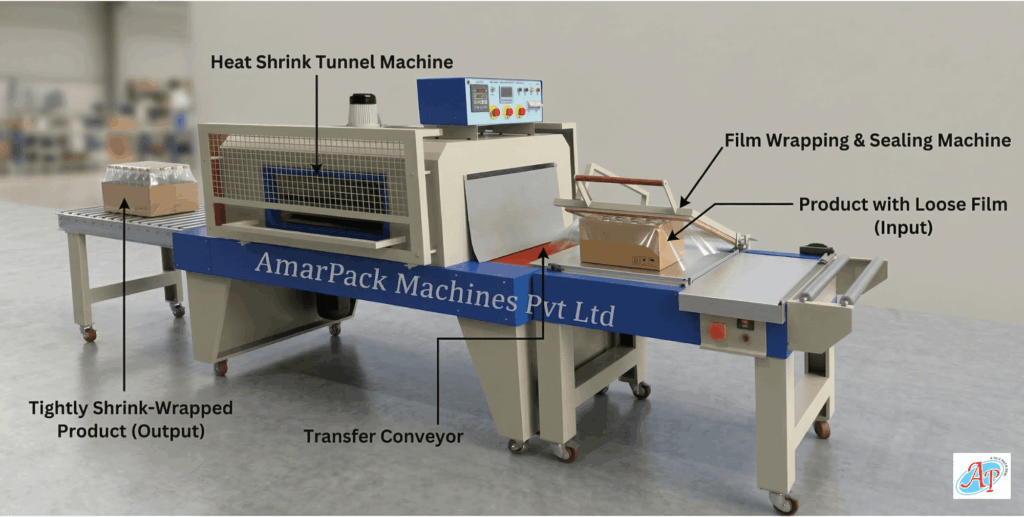
The following table reflects real 2025 market pricing for shrink tunnel machines available in India — inclusive of domestic manufacturers, grey-market imports, and premium international brands. Prices are ex-works and exclude GST, freight, and installation unless noted.
| Tier | Machine Type | Price Range (INR) | Output Speed | Best For |
|---|---|---|---|---|
| Entry-Level | Portable | ₹86,000 – ₹1.10 Lakh | 5–15 packs/min | Startups, home industry, artisan food |
| Mid-Range | Standard | ₹1.25 Lakh – ₹2.36 Lakh | 15–40 packs/min | SMBs, MSMEs, growing factories |
| Industrial | Heavy Duty | ₹2.35 Lakh – ₹4.5 Lakh | 40–120 packs/min | Mid-size manufacturers |
| High-End | Integrated Auto Line | ₹3 Lakh – ₹28 Lakh | 120–300+ packs/min | Large FMCG, pharma, beverages |
Note: Prices shown are for the shrink tunnel unit only. Adding an L-bar sealer, Web-Sealer, conveyor extension, or automatic product feeding system adds ₹80,000 to ₹25 Lakh to your total system investment depending on configuration and automation level.
⚠️ Buyer Beware: If you are quoted a price below ₹70,000 for a new shrink tunnel, there is a very high probability you are looking at a Chinese imported machine, which often comes with zero local warranty and severe delays in spare parts.
⚠️ GST Note: Shrink tunnel machines attract 18% GST in India. Always confirm whether a supplier’s quote is inclusive or exclusive of GST — a ₹5 Lakh quote can increase to approximately ₹5.9 Lakh after tax.
For registered businesses, Input Tax Credit (ITC) is claimable, which significantly reduces the effective cost of the machine.
🏭 AmarPack Advantage: AmarPack Machines Pvt. Ltd. manufactures high-quality shrink tunnel machines across all four tiers at its state-of-the-art facility, with models starting from ₹86,000. All machines are GST-compliant, CE-marked, and supported by reliable pan-India after-sales service.
The cost of shrink wrapping machinery in India is not random — it is a direct function of the following variables. Understanding each one positions you to negotiate smartly and specify correctly.
| Cost Factor | Impact Level | Typical INR Price Variance |
|---|---|---|
| Automation Level (Manual → Fully Automatic) | Very High ⬆⬆⬆ | +₹50,000 – ₹18 Lakh |
| Tunnel Aperture & Chamber Dimensions | High ⬆⬆ | +₹20,000 – ₹5 Lakh |
| Domestic vs. Imported Brand | High ⬆⬆ | +₹50,000 – ₹12 Lakh |
| Conveyor Speed (packs/min) | High ⬆⬆ | +₹30,000 – ₹6 Lakh |
| Film Compatibility (PVC / POF / PE) | Moderate ⬆ | +₹10,000 – ₹1.5 Lakh |
| Energy Efficiency / Power Consumption | Moderate ⬆ | +₹20,000 – ₹2 Lakh |
| PLC / HMI Control System | Moderate ⬆ | +₹40,000 – ₹3 Lakh |
| SS304 Stainless Steel Construction | Low–Moderate ⬆ | +₹30,000 – ₹2.5 Lakh |
| Warranty & AMC (Annual Maintenance Contract) | Moderate ⬆ | +₹15,000 – ₹1.5 Lakh / year |
| Installation & Commissioning | Variable | ₹10,000 – ₹1 Lakh |
No single variable shifts shrink tunnel machine prices in India more than automation level. A reliable tabletop manual unit may start around ₹86,000. A fully integrated automatic system with PLC logic, HMI touchscreen, auto-film loading, and reject detection can reach up to ₹28 Lakh for top-tier domestic lines. Specify your output volume honestly before choosing your automation tier — overspending on automation you won’t use is a common and costly mistake.
Manual: Operator-loaded, basic thermostat, suitable for <10 packs/min
Semi-Automatic: Conveyor-fed, digital temperature control, variable speed — the sweet spot for most Indian MSMEs
Fully Automatic: PLC-controlled, upstream/downstream integration, minimal human intervention
The internal opening of the heat chamber (width × height) determines what product dimensions the machine can handle. Wider tunnels with taller apertures require larger heating arrays, heavier conveyors, and more insulation material. In the Indian market, the most common aperture for FMCG and MSME operations is 400mm × 200mm, which handles most standard retail product sizes at a reasonable cost.
This is one of the most important decisions Indian buyers face. European and American brands offer precise engineering and global certifications, but come with significant import duty, freight, and local service gaps. Chinese imports offer low sticker prices but frequently involve high long-term costs in spare parts delays, compatibility issues, and absent after-sales support.
A trusted domestic Indian manufacturer like AmarPack Machines Pvt. Ltd. delivers the best of both worlds: engineered to Indian production conditions, priced for the Indian market, with nationally accessible service and spare parts — without import wait times or customs complications.
💡 Pro Tip: Always ask for CE certification documentation and BIS compliance information from any supplier. For food-grade or pharmaceutical packaging environments, this is non-negotiable and increasingly required by retail chains and export buyers.
Machines designed exclusively for PVC film are generally cheaper but increasingly restricted — several Indian states and multiple retail chains now mandate food-safe POF film for wrapped products. POF-compatible shrink tunnels cost more upfront but are the future-proof choice. If your products go to modern trade (D-Mart, Big Bazaar, Reliance Retail) or are exported, specify POF compatibility from Day 1.
A frequently overlooked cost factor in India: confirm whether the machine is designed for single-phase (220V) or three-phase (415V) power. Three-phase is standard in most industrial estates and is more cost-efficient for larger machines, but adding a three-phase connection to a facility not already equipped adds ₹50,000–₹3 Lakh to your total setup cost.x`x`
The purchase price is only the beginning. Indian procurement managers who focus exclusively on the machine’s sticker price often find themselves over budget within the first year of operation. Here is a complete picture of what you actually spend:
| Hidden Cost Item | Frequency | Estimated Annual Cost (INR) |
|---|---|---|
| Electricity / Power Consumption | Daily | ₹90,000 – ₹6 Lakh / year |
| Shrink Film Consumables (PVC / POF Rolls) | Weekly | ₹2.5 Lakh – ₹18 Lakh / year |
| Heating Element Replacement | Every 1–3 Years | ₹25,000 – ₹1.5 Lakh |
| Conveyor Belt Replacement | Every 2–5 Years | ₹15,000 – ₹1.2 Lakh |
| AMC / Preventive Maintenance | Half-Yearly | ₹40,000 – ₹2.5 Lakh / year |
| Spare Parts Inventory (Buffer Stock) | On Demand | ₹40,000 – ₹4 Lakh / year |
| Operator Training | One-Time / Updates | ₹15,000 – ₹1.5 Lakh |
| GST on Machine Purchase | One-Time (ITC Claimable) | 18% of Machine Cost |
| Installation & Commissioning | One-Time | ₹15,000 – ₹1.2 Lakh |
| Unplanned Downtime / Lost Production | Unplanned | ₹30,000 – ₹2.5 Lakh / event |
3-Year TCO = Machine Price + GST (net of ITC) + Installation + Training + (Annual Energy Cost × 3) + (Annual Film Consumables × 3) + Maintenance Reserve + Spare Parts Buffer
Example: A ₹4.5 Lakh semi-automatic shrink tunnel with ₹2.8 Lakh in annual operating costs has a 3-year TCO of approximately ₹12.9 Lakh. An energy-efficient AmarPack unit at ₹7.5 Lakh with ₹1.5 Lakh in annual running costs has a 3-year TCO of ₹12 Lakh — and delivers faster cycle times, less film waste, and zero import-related spare parts delays.
Indian buyers frequently confuse these two terms — and it directly affects their purchasing decision. Here is a clear comparison for the Indian market context:
| Factor | Shrink Tunnel Machine | Shrink Wrapping Machine (L-Sealer Combo) |
|---|---|---|
| Primary Function | Applies heat to shrink pre-wrapped film | Seals and shrinks film in a single unit |
| Entry Price (India) | ₹86,000 – ₹5 Lakh | ₹1.5 Lakh – ₹12 Lakh (combo system) |
| Used With | Requires a separate L-sealer or sleeve wrapper | Complete standalone packaging system |
| Output Speed | Higher throughput for dedicated production lines | Depends on sealer speed; suitable for lower to mid volumes |
| Best For | High-volume shrink finishing lines | All-in-one small to mid-scale operations |
| Footprint | Longer — requires conveyor run space | Compact — ideal for smaller factory floors |
| Typical Indian Use | FMCG, pharma, beverage bottling lines | Retail, kirana supply, e-commerce fulfilment |
For Indian small businesses and MSMEs packaging fewer than 20 units per minute, an all-in-one shrink wrapping machine with a built-in tunnel is typically the most cost-effective and space-efficient starting point. For factories running dedicated packaging lines above 30 packs/minute, a separate shrink tunnel gives you the throughput flexibility and serviceability that a combo unit cannot match.
🏭 AmarPack manufactures both standalone shrink tunnels and integrated L-sealer + tunnel OR Web-sealer + tunnel combos. Our team can help you determine which configuration is right for your specific production floor layout and output requirement.
A question we hear from Indian factory owners consistently: with lower labour costs in India compared to the West, does automation on a shrink tunnel machine still make financial sense? The honest answer is yes — but the ROI story in India is different, and you need to understand it correctly before making a capital expenditure decision.
Current method: Manual shrink gun wrapping with 2 operators
Indian factory operator wage: ₹12,000/month per operator (standard unskilled-to-semi-skilled rate in Tier 2 cities, 2026)
Combined labour cost: ₹24,000/month = ₹2.88 Lakh/year
Output with manual method: ~8–10 packs/minute per operator = 16–20 packs/minute total
Semi-automatic AmarPack shrink tunnel: ₹5.5 Lakh | Output: 40–50 packs/minute with 1 operator
| ROI Metric | Manual Method | With AmarPack Semi-Auto Tunnel |
|---|---|---|
| Operators Required | 2 Operators | 1 Operator |
| Annual Labour Cost | ₹2.88 Lakh | ₹1.44 Lakh |
| Annual Labour Saving | — | ₹1.44 Lakh / year saved |
| Output per Minute | 16–20 packs | 40–50 packs |
| Annual Productivity Gain | Baseline | 2× – 2.5× throughput |
| Film Waste Reduction | High (manual) | 30–40% lower waste |
| Package Quality Consistency | Variable | Uniform — retail-ready finish |
| Machine Investment | ₹0 (status quo) | ₹5.5 Lakh |
| Payback Period (Labour Only) | — | ~3.8 Years |
| Payback (Labour + Output Gain) | — | 12–18 Months |
Because Indian labour costs are lower than Western benchmarks, the labour-savings-only payback period is longer — around 3–4 years. But when you factor in the productivity gain (2–2.5x output from the same floor space and headcount), the reduction in film wastage, improved package quality for modern trade acceptance, and the reduced rejection rate from retailers, the economic case becomes compelling within 12–18 months for most Indian production environments.
The most expensive mistake Indian buyers make is starting with a price they want to pay and then trying to find a machine to fit it. The correct approach is the reverse: start with your production requirement and build the budget upward.
Calculate your required output in packs per hour at peak production. This single figure eliminates most of the market and immediately defines your automation tier. Be honest — use your actual peak shift volume, not your theoretical maximum. Selecting a machine that only meets your “average” speed will lead to massive bottlenecks during the Diwali or festive rush.
Measure the maximum cross-sectional dimensions of your product (width × height). Your tunnel aperture must exceed these dimensions by at least 20–30% on each side for proper film slack and hot air circulation. Most Indian SMEs find a 400mm × 200mm aperture covers their product range comfortably.
Pro Tip: Selecting a tunnel size that is too small for your product forces the heating elements to work 40% harder to maintain temperature, leading to the frequent (and expensive) heating element replacements mentioned in our hidden costs section.
If your product is food-grade or destined for modern trade retail (D-Mart, Reliance Smart Bazaar, Star Bazaar), specify POF film compatibility from Day 1. While PVC-only machines are slightly cheaper, several Indian states are tightening regulations on PVC. Buying a PVC-only machine today and being forced to replace it in 24 months due to retail compliance effectively doubles your investment cost.
| Budget Item | % of Total Budget | Example (₹8 Lakh Total Project) |
|---|---|---|
| Machine Purchase (Excl. GST) | 58% – 65% | ₹4.6 Lakh – ₹5.2 Lakh |
| GST @ 18% (ITC Claimable) | 18% of Machine Cost | ₹82,800 – ₹93,600 |
| Installation & Commissioning | 6% – 10% | ₹48,000 – ₹80,000 |
| Operator Training | 2% – 4% | ₹16,000 – ₹32,000 |
| First-Year Spare Parts Buffer | 5% – 8% | ₹40,000 – ₹64,000 |
| Contingency Reserve | 8% – 10% | ₹64,000 – ₹80,000 |
Lock your specifications first — output speed, aperture dimensions, film type, power supply (Single vs. 3-Phase), automation level, and warranty terms. Then request quotes from at least three suppliers against those exact specifications. Comparing quotes that differ in spec is not a price comparison — it is confusion. This single discipline saves Indian buyers an average of 15–25% on the final purchase price.
MUDRA Loan (Tarun category): Equipment financing up to ₹10 Lakh at concessional rates for MSMEs.
CGTMSE Guarantee Scheme: Collateral-free credit for manufacturing SMEs.
State-level capital subsidy schemes: Many states (Gujarat, Maharashtra, UP, Tamil Nadu) offer 15–25% capital subsidy on packaging machinery for registered units.
Vendor financing: AmarPack offers EMI-based payment plans in partnership with leading NBFCs, allowing flexible down payments for qualified buyers.
📩 Want AmarPack to help you build a specification-locked budget for your factory? Our technical sales team will assess your requirement and provide a detailed total cost proposal. [Request a Free Budget Consultation →]
A machine is only as good as the support structure behind it. European brands offer precision engineering but come with 6–12 week spare parts lead times and high import costs. Chinese machines offer attractive prices but often lack consistent quality control and have nearly zero local service infrastructure. An Indian manufacturer with a national distribution and service network — like AmarPack — offers the speed of local support, the pricing advantage of domestic production, and the accountability of a company operating under Indian law.
A 120 packs/min machine running at 12 packs/min is not an investment — it is stranded capital. Specify for your projected 3-year volume, not your aspirational maximum. AmarPack engineers can help you model this accurately and recommend the right tier without upselling you on capacity you won’t use.
Any reputable Indian manufacturer should be willing to run your actual product and film through a demonstration machine before purchase. If a supplier refuses a product trial, that is a significant warning sign. AmarPack’s Pune facility conducts free product trials for all serious buyers — call us to schedule.
Ask every supplier one specific question: “If my heating element fails on a Monday morning, how quickly can I get a replacement to my factory?” For domestic Indian manufacturers, the honest answer should be 24–48 hours. For importers, the answer is often 3–8 weeks — and that is production downtime your business cannot afford.
In India, an AMC negotiated at the time of purchase is almost always 30–40% cheaper than a standalone service contract taken after the warranty expires. AmarPack’s AMC programs cover preventive maintenance, emergency service response, and discounted spare parts across all our machine models.
This sounds obvious but is frequently overlooked when buying from small traders or grey-market importers. Ensure your supplier provides a proper GST invoice so you can claim Input Tax Credit (ITC). Buying from a non-GST-registered supplier to save 18% upfront means permanently losing that ITC — a costly false economy for any registered business.
Buying based on price alone without verifying the machine matches your actual product dimensions and output volume.
Ordering an imported machine without confirming local spare parts availability and service response times in your city.
Choosing a PVC-only shrink tunnel when your products will eventually move to modern retail (D-Mart, Reliance, etc.), which increasingly demands POF film packaging.
Ignoring power supply compatibility — ordering a three-phase machine for a facility with only single-phase supply adds significant setup cost and delay.
Skipping the product trial — always test your actual product and film on the machine before signing a purchase order.
Failing to negotiate installation, commissioning, operator training, and first-year AMC into the purchase price.
Assuming the lowest-quoted price includes GST — always confirm GST treatment explicitly.
Buying a machine without checking that the supplier has a physical presence or authorised service partner in your state or region.
Over-buying automation for a facility that lacks trained maintenance staff to support complex PLC-based systems.
⚠️ Red Flag: Any supplier unable to provide a factory visit, customer references from Indian operations in your industry, or a clear spare parts policy should be approached with serious caution — regardless of price.
Q: What is the price of a shrink tunnel machine in India in 2026? A: The shrink tunnel machine price in India in 2026 ranges from approximately ₹86,000 for a reliable entry-level unit to ₹28 Lakh for a fully integrated automatic line. For most Indian MSMEs, a high-quality semi-automatic shrink tunnel from a domestic manufacturer like AmarPack Machines costs between ₹4.5 Lakh and ₹15 Lakh, depending on production speed and aperture size.
Q: Should I buy a Chinese shrink tunnel machine or an Indian-made one? A: For most Indian buyers, a domestic manufacturer offers superior long-term value. While Chinese machines may appear cheaper on the initial invoice, you must factor in import duties, high freight costs, and—most importantly—the 4–10 week lead time for spare parts. AmarPack Machines Pvt. Ltd. provides machines with comparable or better technical specifications at Indian market prices, with a 24–48 hour spare parts response that prevents costly production downtime.
Q: How much does it cost to operate a shrink tunnel machine per year in India? A: Annual operating costs typically range from ₹3 Lakh to ₹24 Lakh depending on production volume. The three largest recurring expenses are electricity (₹90,000–₹6 Lakh), shrink film consumables (₹2.5 Lakh–₹18 Lakh), and scheduled maintenance (₹40,000–₹2.5 Lakh). Choosing an energy-efficient machine can reduce these costs by up to 20% annually.
Q: What government subsidies are available for Indian MSMEs buying packaging equipment? A: Several schemes support Indian manufacturers, including the MUDRA Loan (Tarun category) for equipment up to ₹10 Lakh and the CGTMSE scheme for collateral-free credit. Additionally, states like Gujarat, Maharashtra, and UP offer 15–25% capital subsidies on approved packaging machinery. AmarPack’s team can guide you through the application process for your specific state.
Q: How long does an AmarPack shrink tunnel machine last? A: A well-maintained AmarPack machine is engineered for an operational life of 10–15 years. We ensure long-term reliability by maintaining a nationwide spare parts network and offering Annual Maintenance Contracts (AMCs) that cover preventive service visits, ensuring your line never stops moving.
The right shrink tunnel machine price in India is not the lowest quote in your inbox — nor is it the most expensive machine in the catalogue. It is the price that correctly aligns with your production volume, product dimensions, film requirements, factory power supply, and operational support needs.
For Indian startups and micro-enterprises: Packaging under 10 units per minute, a reliable entry-level manual setup in the ₹86,000 – ₹2.5 Lakh range is a practical and low-risk starting point.
For growing Indian MSMEs: Producing 20–40 units per minute, a semi-automatic domestic shrink tunnel in the ₹2.5 Lakh – ₹10 Lakh range, backed by a proven AMC and service network, is the right investment tier.
For established Indian manufacturers: Running multi-shift operations and supplying modern retail, a fully automatic system in the ₹10 Lakh – ₹28 Lakh range delivers the throughput, consistency, and integration capability that justifies the capital expenditure.
Whatever your tier, apply the Total Cost of Ownership framework, confirm spare parts availability in your city before signing, insist on a live product trial, and ensure your supplier can give you a definitive answer when you ask: “If my machine breaks down on a Tuesday morning, what happens?”
At AmarPack Machines Pvt. Ltd., the answer is straightforward: a trained service engineer is on-site within 24 hours, and standard spare parts are dispatched the same day from our national warehouse network. That is the AmarPack promise — and it is the standard every Indian packaging equipment buyer should hold their supplier to.
🔧 Talk to an AmarPack specialist for a free site assessment, product trial, and tailored price proposal for your Indian packaging line. Call: 9821778501 | amarpackaging.com | [email protected]

AmarPack Machines Pvt. Ltd., founded in 1998, is a leading manufacturer and exporter of packaging machines in India. With over 25 years of experience, we specialize in shrink wrapping machines, vacuum packaging machines, band sealers, and automatic liquid filling machines, delivering reliable packaging solutions to diverse industries in India and international markets
Get a quick quote from our experts. Fast response guaranteed!
