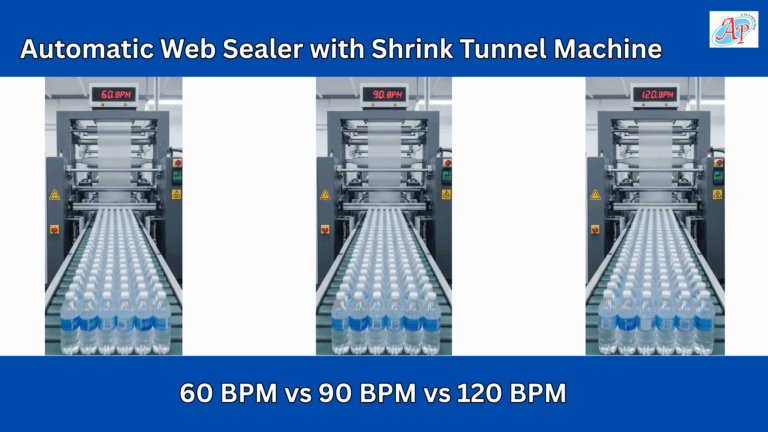
In the competitive landscape of Fast-Moving Consumer Goods (FMCG) and beverage manufacturing, optimizing the high-speed packaging line is non-negotiable. For many Production Directors, the first consideration when selecting an end-of-line shrink packaging machine is the advertised speed rating: 60 BPM, 90 BPM, or 120 BPM Shrink Machine Capacity Comparison.
This initial metric, however, often provides an incomplete picture of actual production capability. The assumption—that doubling a machine’s Bottles Per Minute (BPM) rating will predictably double usable output—is a common oversight that can lead to substantial financial loss through unrealized efficiency. True performance and profitability are defined not solely by nominal BPM, but by the resultant Packs Per Minute (PPM) and the machine’s foundational ability to maintain high Overall Equipment Effectiveness (OEE).
Many businesses start their journey with semi-automatic or lower-volume automatic machines, typically operating in the 30–40 BPM range. As market share grows and product demand intensifies, these foundational machines quickly become the critical bottleneck in the entire production system, limiting the capacity of otherwise efficient fillers and labelers.
The necessity to scale necessitates a move to the medium-speed production tier (60–90 BPM) or immediately jumping to high-speed (120 BPM and beyond). This leap is not merely a speed upgrade; it is a fundamental shift in required capital investment, technology (mechatronics), and operational complexity. The decision requires a robust justification based on Total Cost of Ownership (TCO) and expected ROI of Shrink Wrappers, analyzing not just the sticker price but the sustained efficiency provided by the machine.
This report provides a detailed technical and financial comparison of the three primary automatic shrink wrapping machine tiers (60 BPM, 90 BPM, and 120 BPM). The analysis shifts the strategic focus from the linear metric of BPM to the operational metrics of PPM and OEE.
Definition of BPM (Bottles Per Minute): BPM refers to the speed at which individual units (bottles, jars, or cans) are fed into the machine’s collation zone. This speed is typically constrained or synchronized by upstream equipment like the filler or labeler.
How BPM Converts into PPM (Packs Per Minute): PPM is the vital throughput calculation metric, representing the number of finished, sealed, and shrunk bundles (e.g., 6-packs, 12-packs) exiting the line every minute.
The conversion is calculated by dividing the machine’s nominal BPM by the quantity of individual units required in the specified collation (pack format). For instance, if a machine handles a 120 BPM input:
| Collation Format (Bottles/Pack) | Bottle Quantity (N) | Nominal PPM (120 BPM / N) |
| 6-Pack (3×2 Collation) | 6 | 20 PPM |
| 12-Pack (4×3 Collation) | 12 | 10 PPM |
| 24-Pack (6×4 Collation) | 24 | 5 PPM |
This relationship illustrates that a 120 BPM machine, if running a heavy 24-pack collation, achieves an output of only 5 packs per minute. Therefore, the true comparison must be grounded in the achievable PPM output for common pack formats.
The increase in speed from 60 BPM to 120 BPM necessitates a complete redesign of the machine architecture, impacting infrastructure, power demands, and film handling capability. The 90 BPM tier serves as the functional transition point where advanced technologies begin to dominate mechanical systems.
Table 1 provides a technical overview based on standard single-lane operations.
Table 1: Technical Specification Comparison — BPM to PPM Output
| Metric | 60 BPM | 90 BPM | 120 BPM |
| Estimated PPM (Common Formats) | 5–8 PPM | 8–12 PPM | 10–15 PPM |
| Annual Volume (2 Shifts) | ~10M Bottles | ~15M Bottles | ~20M+ Bottles |
| Power Consumption (Connected Load) | 12–18 kW | 18–25 kW | 25 kW+ |
| Footprint Size | Compact Linear (Small) | Standard Linear (Medium) | Extended / Dual-Lane Options (Large) |
| Film Supported | LDPE/PE (Thicker Gauge) | LDPE/PE/LLDPE | Thin-Film Optimized (LLDPE Focus) |
| Automation Level | Entry Auto (Pneumatic/Mechanical) | Mid Auto (Basic Servo, PLC) | High-Speed Auto (Full Servo Control) |
The annual volume figures represent estimated output based on operating two 8-hour shifts daily, five days a week, assuming a conservative average OEE target of 75–85%. The doubling of speed from 60 BPM to 120 BPM directly translates into a potential doubling of annual output (from approximately 10 million bottles to over 20 million bottles) if all other operational factors are maintained.
The capacity differences are underpinned by critical variations in mechanical and electronic design required to achieve continuous motion at high velocity.
The seal bar operation is arguably the most significant factor constraining machine speed and reliability.
60 BPM (Hot Knife/Wire): Machines in the medium-speed production tier often utilize traditional constant heat sealing elements, such as Teflon-coated hot knives or wire seal bars. These systems typically use a reciprocating motion, requiring the product flow to pause momentarily while the seal is made and the film is cut. While highly reliable for thicker Low-Density Polyethylene (LDPE) film, the stop-start nature fundamentally limits speed. Hot knife sealers are built for strength and speed and handle thicker films that require significant heat.
120 BPM (Continuous Servo Sealing): To achieve continuous, high-speed output, the sealing process must be dynamic. This requirement mandates continuous motion side-sealing functions driven by integrated servo motor control. The entire sealing assembly, controlled precisely by the actuator, moves synchronously with the conveyor and the product group, wrapping, cutting, and sealing the film without interrupting the continuous product stream. This sophisticated synchronization utilizing servo technology is necessary to ensure packaging is smoother, fully automated, and precise, maximizing the throughput of the high-speed packaging line.
Handling individual containers at speeds of 120 BPM requires far more meticulous control than at 60 BPM.
Medium-Speed Handling (60 BPM): Collation systems at this level typically rely on simpler mechanical pushers, gate systems, or pneumatic sorting devices. While these are adequate for achieving rates up to 60 BPM, they are highly susceptible to performance degradation, jams, or product misalignment when operating near maximum capacity.
High-Speed Handling (90 BPM & 120 BPM): The 120 BPM tier requires electronic product-grouping systems, which often include precision components such as timing screws or metering devices, all driven by advanced servo motors and sensors. Precision synchronization is paramount to ensure collision-free collation and packaging, minimizing micro-stoppages that rapidly degrade OEE.
The shrink tunnel is the major energy consumer and a physical constraint on line speed. Shrinking is governed by the correlation of heat (temperature) and exposure time (dwell time).
Dwell Time Constraint: As the machine speed increases from 60 BPM to 120 BPM, the packs move through the heat source twice as quickly. To compensate and ensure uniform shrinking, the overall tunnel length must increase to maintain the minimum required dwell time.
Thermal Load Management: The high-speed packaging line requires a higher heating power to sustain internal temperatures and continuously compensate for the significant thermal load introduced by the rapid flow of cold product through the chamber. Machines running at 120 BPM usually feature increased total connected power (25 kW+) and deploy multiple, independently controlled heating zones (dual-zone tunnels) with PID control for superior temperature stability, demanding a larger physical footprint.
The performance jump to 120 BPM necessitates a transition from automated mechanical machinery to sophisticated mechatronic automation.
Servo Integration: Integrated servo motors, which combine the motor, drive, feedback device, and controller into a single unit, are crucial for high-speed repeatability and motion control. This precise control is essential for complex tasks like continuous sealing and rapid, accurate product indexing.
Advanced PLCs: High-speed lines require high-performance PLCs (Programmable Logic Controllers) capable of fast and precise logic calculations to streamline equipment synchronization across the entire production line. This ensures that the system can react instantly to minor variations, achieving a fully automated and efficient workflow. Without this advanced digital control architecture, the high acceleration and rapid movements required at 120 BPM would lead to unacceptable rates of mechanical stress, vibration, and product defects.
The decision to invest in a higher capacity shrink wrapper is a core business strategy dictated by the objective of minimizing the long-term cost per pack over minimizing the initial investment.
The Total Cost of Ownership (TCO) calculation for automated packaging machinery must incorporate the initial capital outlay (CAPEX) alongside operational costs (OPEX), including energy, labor, maintenance, and material optimization.
The increase in required CAPEX reflects the technological complexity necessary to achieve high throughput and reliability.
60 BPM Investment: This tier represents the baseline automatic investment (approximately 1.0x). It is ideal where controlling upfront capital is paramount, although this strategy accepts higher operational constraints and greater labor input relative to output.
120 BPM Investment: Due to the requirements for full servo systems, advanced PLCs, reinforced construction, and dual-lane capabilities, the 120 BPM investment often ranges from 2.5x to 4.0x the baseline. This significant capital outlay is justified only if the manufacturer can reliably leverage the resulting labor reduction and efficiency gains across exceptionally high annual volumes (over 20 million units/year).
While the connected electrical load of a 120 BPM machine (25 kW+) is substantially higher than a 60 BPM machine (12–18 kW) , the efficiency is measured by the energy consumed per packaged unit.
Volume Leverage: By doubling the output rate, the energy consumed to shrink one pack decreases significantly. The fixed thermal overhead of heating the large tunnel and compensating for ambient heat loss is distributed across a much higher volume of product. Consequently, a 120 BPM machine, despite its higher total power draw, may lower the energy cost per pack by 15–30% compared to a 60 BPM line, providing a decisive competitive advantage in high-volume operations.
Working Demo Of Packaging Machine Manufactured By AmarPack Machines Pvt Ltd
For More, Visit Official Youtube Channel: AmarPack Machines Pvt Ltd
The shift in speed correlates directly with complexity in maintenance procedures.
60 BPM Maintenance: Maintenance tasks are predominantly mechanical, involving replacement of standard wear parts like belts, chains, and sealing elements. This tier can often be supported by in-house maintenance teams with standard mechanical skills.
120 BPM Maintenance: High-speed machinery requires specialized expertise in mechatronics, focusing on servo motor diagnostics, complex sensor calibration, and PLC programming. To ensure maximum uptime, high-volume operations often utilize comprehensive preventative maintenance programs and Annual Maintenance Contracts (AMCs) from the manufacturer, increasing maintenance expenditure but safeguarding high OEE.
Overall Equipment Effectiveness (OEE) is the definitive metric of truly productive manufacturing time, calculated as: OEE = Availability × Performance × Quality. A high-speed line rated at 120 BPM running at 65% OEE is inherently less profitable than a 90 BPM line running at 85% OEE. Monitoring and analyzing OEE metrics provides valuable insights into the performance of the equipment and the production process.
Availability measures the proportion of planned production time the machine is operational. It is primarily impacted by scheduled events like changeovers and maintenance.
The SMED Requirement: To justify the 120 BPM speed, changeover times must be drastically minimized. High-speed lines mandate the implementation of Single-Minute Exchange of Die (SMED) principles, aiming to reduce changeover times to the single digits (less than 10 minutes). This is achieved by converting “internal” changeover tasks (machine stopped) into “external” tasks (performed while running).
Automation for Availability: 120 BPM machines facilitate SMED through advanced automation, such as servo-driven, recipe-controlled adjustments for sealing height, film track alignment, and quick-change collation components. Without this technological capability, the lengthy manual changeovers (30–60 minutes) typical of a 60 BPM line would severely limit the high-speed machine’s Availability, eroding its competitive advantage.
Performance assesses the machine’s actual operating speed compared to its theoretical maximum, accounting for minor stops and idling time. This metric is significantly affected by the cumulative loss from micro-stoppages.
Micro-Stoppages Defined: These are short, unplanned halts lasting seconds or up to five minutes, typically caused by momentary misfeeds, sensor fluctuations, or film handling issues.
Amplified Loss: In a high-speed packaging line, the cumulative effect of frequent micro-stoppages is amplified, rapidly consuming valuable runtime. Research indicates that the combination of micro-stops and slow speed can account for a substantial portion of performance loss. Advanced precision electronics, servo control, and integrated diagnostics are essential at the 120 BPM tier because they dramatically reduce the frequency and recovery time required for these transient faults, ensuring the line runs consistently close to its ideal cycle time.
Quality evaluates the rate of defect-free product output (Good Count).
Precision and Consistency: High-speed systems, driven by servos and managed by PID temperature controls, inherently offer greater control over sealing and shrinking parameters. This technological precision minimizes variations, leading to more consistent seal strength, uniform shrink aesthetics, and ultimately, lower scrap and product reject rates. A sustained reduction in defect rate directly contributes to a higher OEE and improves the overall ROI of Shrink Wrappers.
Selecting the optimal shrink wrapper requires systematically matching the machine’s inherent capabilities—speed, complexity, and OEE requirements—to the manufacturer’s specific business stage, volume demands, and SKU management strategy.
The 60 BPM machine is the quintessential entry point into automatic industrial shrink wrapping. It is a robust machine designed for stable, medium-speed production that prioritizes low initial investment over hyper-efficiency.
Ideal Business Profile: This machine suits small-to-medium enterprises (SMEs), regional brands, and co-packers needing reliable automation to support growing demand.
Operational Requirements: Target annual volume is typically under 15 million bottles. Operations are usually limited to one standard 8-hour shift, possibly extending to a second shift. Changeover frequency is minimal, perhaps dedicated to 2–3 core pack formats.
ROI Context: The relatively low initial investment (1.0x baseline) provides rapid labor cost reduction compared to manual or semi-automatic methods, minimizing financial risk while stabilizing initial automation. Typical ROI timelines span 18–36 months.
The 90 BPM machine is the industry sweet spot, offering the best compromise between high throughput and manageable complexity. It is the necessary bridge for regional manufacturers planning national market entry.
Ideal Business Profile: Businesses experiencing rapid growth or regional brands solidifying their market dominance. These manufacturers require consistent output to fulfill larger retail contracts.
Operational Requirements: Target annual volumes range from 15 to 25 million bottles. Operations typically involve maximizing asset utilization across two to three shifts. Moderate SKU variation is acceptable, provided changeovers are structured and standardized to minimize downtime.
ROI Context: The increased volume efficiency (driving a lower cost per pack) allows the machine to achieve critical production targets faster than the 60 BPM unit. The machine’s higher efficiency justifies the increased capital expenditure (1.6x – 2.2x baseline), leading to competitive ROI timelines of 12–24 months.
The 120 BPM machine represents a dedicated high-speed packaging line solution, engineered specifically for sustained, massive volume and ruthless cost efficiency.
Ideal Business Profile: Large national or multinational brands in high-volume sectors such as soft drinks, bottled water, or dairy. These operations require continuous, 24/7 output.
Operational Requirements: Target annual volumes consistently exceed 20 million bottles. The line must run nearly continuously, often dedicated to specific bottle sizes (200 ML to 2000 ML) and requiring minimal SKU variation. This machine demands seamless mechanical and electronic synchronization with upstream fillers and downstream case packers. The line must commit to rigorous OEE management, prioritizing SMED protocols for every changeover.
The Scalability Advantage: This tier often includes optional dual-lane configurations, effectively doubling the PPM output capacity without doubling the machine footprint length. Furthermore, these machines are optimized to handle cost-saving, thin-gauge films like LLDPE, reducing material costs over time.
ROI Context: Although the initial CAPEX is highest (2.5x – 4.0x), the combination of minimal labor intervention, highest energy efficiency per pack, maximized throughput, and minimal film waste generates the fastest cost recovery. This strategy results in the shortest ROI timeline, typically 8–18 months, by leveraging sheer scale.
The selection of a shrink wrapping machine must be a strategic capital expenditure decision, pivoting decisively away from the nominal Bottles Per Minute (BPM) rating toward the functional metric of Packs Per Minute (PPM). PPM reflects the actual bundles ready for distribution, providing a more accurate measure of the line’s true throughput calculation.
The difference between a 60 BPM and a 120 BPM machine is defined by more than speed; it is a fundamental shift in technical complexity, requiring specialized investments in continuous servo sealing, advanced PLCs, and robust, extended heating tunnels. The higher investment associated with the 120 BPM tier is warranted only when a manufacturer can utilize that speed through maximized throughput, aggressive OEE maintenance, and the strategic reduction of unit operating costs through volume leverage.
When choosing the right shrink wrapping machine, manufacturing executives must prioritize a holistic view of asset performance:
Throughput Consistency: Ensure the machine can sustain the target PPM under real-world conditions, actively mitigating performance losses from micro-stoppages, which are compounded severely at high speeds.
OEE Management: Recognize that higher speed amplifies all forms of loss (downtime, slow cycles, rejects). Investment in a 120 BPM machine must be paired with investment in SMED, real-time monitoring, and highly skilled technical maintenance to ensure sustained OEE above 85%.
Future Scalability: Select a platform (like the 120 BPM) that offers optional configurations, such as dual-lane infeed, to provide immediate scalability and longevity, allowing the system to accommodate future volume growth without requiring complete replacement.
The decision represents a long-term economic equation where the initial capital expenditure of a high-speed system translates directly into competitive operational advantages and an accelerated ROI of Shrink Wrappers when utilized to its full potential.
It is essential to validate any machine’s claimed throughput. Production managers should insist on a rigorous Factory Acceptance Test (FAT) where the machine runs its largest and most challenging pack format using the actual production film stock. This validation confirms the machine can consistently deliver the required throughput calculation at the target OEE, ensuring that the investment meets strategic operational demands.
Want a precise throughput & ROI calculation for your packaging line? Contact our engineering team for a free technical evaluation.
With 25+ years of proven experience, AmarPack Machines Pvt. Ltd. has been delivering reliable shrink wrapping and packaging solutions to industries across India and abroad. Based in Mumbai, India’s packaging hub, we combine advanced manufacturing expertise with responsive after-sales support.
As a direct manufacturer, we provide factory pricing with customization options tailored to your production needs — ensuring you only pay for the features you truly require. Our team offers installation, operator training, and free consultations to help you select the ideal machine for your products, ensuring long-term performance and value.
Looking to automate your packaging line?
Contact AmarPack Machines Pvt Ltd, India’s trusted packaging machine manufacturer serving global markets.

AmarPack Machines Pvt. Ltd., founded in 1998, is a leading manufacturer and exporter of packaging machines in India. With over 25 years of experience, we specialize in shrink wrapping machines, vacuum packaging machines, band sealers, and automatic liquid filling machines, delivering reliable packaging solutions to diverse industries in India and international markets
Get a quick quote from our experts. Fast response guaranteed!
