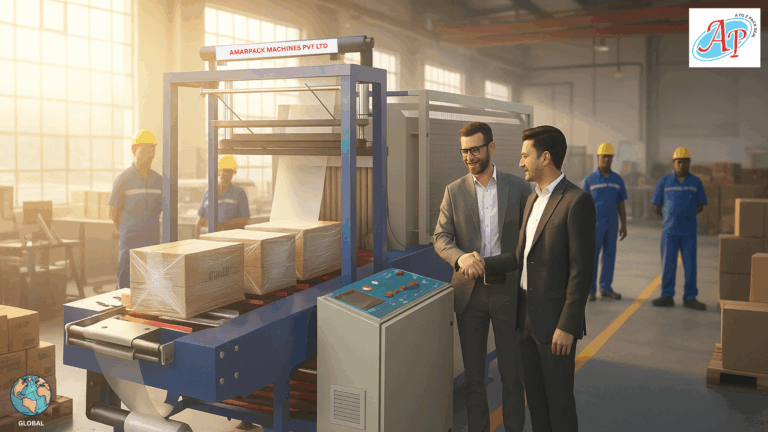
Across the globe, industrial manufacturers are facing twin pressures: soaring labor costs and the unrelenting demand for higher throughput driven by e-commerce expansion. For too long, packaging operations have remained a bottleneck. This is where the Fully Automatic Shrink Wrapping Machine provides the solution. Unlike semi-automatic systems that still require operator feeding and sealing, automatic systems integrate seamlessly into the production line, handling product collating, film application, and sealing without manual intervention. By 2025, this level of automation isn’t just an upgrade; it’s the global standard. This shift is being driven by the need for operational necessity, IoT integration, and crucial demands for sustainability and superior quality control. Businesses leveraging industrial shrink wrap automation are not just keeping pace—they’re setting it.
This section directly addresses the primary B2B concern: getting more product out faster, consistently, and reliably.
A. High-Speed Cycling: Human limitations—fatigue, shift changes, and variable skill—are completely removed from the equation. A modern automatic shrink wrapper is designed for continuous, high-speed output often exceeding 60 Pieces Per Minute (PPM). This capability ensures peak production during all hours of operation.
B. Reduction in Bottlenecks: Integrated automatic systems utilize advanced sensors and servo drives to ensure a smooth, continuous flow from the infeed conveyor through the seal bar and into the shrink tunnel. This engineered synchronization minimizes system stops and jams, drastically reducing downtime and operational bottlenecks that plague manual lines.
A. Reallocation of Resources: The ROI on automation isn’t just about cutting salaries; it’s about shifting skilled personnel away from repetitive, low-value packaging tasks toward higher-value roles, such as quality control, complex machine maintenance, and upstream process management. This reallocation of resources boosts overall workforce productivity.
B. Minimizing Repetitive Strain Injury (RSI): Workplace safety is a growing corporate concern and liability. Fully automatic equipment eliminates the need for operators to perform strenuous, repetitive motions required in manual or semi-automatic sealing, helping companies meet workplace safety compliance standards and mitigate RSI-related claims.
While the initial capital expenditure (CapEx) for a fully automatic machine is higher, the financial arguments supporting the move are compelling when analyzing the Total Cost of Ownership (TCO).
A. Precision Tensioning: Modern, automatic wrappers are equipped with highly sensitive, servo-driven film feeds. These sensors apply the exact necessary amount of film based on the product’s dimensions, minimizing material overage. This precision tensioning capability leads to a significant and sustained reduction in material costs and waste compared to manual over-wrapping.
B. Energy Efficiency: Today’s machines feature advanced, well-insulated shrink tunnels and intelligent heat recovery systems. These designs require less energy to achieve a perfect seal and shrink, making the system an energy-efficient asset that directly contributes to a lower Total Cost of Ownership (TCO).
A. Payback Period Metrics: When factoring in savings on labor (often two or more full-time employees), reduced film waste, lower energy consumption, and fewer damage claims, the investment return typically yields a 12 to 24-month payback period.
B. Predictable Operating Expense (OpEx): The costs associated with human labor (wages, benefits, absenteeism, and high turnover) are volatile. In contrast, the operating expense (OpEx) of a fully automatic machine is defined by a predictable and manageable preventative maintenance schedule, offering stability in financial planning.
For B2B brands, packaging quality is a crucial component of brand perception and distribution compliance.
A. Uniform Heat Application: Automated systems utilize computer-controlled, uniform heat and pressure across the seal bar. This eliminates weak seals and inconsistent product appearance caused by human error or fatigue, ensuring a flawless, tamper-evident seal integrity for every single unit.
B. Damage Reduction: A consistently tight and uniformly wrapped product is structurally more secure. This tighter packaging significantly reduces product shifting, scuffing, and internal damage during warehousing and transit, leading to lower claims, fewer product returns, and improved customer satisfaction.
A. Traceability and Compliance: Critical in the food, pharmaceutical, and beverage industries, automatic wrappers support compliance by integrating machine data logging. They record operational parameters, such as seal temperature and cycle time, providing essential traceability and documentation.
B. Retailer Requirements: Standardization is non-negotiable for modern supply chains. Automatic systems produce consistently dimensioned, square, and stackable wrapped units. This meets the increasingly strict packaging dimension and stacking requirements of major global retailers and automated distribution centers.
The future of packaging is smart, connected, and predictive. Fully automatic shrink wrappers are central to the Industry 4.0 movement.
A. Seamless System Integration: Utilizing modern Programmable Logic Controllers (PLCs), the automatic wrapper acts as an intelligent node within the production line. It communicates flawlessly with upstream equipment (like fillers) and downstream systems (like case packers and robotic palletizers), achieving total system harmony.
B. Predictive Maintenance: Advanced machine sensors monitor vibration, motor temperature, and other key variables. These sensors enable the system to forecast potential mechanical failures, allowing managers to move from expensive, reactive repairs to planned, scheduled, and predictive maintenance.
A. Tracking OEE (Overall Equipment Effectiveness): The wrapper generates real-time data on the three pillars of efficiency: Availability (uptime), Performance (speed), and Quality (yield). This OEE monitoring gives plant managers an immediate, data-backed view of true efficiency, allowing for instant adjustments and continuous improvement.
The transition to fully automatic shrink wrapping machines is no longer a strategic option; it is a foundational requirement for any competitive global operation in 2025. The benefits are clear and quantifiable: maximized throughput, demonstrable ROI and TCO advantages, consistent quality that protects your brand, and seamless integration with the smart factories of the future. These systems transition packaging from a necessary expense to a powerful competitive asset.
Ready to calculate your automation payback? Our experts are here to provide a detailed Total Cost of Ownership analysis specific to your production environment and help you select the ideal automatic packaging system to future-proof your business. Contact us today.
With 25+ years of proven experience, AmarPack Machines Pvt. Ltd. has been delivering reliable shrink wrapping and packaging solutions to industries across India and abroad. Based in Mumbai, India’s packaging hub, we combine advanced manufacturing expertise with responsive after-sales support.
As a direct manufacturer, we provide factory pricing with customization options tailored to your production needs — ensuring you only pay for the features you truly require. Our team offers installation, operator training, and free consultations to help you select the ideal machine for your products, ensuring long-term performance and value.
Looking to automate your packaging line?
Contact AmarPack Machines Pvt Ltd, India’s trusted packaging machine manufacturer serving global markets.

AmarPack Machines Pvt. Ltd., founded in 1998, is a leading manufacturer and exporter of packaging machines in India. With over 25 years of experience, we specialize in shrink wrapping machines, vacuum packaging machines, band sealers, and automatic liquid filling machines, delivering reliable packaging solutions to diverse industries in India and international markets
Get a quick quote from our experts. Fast response guaranteed!
