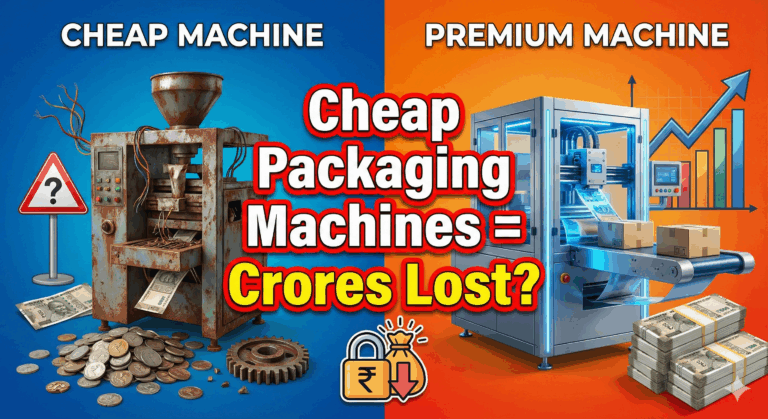
In the high-stakes ecosystem of Indian manufacturing—particularly across the FMCG, pharmaceutical, and food processing sectors—the selection of packaging machinery is no longer a routine capital purchase. It is a strategic business decision that directly impacts profitability, regulatory compliance, and brand reputation.
Despite this reality, a large section of the industry continues to fall into the “L1 Trap”—procurement driven solely by the lowest bidder. While this approach works for commoditized office supplies, it proves disastrous when applied to complex industrial assets.
Cheap packaging machines—often imported with vague specifications or assembled by unorganized players using sub-standard components—create a dangerous financial mirage. What appears to be a “smart saving” of ₹5–8 Lakhs at the time of purchase quickly transforms into a recurring financial hemorrhage. Through energy inefficiencies, material wastage, and regulatory penalties, these machines can cost manufacturers crores of rupees over their operational lifecycle.
This guide evaluates packaging machinery not by its sticker price, but by Total Cost of Ownership (TCO). We analyze the hidden costs of operational inefficiency, the legal risks under BIS Scheme X and FSSAI, and the mathematical certainty of why “cheap” is the most expensive option you can buy.
Procurement officers, often driven by quarterly CAPEX targets, frequently favor a generic, pneumatic Vertical Form Fill Seal (VFFS) machine priced at ₹4,50,000 over a servo-driven alternative priced at ₹12,50,000.
On paper, this saves the company ₹8,00,000. In reality, this calculation is fatally flawed.
Industry data confirms that the initial purchase price accounts for less than 10% of the total cost incurred over a machine’s usable life. The remaining 90% is embedded in Operational Expenditure (OPEX)—energy bills, film wastage, spare parts, and the exorbitant cost of downtime. Cheap machines achieve their low price points by engineering out reliability and efficiency, effectively transferring costs from your Capital Budget to your Operational Budget.
To understand the true cost, Indian manufacturers must use the TCO formula:
I (Initial Cost): Purchase price + Installation.
O (Operational Costs): Energy + Film + Labor.
M (Maintenance): Spares + Service fees.
D (Downtime): Lost production value + Penalties.
R (Residual Value): Resale price (often near-zero for cheap machines).
Let’s compare a Low-Cost Pneumatic Machine vs. a Premium Servo Machine running in a standard Indian snack plant (Pune, Maharashtra tariff @ ₹12.83/unit) .
Scenario: 16 hours/day operation, 26 days/month.
| Cost Component | Low-Cost Pneumatic VFFS | Premium Servo VFFS | The “Cheap” Penalty |
| Initial Price (I) | ₹4,50,000 | ₹12,50,000 | Saved ₹8.0 Lakhs |
| Energy Cost (5 Years) | ₹27.2 Lakhs (8.5kW Load) | ₹11.2 Lakhs (3.5kW Load) | Lost ₹16.0 Lakhs |
| Film Wastage (5 Years) | ₹15.0 Lakhs (3% waste) | ₹2.5 Lakhs (0.5% waste) | Lost ₹12.5 Lakhs |
| Maintenance (5 Years) | ₹2.5 Lakhs | ₹0.75 Lakhs | Lost ₹1.75 Lakhs |
| Net Financial Result | TCO: ₹49.2 Lakhs | TCO: ₹26.9 Lakhs | Total Loss: ₹22.25 Lakhs |
The Verdict: The “cheap” machine effectively costs you ₹22 Lakhs more than the premium machine over just five years. You pay for the premium machine twice over—once in electricity bills and wastage, and again in downtime—but you never get the benefits of owning one.
One of the easiest ways for manufacturers to slash costs is by substituting AISI 304 Food Grade Stainless Steel with SS202 or SS201. To the naked eye, a brand-new machine made of SS202 looks identical to one made of SS304. However, the chemical difference is stark.
SS304 (The Standard): Contains 8%–10% Nickel. This creates a self-repairing passive oxide layer that prevents rust, even in humid Indian factory conditions .
SS202 (The Imposter): Contains only 0.5%–4% Nickel, substituting it with Manganese to cut costs. It is highly susceptible to pitting and corrosion when exposed to salt, acidic foods (pickles, juices), or simple wash-down moisture .
Using SS202 contact parts is a direct violation of FSSAI Schedule 4, Part II, which mandates that all food contact surfaces must be made of “non-corrosive, non-toxic, and impervious material” .
Audit Failure: FSSAI auditors are trained to spot corrosion. A rusted hopper or chute can lead to the immediate suspension of your production license.
Contamination Risk: Flaking rust particles are classified as “foreign matter.” If a consumer finds a speck of rust in your product, the resulting batch recall and brand damage can cost millions—far more than the price of a machine.
The Spark Test: Smart auditors and buyers now use a simple grinder test. SS304 produces thin, reddish-orange sparks that don’t fly far. SS202 produces thick, yellow, flying sparks .
Low-cost machines rely on pneumatic (air-driven) cylinders for sealing and pulling film. Premium machines use Servo motors.
The Air Leak Economy: Pneumatic systems have a thermal efficiency of only 10–15%. You are essentially paying to compress air, lose heat, and then push a piston. Furthermore, according to energy audit data, a single 1/4-inch air leak in a factory can cost upwards of ₹6,00,000 annually in wasted electricity.
Servo Precision: Servo motors draw power only when moving (“on-demand”). They offer programmable acceleration/deceleration curves, which protect the machine frame from the mechanical shock (“bang-bang” physics) typical of pneumatic cylinders. This extends machine life by years .
Flexible packaging laminate (BOPP/PET/PE) is a major recurring cost, trading between ₹180–₹250 per kg .
Cheap machines lack “Active Web Guiding” systems (like Fife guides). As the film roll unwinds, it drifts left or right. To compensate, operators on cheap machines often set wider operational tolerances or simply accept a 3–5% rejection rate due to poor sealing or misalignment.
Math: On a line producing 10,000 packs/day, a 3% wastage rate destroys 1,09,500 packs per year. A premium machine with Servo tension control keeps wastage below 0.5%, saving lakhs in raw material costs annually.
Unplanned downtime doesn’t just stop production; it kills momentum. In the Indian FMCG sector, the cost of downtime for large-scale operations is estimated at ₹7 million (₹70 Lakhs) per hour due to lost revenue, idle labor, and supply chain penalties .
Cheap machines suffer from:
High Mean Time to Repair (MTTR): Non-standard parts mean you wait weeks for a replacement.
Vendor Lock-in: Proprietary “Black Box” circuit boards that no local engineer can fix.
Under the Legal Metrology (Packaged Commodities) Rules, 2011, every pack must comply with “Maximum Permissible Error” (MPE) limits.
The “Giveaway” Problem: Cheap machines with poor Load Cells or Volumetric Cup fillers drift in accuracy. To avoid legal penalties for under-weighing, manufacturers are forced to over-fill.
The Cost: If you overfill a 50g spice pouch by just 1g to be “safe,” and you pack 50,000 pouches a day, you are giving away 50kg of product daily. For high-value commodities like cardamom or dry fruits, this giveaway exceeds the machine’s cost in months. Premium Servo Auger fillers offer ±0.1% accuracy, virtually eliminating giveaway.
A seismic shift has hit the industry with the Machinery and Electrical Equipment Safety (Omnibus Technical Regulation) Order, 2024. As of late 2024/2025, packaging machinery must be certified under IS 16819:2018 / ISO 12100:2010 .
The Mandate: Imported or domestic machines must bear the ISI Mark.
The Trap: Most “cheap” imports from non-regulated markets lack the required safety interlocks, proper earthing, and guarding standards to pass BIS certification.
The Consequence: Customs can seize non-compliant machines at the port. Factory inspectors can seal production lines using non-certified equipment. Buying a non-BIS machine is no longer just a quality risk; it is a legal liability.
Reliability is not magic; it is the sum of quality components.
| Component | Premium Machine Standard | Cheap Machine Reality | Risk |
| PLC (Brain) | Omron / Siemens / Schneider | Unbranded Chinese / Cloned “Delta” | Unrepairable: If the board dies, the machine is scrap. No local code support. |
| Pneumatics | Festo / SMC | “Copycat” Cylinders | Leakers: Seals fail in months, causing weak package seals and market returns. |
| Safety | Schmersal Interlocks | Bypassed / Missing Sensors | Amputation Risk: High liability for worker injury under the Factories Act. |
| Electrical | Schneider MCBs | Local/Generic Breakers | Fire Risk: Poor overload protection. |
For Indian decision-makers, the path to profitability requires a shift from “Price Discovery” to “Value Discovery.”
1. Demand a TCO Audit, Not Just a Quote: Ask vendors to submit a guaranteed power consumption figure (kW/hr at running load) and a guaranteed film wastage cap (e.g., max 0.5%).
2. Verify the Metallurgy: Do not accept “SS” as a specification. Demand a Mill Test Certificate (MTC) confirming SS304/SS316 for all contact parts. Carry a magnet or perform a spark test during the Factory Acceptance Test (FAT).
3. Check for BIS Compliance: Ensure the machine model is listed under the vendor’s BIS license. Ask for the IS 16819:2018 compliance certificate.
4. The “Made in India” Advantage: With the new BIS norms, high-quality Indian OEMs offer a significant advantage over generic imports: local spare parts availability, compliance with Indian power conditions, and zero import duty/customs friction.
The allure of the cheap packaging machine is a financial trap. While the initial saving of a few lakhs appears prudent on a balance sheet, the downstream reality is a relentless drain on profitability.
In an era defined by strict FSSAI hygiene audits, mandatory BIS safety standards, and rigorous Legal Metrology enforcement, the “safe” option is no longer the cheapest option. It is the option that guarantees uptime, compliance, and product integrity. Investing in premium, compliant, and efficient packaging machinery is not a cost—it is insurance for your company’s future growth.
Working Demo Of Packaging Machine Manufactured By AmarPack Machines Pvt Ltd
For More, Visit Official Youtube Channel: AmarPack Machines Pvt Ltd
With 25+ years of proven experience, AmarPack Machines Pvt. Ltd. has been delivering reliable shrink wrapping and packaging solutions to industries across India and abroad. Based in Mumbai, India’s packaging hub, we combine advanced manufacturing expertise with responsive after-sales support.
As a direct manufacturer, we provide factory pricing with customization options tailored to your production needs — ensuring you only pay for the features you truly require. Our team offers installation, operator training, and free consultations to help you select the ideal machine for your products, ensuring long-term performance and value.
Looking to automate your packaging line?
Contact AmarPack Machines Pvt Ltd, India’s trusted packaging machine manufacturer serving global markets.

AmarPack Machines Pvt. Ltd., founded in 1998, is a leading manufacturer and exporter of packaging machines in India. With over 25 years of experience, we specialize in shrink wrapping machines, vacuum packaging machines, band sealers, and automatic liquid filling machines, delivering reliable packaging solutions to diverse industries in India and international markets
Get a quick quote from our experts. Fast response guaranteed!
