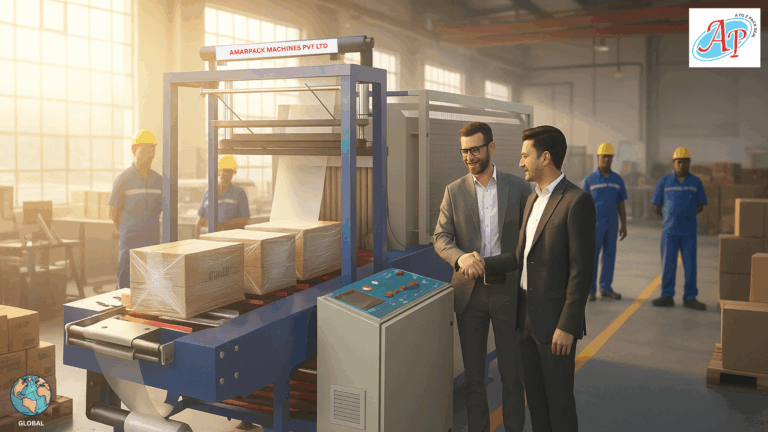
India stands as the undisputed global leader in rice exports, commanding a colossal share of the international market. With annual exports frequently exceeding 20 million tonnes — representing over 30% of global rice trade and generating billions of dollars in revenue — the operational efficiency of India’s rice mills directly dictates global food security and national economic stability.
However, despite advancements in milling and logistics, a critical bottleneck remains: manual secondary packaging. This is where modern solutions like the Automatic Web Sealer with Shrink Tunnel from AmarPack Machines Pvt Ltd are transforming operations. By automating rice bag bundling and shrink wrapping, these machines eliminate inconsistencies, reduce labor dependency, and ensure export-ready packaging quality.
Historically, many large mills utilized highly manual processes or semi-automated systems for collating and securing multiple retail bags (such as 5kg or 10kg units) into transit-ready groups. This practice is severely prone to errors, slow throughput, and excessively high operational costs. The reliance on human intervention introduces three significant operational pain points that erode profitability and compromise quality:
Inconsistent Sealing and Product Loss: Manual sealing techniques often suffer from variability in heat application and pressure. This inconsistency leads to weak seals, causing individual pouches to open or nitrogen to leak, which can compromise the entire bundle chain. A single faulty seal risks the loss of multiple kilogrammes of high-value rice during handling or transit.
Labor Dependency and Inaccuracy: India faces an acute shortage of reliable labor for intensive packing tasks. Manual processes are inherently slow, increasing labor costs, and unreliable in terms of weight variation or precise collation, leading to market complaints (less weight) or costly product giveaway (excess weight).
Environmental and Transit Vulnerability: The heavy rice bags endure rigorous logistics, from stacking in warehouses to long-haul transport in containers. During India’s highly humid monsoon season, manual packaging fails to provide the necessary moisture barrier, making the packaged goods susceptible to humidity, leading to mold, mildew, and structural breakdown.
These operational risks are financially untenable for businesses operating at the immense scale of the Indian rice export market. The industry requires a high-speed, repeatable, and robust system. The strategic answer lies in advanced automation.
The introduction of the Automatic Web Sealer with Shrink Tunnel represents the definitive transformation in rice bag group packaging throughout India. This integrated system provides a robust solution that delivers exponential improvements in speed, ensures unparalleled product protection, and secures global market compliance. This Automatic Packaging Machine is now the essential industrial tool for any mill seeking to transition from operational risk management to predictable, profitable growth. By adopting this Automatic Shrink Wrapping Machine, manufacturers are improving throughput reliability and achieving a superior return on investment (ROI) that secures their competitive edge in international markets.
Want to automate your rice packaging line and secure your supply chain? Here’s how…
The Automatic Web Sealer with Shrink Tunnel is a highly specialized, integrated industrial system engineered for secondary packaging applications, particularly the collation and secure wrapping of heavy, multi-unit items such as rice bags, beverage cartons, or industrial goods. It combines two distinct processes—collating and wrapping—into a single, high-speed automated workflow, producing a package that is tamper-evident, moisture-resistant, and structurally durable.
The system is fundamentally defined by its two sequential stages:
The Web Sealer (Bundler): This machine acts as the entry point, automatically collating the primary products (individual rice bags) into a defined group size (e.g., 4 x 5kg bags) and wrapping them in a protective sleeve of film. This is the precision stage that removes human variability from the grouping process.
The Shrink Tunnel: The subsequent heating chamber provides controlled, uniform thermal energy. This heat causes the specific film material to constrict tightly and conform precisely to the product shape, maximizing unitization, package integrity, and overall stability.
This technology is widely adopted across high-volume food, beverage, and grain packaging lines where structural integrity and unitization for transport are paramount.
For the secure group packaging of heavy commodities like rice bags—which can weigh up to 25kg and must withstand considerable mechanical stress during handling and container stacking —the selection of film material is a critical design element.
Low-Density Polyethylene (LDPE) and Linear Low-Density Polyethylene (LLDPE) films are the mandated industry standards for this heavy-duty application. Unlike lighter films (such as polyolefin), LDPE is known for its superior tear and puncture resistance. This material strength is a non-negotiable requirement for groups of heavy rice bags, ensuring the package maintains integrity throughout the demanding, often rugged, logistical environment. The inherent durability of LDPE serves as a proactive risk mitigation strategy, protecting against mechanical failure caused by load shifting or forklift handling, which are common sources of freight damage. Furthermore, LDPE, due to its properties, is widely utilized and generally approved for bundling food products, ensuring compliance in the secondary packaging layer.
Looking for the ideal film partner for your new Automatic Shrink Wrapping Machine? Read on to see its operational mechanics…
The effectiveness of the Automatic Web Sealer with Shrink Tunnel system is rooted in the precise synchronization of its two distinct stages, which collectively transform a loose collection of bags into a secure, unitized block suitable for export.
The first stage focuses on accurate grouping and the application of the heavy-gauge shrink film sleeve.
The individual rice bags are automatically transferred from the primary packaging line (e.g., the filler and sealer) onto the web sealer’s infeed conveyor. An indexing system precisely collates them into the required multi-pack configuration (e.g., two 10kg bags side-by-side, or four 5kg bags grouped together). This automated collation process eliminates the human error associated with manual grouping. The collated group is then automatically pushed through two rolls of single-wound LDPE shrink film—one positioned above and one below—which envelops the product group into an open-ended sleeve.
The web sealer utilizes a highly controlled sealing mechanism, typically a Hot Knife or Impulse bar, to seal and cut the film precisely, separating the completed pack from the bulk film roll. This consistent, high-quality horizontal seal is essential to prevent the catastrophic “pouch opening” failures often observed in manually packaged goods.
Crucially, this industrial bundling method creates a seal only on the front and back edges of the sleeve, intentionally leaving circular openings on the two sides. These characteristic openings are referred to as “bulls-eye” enclosures. This specific engineering choice optimizes functional logistics over pure aesthetics, which is the priority for B2B industrial clients. The bullseye design is critical for two reasons: First, it provides necessary air pathways, allowing trapped air to escape during the subsequent heating stage, which prevents the film from rupturing. Second, the resulting taut, sealed film around the open ends creates a natural, ergonomic handhold, which is immensely beneficial for manual lifting and stacking in traditional Indian warehouse and loading environments.
Once sealed, the sleeved product moves immediately into the shrink tunnel for the final unitization phase. This process defines the core principle of every Automatic Shrink Wrapping Machine—speed, consistency, and durability.
The shrink tunnel is a heated chamber equipped with recirculating high-velocity fans to ensure temperature consistency and uniform heat distribution across the entire surface area of the package. The temperature is precisely controlled, typically adjustable across a wide range, often between 80 C and 250 C. This precise control is vital for managing different gauges and compositions of LDPE film.
As the heat is applied, the LDPE film material shrinks rapidly and powerfully, often achieving shrinkage ratios of 30% to 80%. This contraction applies high radial holding force, unitizing the loose collection of individual rice bags into a single, cohesive, rigid block. The resulting package is structurally sound, making it highly tamper-evident and capable of withstanding the mechanical compression required for effective stacking and transport stability.
Upon exiting the high-heat zone, the pack enters a controlled cooling area. This cooling allows the highly tensioned film to fully set and solidify its structure. The final output is an export-ready bundle that stabilizes the load for palletization and long-distance shipping.
The strategic design of the web sealer and shrink tunnel, specifically using the bullseye design, ensures efficient operation with heavy products. It is intrinsically linked to superior material efficiency and reduced operational risk, positioning this machine as a heavy-duty logistical tool.
Discover the financial benefits—learn how this technology delivers exponential rice mill automation ROI.
While increased speed is an immediate benefit, the true value of adopting an Automatic Packaging Machine like the Automatic Web Sealer with Shrink Tunnel is measured in the long-term, quantifiable return on investment (ROI). For high-volume rice mills, automation is not merely an expense, but a strategic financial leverage tool that dramatically improves the bottom line.
The most direct and rapid source of ROI stems from the significant reduction in human labor required. Automation replaces multiple manual roles—often four to five operators previously dedicated to grouping, wrapping, and manual handling—with just one trained supervisor/operator. This high labor savings ratio directly translates into substantial operational expenditure reductions.
Furthermore, this reduction mitigates the significant financial and operational risk posed by the acute labor shortages prevalent across many parts of India. By guaranteeing consistent, machine-driven production rates, mills achieve operational continuity, insulated against high labor turnover or seasonal absenteeism. Through this combined saving on headcount and risk mitigation, high-volume plants frequently achieve full ROI payback within 12 to 18 months, purely driven by reduced labor and packaging waste.
Packaging failure is a critical driver of food loss and waste along the supply chain. For high-value commodities like Basmati rice, damaged freight is synonymous with direct revenue loss. The tightly shrunk LDPE wrap produced by the Automatic Shrink Wrapping Machine provides two crucial layers of protection:
Mechanical Integrity: The strong unitization prevents individual bags from shifting, tearing, or being punctured during loading, unloading, and long-haul transport. This unit stability reduces the risk of load shifts that cause damage within containers or trucks.
Moisture Barrier: The comprehensive wrap creates a secondary moisture barrier that is essential during handling in India’s high ambient humidity, particularly at port and during the monsoon season. This greatly reduces the chance of moisture ingress, mold, and mildew.
The result is a package with dramatically improved structural integrity, which significantly lowers rejection rates and reduces the 15% to 20% product damage often attributed to poor packaging and handling. This percentage point reduction on a high-value export commodity adds substantial, leveraged revenue directly to the mill’s profitability.
The limitations of manual processes often create a throughput bottleneck, preventing the packaging line from matching the speed of modern milling equipment. The Automatic Web Sealer with Shrink Tunnel eliminates this choke point by operating consistently at 8 to 15 bundles per minute (PPM), depending on the pack size.
For large-scale rice mills, consistent, high-speed output is non-negotiable for meeting strict export commitments. This production reliability is required to secure the substantial, time-sensitive contracts that demand faultless execution, allowing mills to commit to and fulfill major export volumes into high-demand markets. The Automatic Packaging Machine provides the scalable capacity necessary to justify major capital investment and expand market presence.
Manual and outdated semi-automatic sealing often leads to excessive film overlap, inconsistent cutting, and high rework rates due to faulty seals. The automated, precision-controlled sealing technology (Hot Knife/Impulse) virtually eliminates material waste caused by imperfect sealing.
Furthermore, the machine’s ability to apply immense, consistent holding force through the thermal shrinking process allows manufacturers to engage in “downgauging.” This means migrating from extremely thick, expensive LDPE films to thinner-gauge, high-performance LLDPE variants that still maintain sufficient strength because the shrink system maximizes the film’s intrinsic properties.16 This strategic optimization results in significant annual film cost savings—a reduction of 10% to 25% in material procurement costs is frequently observed—directly accelerating the rice mill automation ROI.
Global rice buyers, particularly those in the Middle East and Africa, demand strict adherence to international safety and hygiene standards, such as HACCP and ISO certifications.
Construction Compliance: AmarPack machines utilize SS304-grade stainless steel for all product contact parts, ensuring compliance with global food safety benchmarks and preventing corrosion in high-humidity environments.
Tamper-Evidence: The tightly secured, unitized package serves as visible proof of quality adherence, minimizing inspection delays and securing buyer trust. The packaging consistency provided by the Automatic Web Sealer with Shrink Tunnel is crucial for accessing regulated export markets that demand high safety and quality standards.
Need granular detail on your potential savings? Check out our Automatic Packaging Solutions and contact our analysts today.
Achieving success with automation in the Indian industrial landscape requires machinery that is not merely fast, but supremely robust, locally supported, and engineered to withstand India’s specific operating challenges. As a leading Packaging Machine Manufacturer in India, AmarPack’s design philosophy focuses on maximizing longevity and minimizing downtime in demanding environments.
Indian operations face unique environmental obstacles, primarily high dust levels and the relentless humidity of the monsoon season. High moisture levels, often exceeding 90% relative humidity, are a known catalyst for mold growth and can compromise electrical components and the integrity of manual seals.
AmarPack addresses this by engineering the Automatic Shrink Wrapping Machine with heavy-duty construction and sealed electrical components resistant to dust and moisture ingress. This resilience ensures the delicate sealing operation remains flawless and consistent throughout the year, especially during humid periods that would typically cause manual sealing equipment to fail or produce weak, unreliable packages. The use of SS304-grade material further guarantees the machine’s structural resilience against dust and continuous operational wear-and-tear.
Energy stability is a core concern for continuous manufacturing. Unlike many imported systems that require complex power conditioning or struggle with intermittent supply, AmarPack’s Automatic Packaging Machine is built standard for reliable, heavy-duty utilization within the nation’s existing industrial framework. The system operates efficiently on the required 3-Phase, 440V AC power supply common across Indian industrial zones. This fundamental compatibility ensures stable, continuous 24/7 operation, minimizing energy-related downtime and supporting the long production runs typical of large rice mills.
The versatility of the collation system is a significant operational advantage. The mill must often service diverse distribution channels, requiring quick adaptation between various pack formats.
The Automatic Web Sealer with Shrink Tunnel offers rapid, typically tool-less changeover between popular rice bag sizes. It can handle small 5kg retail bags grouped into packs of four, 10kg bags grouped in pairs, or even secure individual 25kg bulk bags for transport stability. This versatility ensures that the packaging line can swiftly adjust to fluctuating regional distributor demands or international buyer specifications, maximizing market responsiveness and utilization rate. Furthermore, the robust conveyor and sealing system is specifically designed to accommodate the inherent weight and density of these heavy rice bags, guaranteeing reliable transfer into the shrink tunnel.
The cost of downtime often dwarfs the initial capital investment. For imported machinery, even minor component failure can lead to weeks of waiting for spare parts and specialized foreign technicians. As a leading Shrink Tunnel Machine Manufacturer in India and premier Packaging Machine Manufacturer in India, AmarPack eliminates this risk.
AmarPack provides immediate access to locally stocked, high-quality spare parts and rapid dispatch of skilled service technicians through an established pan-India service network. This infrastructure minimizes critical downtime from potential weeks to mere hours, ensuring operational continuity and protecting the accrued ROI. Comprehensive training is also provided to ensure the mill’s single designated operator is fully proficient, rapidly accelerating the timeline to achieving maximum operational efficiency and financial returns.
Ready to install a robust system that thrives in the Indian environment? Explore our Shrink Wrapping Machines catalogue.
For engineering and procurement decision-makers, the precise technical specifications of the Automatic Web Sealer with Shrink Tunnel underscore its authoritative positioning as a high-performance industrial asset. These details ensure compatibility, reliability, and precision control necessary for optimizing packaging material usage and guaranteeing consistent output quality.
AmarPack Automatic Web Sealer Technical Specifications: Essential Data
| Specification | Detail | Justification for Heavy Rice Packaging |
|---|---|---|
| Sealing Knife | Continuously heating Teflon-coated sealing knife 32” long with film | Provides a consistent, durable seal suitable for heavy-duty LDPE film; the Teflon coating prevents film sticking and ensures smooth, continuous operation. |
| Film Compatibility | LDPE / LLDPE Shrink Film (Heavy Gauge) | Offers excellent strength, puncture resistance, and elasticity — ideal for securely wrapping 5kg–25kg rice bags without tearing. |
| Automation Level | Fully Automatic (Standard) | Enables high productivity with minimal manual handling, ensuring uniform sealing and wrapping quality at scale. |
| Speed | 3–4 Packs Per Minute (PPM) | Balanced speed optimized for large-format rice packs, maintaining reliable seal quality and film shrink consistency. |
| Power Requirement | 3-Phase, 440V AC, 50 Hz | Supports stable, heavy-load operation in industrial rice mill environments with continuous production demands. |
| Construction Material | SS304 Contact Parts, Heavy-Duty Frame | Ensures hygiene compliance with food industry standards (HACCP) and resists corrosion in dusty or humid packaging areas. |
| Shrink Tunnel Temperature | 0°C – 300°C (Adjustable PID Control) | Provides precise temperature control for varying film gauges and packaging sizes, preventing over-shrink or film burn. |
| Collation Flexibility | Multi-Bag Configurations (e.g., 2×10kg, 4×5kg) | Offers flexibility to pack different bag sizes and bundle types for wholesale and retail distribution. |
The adjustable temperature control in the shrink tunnel is a crucial factor in long-term cost control. To maximize film optimization and achieve sustainable material reduction , the machine must offer fine, accurate control over the heat profile. A superior system allows mill managers to precisely adjust the temperature to achieve a perfect shrink on high-performance, thinner films without risking film burn or tear, realizing immediate and sustained savings in material costs.
(Bonus Tip: While the Automatic Web Sealer with Shrink Tunnel excels in bulk grouping, explore AmarPack’s L-Sealer with Shrink Tunnel options for lighter, fully enclosed retail packs.)
Need customization for your unique rice bag dimensions? Contact our engineering team for specialized sizing.
Theory is substantiated by tangible financial results. A detailed analysis of a recent installation at a large, high-volume rice exporter demonstrates the leveraged financial impact of implementing the Automatic Web Sealer with Shrink Tunnel.
Prior to automation, the mill faced two pressing and interlinked challenges: crippling labor costs for their group packing station and chronic product loss. Their manual sealing line suffered from approximately 15% product damage during transit due to unstable pallets and compromised seals, rendering their export profitability volatile and increasing risk exposure during humid shipping periods.
The mill implemented AmarPack’s fully Automatic Web Sealer with Shrink Tunnel. The system was integrated immediately downstream from the primary filler machines, automating collation and secondary wrapping entirely.
The installation delivered immediate and measurable improvements across all major operational indicators:
Throughput Improvement: The previous manual line bottlenecked production at 4 bundles per minute. The new automatic system achieved a consistent 12 bundles per minute—a 40% increase in overall packaging line efficiency, finally matching the milling capacity.
Damage Mitigation: The tightly unitized and moisture-resistant packaging lowered transit damage rejection rates from 15% to under 3%. This protection of their highest-value export product secured substantial annual revenue that was previously lost to claims and spoilage.
Material Efficiency: Through the combination of precise, zero-waste sealing and successful downgauging to high-performance films, the mill realized annual film usage savings of 25%.
Financial Payback: The combined, measurable savings from reduced labor, material optimization, and damage prevention were so substantial that the mill achieved a full capital payback on the machine investment in under 10 months. This timeline significantly outperformed the conservative 12–18 month industry benchmark.
This outcome demonstrates that the investment acts as a powerful financial leverage tool. By converting unpredictable financial risks (variable labor and product loss) into a highly efficient, predictable operational asset, the mill freed up capital that was previously trapped in waste, allowing the business to immediately redirect funds toward market expansion and other higher-value strategic activities. The investment further allowed the mill to secure a major, multi-year export contract in the Middle East that specifically required stringent, tamper-evident secondary packaging integrity, a contract that was simply unattainable under the previous manual system.
See the Automatic Web Sealer with Shrink Tunnel in action—request a live video demonstration today!
To justify the capital expenditure, decision-makers must view the Automatic Packaging Machine not as a cost centre, but as a critical infrastructure investment providing robust rice mill automation ROI. The mathematical ROI is justified when the total annual savings rapidly outpace the investment cost. The following strategic model details the three primary channels where automated packaging generates leveraged savings, reinforcing the financial security of the system.
The Indian rice industry operates at a scale that necessitates world-class efficiency and quality control. The era of incremental improvements has concluded; the sheer volume and critical nature of India’s rice export market now demand the robust, repeatable protection offered by the Automatic Web Sealer with Shrink Tunnel.
This integrated system is far more than a packaging tool; it is a profit-driving automation investment. It delivers structural load stability, minimizes costly product damage and waste, secures high throughput necessary for export contracts, and guarantees the hygiene and compliance levels required by global markets. The comprehensive benefits—led by the drastic reduction in labor costs and material waste—deliver verifiable rice mill automation ROI typically within the first 12 to 18 months, securing the mill’s financial future.
As a trusted Packaging Machine Manufacturer in India and leading Shrink Tunnel Machine Manufacturer in India, AmarPack Machines Pvt Ltd delivers systems engineered specifically to handle India’s demanding operating conditions. Our expertise ensures reliable performance, whether managing monsoon humidity or integrating with 440V industrial power, backed by a pan-India service network that minimizes operational risk.
Ready to scale your production with a reliable Automatic Web Sealer with Shrink Tunnel? Protect your product, cut your costs, and open doors to new export markets.
Contact AmarPack Machines Pvt Ltd today for a free ROI consultation and live demonstration.
With 25+ years of proven experience, AmarPack Machines Pvt. Ltd. has been delivering reliable shrink wrapping and packaging solutions to industries across India and abroad. Based in Mumbai, India’s packaging hub, we combine advanced manufacturing expertise with responsive after-sales support.
As a direct manufacturer, we provide factory pricing with customization options tailored to your production needs — ensuring you only pay for the features you truly require. Our team offers installation, operator training, and free consultations to help you select the ideal machine for your products, ensuring long-term performance and value.
Looking to automate your packaging line?
Contact AmarPack Machines Pvt Ltd, India’s trusted packaging machine manufacturer serving global markets.

AmarPack Machines Pvt. Ltd., founded in 1998, is a leading manufacturer and exporter of packaging machines in India. With over 25 years of experience, we specialize in shrink wrapping machines, vacuum packaging machines, band sealers, and automatic liquid filling machines, delivering reliable packaging solutions to diverse industries in India and international markets
Get a quick quote from our experts. Fast response guaranteed!
