How a Shrink Wrapping Machine Works
If you are looking for a quick executive summary to guide your machinery budget and planning, here is the selection matrix used by top-tier Indian manufacturing plants:
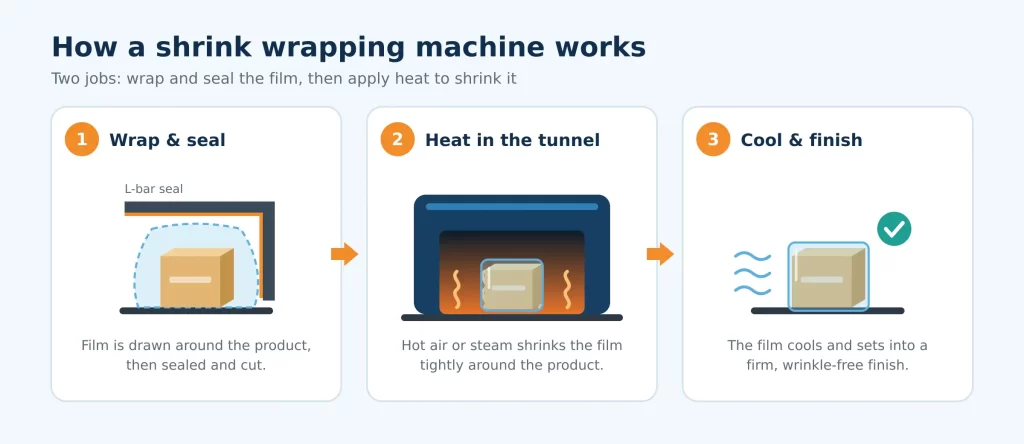
Every machine does two jobs.
- Wrap and seal. Shrink film is made under tension, so it “remembers” a smaller size. The machine draws it around the product, then heated sealing bars seal and cut it, leaving a loose bag or sleeve. Vent holes let trapped air escape.
- Apply heat. The pack rides a conveyor through a shrink tunnel, where hot air (or steam) heats the film until it contracts tightly around the product. A short cooling zone then sets the film into a smooth, firm finish. For very low volumes, a hand-held heat gun can replace the tunnel.
Tunnel temperature, conveyor speed, and airflow decide how clean the finish looks. They have to suit your film and product.
Web Sealer vs L-Sealer vs Sleeve Shrink Machine
Web Sealer with Shrink Tunnel (called a side sealer in some markets)
Products move along aonveyor while film is wrapped around them, sealed, and cut in a continuous flow. Add a collator, and the machine groups bottles or cans into multipacks automatically.
- Best for: high-volume, consistent products such as bottled water, juice, oil, cartons, and boxes
- Strengths: highest throughput, low labor per pack, easy to link into a full line
- Trade-offs: needs more floor space and investment, and is less flexible with frequent size changes
- Amarpack range: semi-automatic web sealers for bottles and boxes, conveyorised automatic machines, and single-line and four-line automatic systems with collators
An L-sealer seals the front and one side of each pack in a single motion, using centerfolded film. It handles a wide range of sizes with almost no changeover.
- Best for: single items and mixed product lines, such as books, files, stationery, gift boxes, date boxes, and cosmetic kits
- Strengths: flexible, affordable, easy to operate, and it scales from manual to fully automatic.
- Trade-offs: it wraps one pack at a time, so speed has a ceiling
- Amarpack range: manual, pneumatic, online (conveyor-fed), and fully automatic L-sealers
This one does a different job. Instead of enclosing the pack, it applies a shrink sleeve, neck band, or tamper-evident band to a bottle or jar, and the tunnel shrinks it to fit.
- Best for: pharma, cosmetic, pickle, juice, and beverage bottles that need tamper evidence or full-body branding
- Amarpack range: manual, rotary, and automatic sleeve applicators
Choosing the Tunnel
- Hot-air tunnels suit general wrapping. Look for adjustable temperature, variable belt speed, and even airflow.
- Steam heat tunnels give gentle, even heat for sleeves and labels on curved containers.
- Heavy-duty tunnels handle thick PE film and large bundles.
Quick Match: What Are You Packing?
| Your product |
Typical setup |
| Bottled water, juice, or oil multipacks at high volume |
Automatic web sealer with collator + tunnel |
| Cartons, detergent boxes, mixer boxes, pouch bundles |
Semi-automatic or conveyorised web sealer + tunnel (heavy-duty for PE film) |
| Books, files, stationery, gift and date boxes |
L-sealer + tunnel, manual through fully automatic |
| Tamper bands or full sleeves on pharma, cosmetic, or juice bottles |
Sleeve shrink machine + steam tunnel |
| Pallets and large cartons |
Stretch wrapping or shrink hood systems |
Why Shrink Wrapping Pays Off
- Protection: film blocks dust and moisture and holds products together in transit
- Tamper evidence and shelf appeal: broken film shows an opened pack, and clear film shows off branding.
- Lower packaging cost: far less material, weight, and bulk than corrugated boxes, which cuts storage and freight costs
- Flexibility: one machine can handle many pack sizes
How to Choose: 6-Point Buying Guide
- Product size, shape, and weight. Measure your largest and smallest packs, including height. Check them against the sealing area and tunnel opening. Round bottles, flat boxes, and irregular items favor different designs.
- Production volume. Estimate your packs per minute now and in two to three years. As a rough guide:
- Low volume: manual or semi-automatic L-sealer
- Medium volume: automatic L-sealer or semi-automatic web sealer
- High volume: automatic web sealer with collator
Real speeds depend on pack size, film, and setup, so ask for demonstrated output on your product.
- Automation level. Weigh labor cost and error rates against purchase price. Automation pays back fastest on steady, high-volume runs.
- Film compatibility. Match the machine to your film:
| Film |
Key traits |
Best for |
| POF (polyolefin) |
Clear, glossy, strong seals, food-safe |
Food, cosmetics, general retail |
| PVC |
Low cost, shrinks at low temperature, can release fumes when sealed, not advised for food contact |
Budget and non-food packs |
| PE / LDPE |
Heavy-duty, puncture-resistant, needs higher tunnel heat |
Heavy bundles, pouch bundling, pallet hoods |
5. Floor space and line fit. Allow for infeed, outfeed, tunnel length, ventilation, and power. Check that conveyors, collators, and downstream carton sealing or strapping connect cleanly.
6. Total cost of ownership. Look past the price to film consumption, energy use, spare parts, service response, and training. A machine sized for your growth beats a cheaper one you’ll outgrow in a year.
Frequently Asked Questions
Conclusion
The best shrink wrapping machine is the one that matches your product, speed, and film:
- Web sealers for high-volume bottles and boxes
- L-sealers for flexible, mixed-product packing
- Sleeve shrink machines for tamper bands and sleeves on bottles
- The right tunnel (hot air, steam, or heavy-duty) to finish the job.
Not sure which fits your line? Amarpack has been building packaging machinery since 1998, and our team can recommend a setup based on your product samples and output targets. Enquire now or call +91 9920114400 for a recommendation or a live demo.